Run in Background
 Gabriel Bacha118 downloads
Keep vaults running in the background for quick access and continued Obsidian Sync.
- Overview
- Scorecard
- Updates12
Keep desktop Obsidian vaults—and Obsidian Sync—available in the background without blocking logout, restart, or operating-system shutdown.
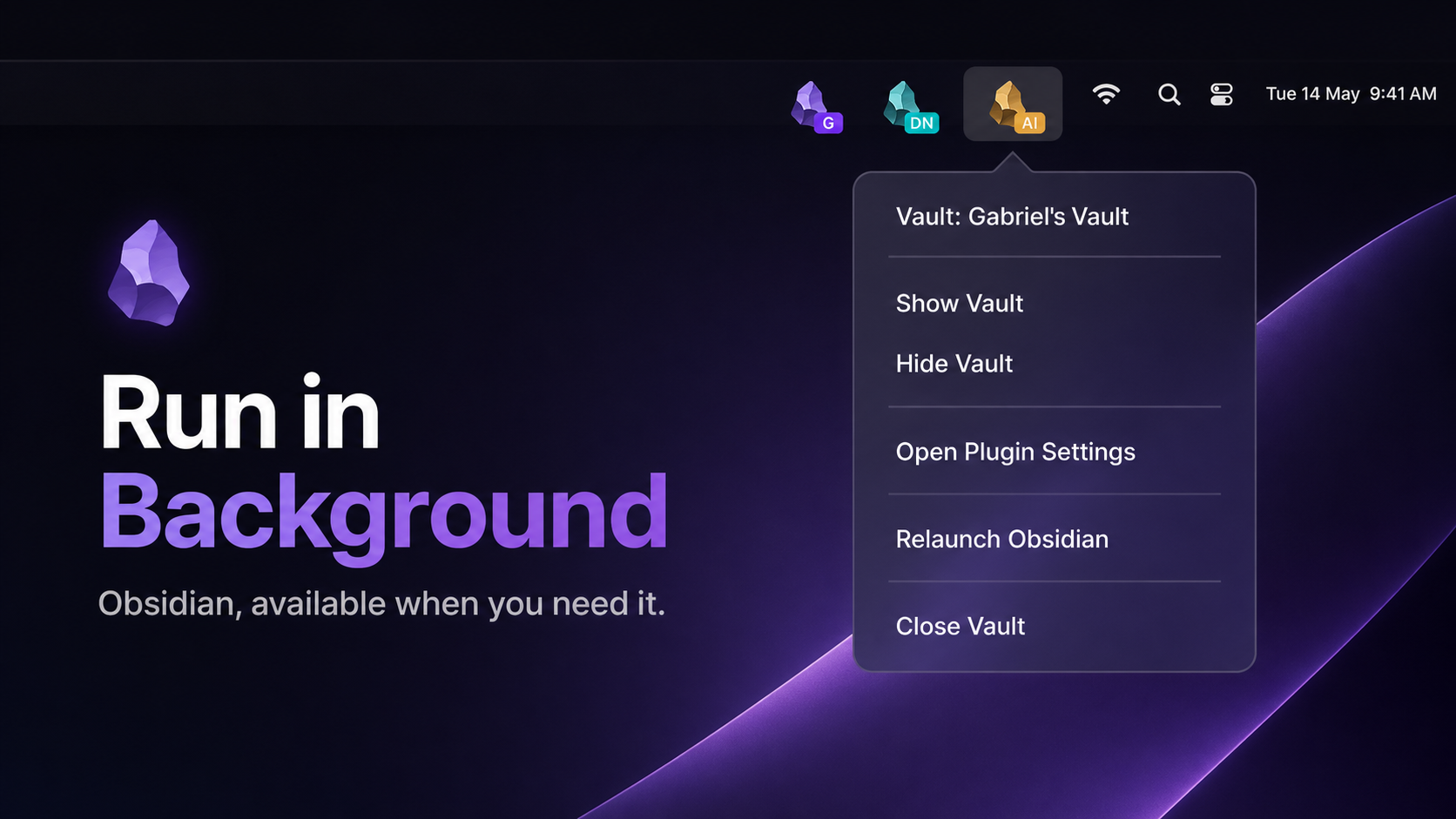
Closing a vault window can hide it instead of terminating it. Restore it from the Dock or taskbar, by launching Obsidian again, or from a vault-specific tray icon. Normal Quit behavior remains independently configurable.
This is especially useful when you want Obsidian Sync to keep processing changes while the vault window is hidden. Run in Background does not replace Obsidian Sync and cannot sync while the computer is asleep or offline.
Highlights
- Keep one or several vaults running in the macOS menu bar or system tray.
- Let Obsidian Sync continue working while vault windows are hidden.
- Restore hidden vaults by activating Obsidian or selecting Show Vault.
- Optionally make Cmd+Q or the normal Quit command hide instead of terminate.
- Always allow explicit Close Vault, Relaunch, logout, restart, and shutdown.
- Distinguish vaults with custom icons and optional colored text, number, symbol, or emoji badges of up to three characters.
- Open the plugin settings directly from the tray menu.
- Import compatible settings from the original Tray plugin on first launch.
Run in Background requires Obsidian 1.7.2 or newer and is desktop-only. It makes no internet requests. On sandboxed Linux packages it communicates with the local desktop portal to request background and login-startup permission.
Window and quit behavior
| Action | Default behavior |
|---|---|
| Close a vault window | Hide the vault and keep it running |
| Cmd+Q / normal Quit | Hide the vault and keep it running |
| Tray Close Vault | Close that vault |
| Relaunch Obsidian | Exit and relaunch cleanly |
| Disable the plugin | Remove listeners and tray objects cleanly |
| Logout, restart, or shutdown | Exit without blocking the operating system |
The two background behaviors have separate toggles, so window closing and the Quit command can be configured independently.
Settings
| Setting | Description | New-install default |
|---|---|---|
| Enable Run in Background | Master switch for all plugin runtime behavior | On |
| Launch on startup | Launch Obsidian when you sign in | Off |
| Hide on launch | Always, only when opened at device login, or never start hidden | Only when opened at login |
| Run in background | Hide an ordinary window close | On |
| Keep running after Quit command | Turn Cmd+Q / Quit into hide | On |
| Hide Dock/taskbar icon | Remove Obsidian from the Dock or taskbar | Off |
| Create tray icon | Create the vault menu-bar or tray icon | On |
| Tray icon image | Select a preset or upload a square PNG/SVG | Obsidian |
| Vault badge | Add up to three characters, optionally separated by spaces | Vault initials |
| Badge color | Set a vault-specific badge background with automatic contrast | Dark |
For safety, hiding the Dock/taskbar icon keeps the tray icon enabled. Disabling the tray icon restores the Dock/taskbar icon.
The top Enable Run in Background switch deactivates the entire runtime without disabling the community plugin. While it is off, no close or Quit behavior, tray icon, Dock/taskbar changes, or launch-at-login behavior remains active; the settings page stays available so you can turn it back on.
Linux startup support
Launch on startup detects native DEB/RPM and distribution packages, AppImage, Flatpak, and Snap installations. Native packages use the standard XDG autostart directory. Sandboxed packages request permission through the XDG Background Portal and may show a one-time system prompt. Startup state is coordinated across vaults so disabling it in one vault does not remove a request still owned by another vault.
Installation
Community Plugins
After publication, open Settings → Community plugins → Browse, search for Run in Background, select it, and choose Install, then Enable.
BRAT
Before community publication, install BRAT, choose Add beta plugin, and enter:
gabrielbacha/run-in-background
Manual installation
Download main.js, manifest.json, and styles.css from a matching
GitHub release,
then place them in:
<vault>/.obsidian/plugins/run-in-background/
Reload Obsidian and enable Run in Background under Community plugins.
Using the tray menu
Each vault menu contains:
- Show Vault and Hide Vault
- Open Plugin Settings
- Relaunch Obsidian
- Close Vault
The menu header and tooltip identify the active vault as Vault: <name>.
Troubleshooting
The vault is running but no window is visible
Click Obsidian in the Dock/taskbar, launch Obsidian again, or choose Show Vault from its tray menu.
Cmd+Q does not terminate Obsidian
Disable Keep running after Quit command, or use Close Vault from the tray menu. Logout, restart, and shutdown always bypass this setting.
I cannot find either the Dock icon or tray icon
Run in Background prevents this combination in its own settings. Launch Obsidian again to restore the vault if another application or macOS preference temporarily hides the icons.
Linux opens visibly after login
Select Only when opened at login under Hide on launch and enable Launch on startup from this plugin. Remove duplicate Obsidian entries from your desktop environment's startup-applications tool so the unmarked launcher does not start a second visible session.
Linux uses one plugin-owned startup entry, targeted at one enabled vault. Once Obsidian is ready, that vault opens the other startup-enabled vaults through Obsidian's URI protocol. This avoids process-singleton races while ensuring a vault still starts after it was explicitly closed in the previous session. Per-vault marker records coordinate the enabled set. The plugin automatically removes the competing per-vault desktop entries created by version 1.3.3. Each Linux vault publishes its tray item on an independent D-Bus connection, avoiding Electron's shared StatusNotifierItem collision when several vaults are open in one Obsidian process.
Sync pauses after hiding a Linux window
Version 1.3.2 and newer disables Electron background throttling for hidden vault windows. Update the plugin and fully restart Obsidian so the new window lifecycle is active.
Development and releases
See CONTRIBUTING.md for setup, verification, pull-request, and release instructions. Report vulnerabilities privately through the repository's GitHub Security Advisories.
Attribution and license
Run in Background is a maintained fork of dragonwocky/obsidian-tray, originally created by dragonwocky. The original project and this fork are distributed under the MIT License.
The Obsidian name and logo are trademarks of Obsidian. The bundled logo is used to identify Obsidian and follows the Obsidian brand guidelines.