Notemd
 jacobinwwey5k downloads
Integrates with various LLMs to process notes, generate wiki-links, and create concept notes
- Overview
- Scorecard
- Updates49
Notemd (Note + EMD — Enhanced Markdown Documents) turns LLM-powered reading into persistent knowledge: wiki-links, concept notes, research summaries, translations, and diagrams all write back to your Obsidian vault.
English | 简体中文 | Español | Français | Deutsch | Italiano | Português | 繁體中文 | 日本語 | 한국어 | Русский | العربية | हिन्दी | বাংলা | Nederlands | Svenska | Suomi | Dansk | Norsk | Polski | Türkçe | עברית | ไทย | Ελληνικά | Čeština | Magyar | Română | Українська | Tiếng Việt | Bahasa Indonesia | Bahasa Melayu
📚 Read docs in more languages: Language Hub
📖 Browse repository docs: Docs Hub
🖼️ Inspect shipped diagram types and production previews: Diagram Gallery
❓ New: Frequently Asked Questions (FAQ)
==================================================
  _   _       _   _ ___    __  __ ___
 | \ | | ___ | |_| |___|  |  \/  |___ \
 |  \| |/ _ \| __| |___|  | |\/| |   | |
 | |\  | (_) | |_| |___   | |  | |___| |
 |_| \_|\___/ \__|_|___|  | |  | |____/
==================================================
 AI-Powered Multi-Languages Knowledge Enhancement
==================================================
What is Notemd?
Notemd is an open-source Obsidian plugin that integrates with 30+ Large Language Models (LLMs) to transform your notes into a structured, searchable knowledge base.
Unlike chat-based AI tools where insights disappear after the session, Notemd writes results directly into your vault as:
- [[Wiki-links]] connecting key concepts
- Concept notes for terms and ideas
- Research summaries with source citations
- Translations for multilingual workflows
- Mermaid diagrams and visual charts
Result: Your reading and research accumulate into a persistent, evolving knowledge graph that stays with you.
If you love using Notemd, please consider ⭐ Give a Star on GitHub or ☕️ Buy Me a Coffee.
Version: 1.9.7
Mainline reliability update (not a new release): cancellation now reaches concurrent LLM work and retry waits; failed diagram saves preserve conflicting edits and report recovery copies. Existing Drawnix companion folders are retained for inspection. Local knowledge batches use an immutable read snapshot, and PowerPoint tables preserve individual border sides, opacity and merged-cell edges. Circuitikz NAND/NOR and transmission-gate exports have clearer wiring and readable labels in mirrored layouts. Implementation and acceptance evidence records the tested environments and remaining limits.
Drawnix supports native tree editing; its exported cross-branch arrows use fixed coordinates and can detach when Drawnix rearranges nodes. Use the SVG preview to inspect connectivity. Cancellation cannot undo earlier writes or stop provider-side work when the host transport cannot physically abort it.
Table of Contents
- Quick Start
- Language Support
- Features
- Installation
- Configuration
- Usage Guide
- Supported LLM Providers
- Network Usage & Data Handling
- Troubleshooting
- Contributing
- Maintainer Docs
- License
Quick Start
- Install & Enable: Get the plugin from the Obsidian Marketplace.
- Configure LLM: Go to
Settings -> Notemd, select your LLM provider (like OpenAI or a local one like Ollama), and enter your API key/URL. - Open Sidebar: Click the Notemd wand icon in the left ribbon to open the sidebar.
- Process a Note: Open any note and click "Process File (Add Links)" in the sidebar to automatically add
[[wiki-links]]to key concepts. - Run a Quick Workflow: Use the default "One-Click Extract" button to chain processing, batch generation, and Mermaid cleanup from one entry point.
That's it! Explore the settings to unlock more features like web research, translation, and content generation.
Language Support
Language Behavior Contract
| Concern | Scope | Default | Notes |
|---|---|---|---|
UI Locale |
Plugin UI text only (settings, sidebar, notices, dialogs) | auto |
Follows Obsidian locale; current UI catalogs are en, ar, de, es, fa, fr, id, it, ja, ko, nl, pl, pt, pt-BR, ru, th, tr, uk, vi, zh-CN, zh-TW. |
Task Output Language |
LLM-generated task output (links, summaries, generation, extraction, translation target) | en |
Can be global or per-task when Use different languages for tasks is enabled. |
Disable auto translation |
Non-Translate tasks keep source-language context | false |
Explicit Translate tasks still enforce the configured target language. |
| Locale fallback | Missing UI key resolution | locale -> en |
Implementation safety net; supported visible surfaces are regression-tested and should not silently fall back during normal use. |
- Maintainer source docs are English and Simplified Chinese, and the published README translations are linked in the header above.
- In-app UI locale coverage currently matches the explicit code catalog:
en,ar,de,es,fa,fr,id,it,ja,ko,nl,pl,pt,pt-BR,ru,th,tr,uk,vi,zh-CN,zh-TW. - English fallback remains an implementation safety net, but supported visible surfaces are regression-tested and should not silently fall back during normal use.
- Further details and contributing guidelines are tracked in the Language Hub.
Features
AI-Powered Document Processing
- Multi-LLM Support: Connect to various cloud and local LLM providers (see Supported LLM Providers).
- Smart Chunking: Automatically splits large documents into manageable chunks based on word count for processing.
- Content Preservation: Aims to maintain original formatting while adding structure and links.
- Progress Tracking: Real-time updates via the Notemd Sidebar or a progress modal.
- Cancellable Operations: Cancel any processing task (single or batch) initiated from the sidebar via its dedicated cancel button. Command palette operations use a modal which can also be cancelled.
- Multi-Model Configuration: Use different LLM providers and specific models for different tasks (Add Links, Research, Generate Title, Translate) or use a single provider for all.
- Stable API Calls (Retry Logic): Optionally enable automatic retries for failed LLM API calls with configurable interval and attempt limits.
- Resilient Provider Connection Tests: If the first provider test hits a transient network disconnect, Notemd now falls back to the stable retry sequence before failing, covering OpenAI-compatible, Anthropic, Google, Azure OpenAI, and Ollama transports.
- Runtime Environment Transport Fallback: When a long-running provider request is dropped by
requestUrlwith transient network errors such asERR_CONNECTION_CLOSED, Notemd now retries the same attempt through environment-specific fallback transport before entering the configured retry loop: desktop builds use Nodehttp/https, while non-desktop environments use browserfetch. This reduces false failures on slow gateways and reverse proxies. - OpenAI-Compatible Stable Long-Request Chain Hardening: In stable mode, OpenAI-compatible calls now use an explicit 3-stage order for each attempt: primary direct streaming transport, then direct non-stream transport, then
requestUrlfallback (which can still upgrade to streamed parsing when needed). This reduces false negatives where providers complete buffered responses but streaming pipes are unstable. - Protocol-Aware Streaming Fallback Across LLM APIs: Long-running fallback attempts now upgrade to protocol-aware streamed parsing across every built-in LLM path, not just OpenAI-compatible endpoints. Notemd now handles OpenAI/Azure-style SSE, Anthropic Messages streaming, Google Gemini SSE responses, and Ollama NDJSON streams on both desktop
http/httpsand non-desktopfetch, and the remaining direct OpenAI-style provider entrypoints reuse that same shared fallback path. - China-Ready Provider Presets: Built-in presets now cover
Qwen,Qwen Code,Doubao,Moonshot,Xiaomi MiMo,GLM,Z AI,MiniMax,Huawei Cloud MaaS,Baidu Qianfan, andSiliconFlowin addition to the existing global and local providers. - Reliable Batch Processing: Improved concurrent processing logic with staggered API calls to prevent rate-limiting errors and ensure stable performance during large batch jobs. The new implementation ensures that tasks are initiated at different intervals rather than all at once.
- Accurate Progress Reporting: Fixed a bug where the progress bar could get stuck, ensuring that the UI always reflects the true status of the operation.
- Robust Parallel Batch Processing: Resolved an issue where parallel batch operations would stall prematurely, ensuring all files are processed reliably and efficiently.
- Progress Bar Accuracy: Fixed a bug where the progress bar for the "Create Wiki-Link & Generate Note" command would get stuck at 95%, ensuring it now correctly shows 100% upon completion.
- Enhanced API Debugging: The "API Error Debugging Mode" now captures full response bodies from LLM providers and search services (Tavily/DuckDuckGo), and also records a per-attempt transport timeline with sanitized request URLs, elapsed duration, response headers, partial response bodies, parsed partial stream content, and stack traces for better troubleshooting across OpenAI-compatible, Anthropic, Google, Azure OpenAI, and Ollama fallbacks.
- Developer Mode Panel: Settings now include a dedicated developer-only diagnostics panel that stays hidden unless "Developer mode" is enabled. It supports selecting diagnostic call paths and running repeated stability probes for the selected mode.
- Developer-Gated Relaxed Input Types: A separate
Relax input file restrictionstoggle can expand selected source-preserving tasks beyond flat.md/.txtinput. When enabled, Translate current file, Batch translate folder, Extract concepts (current/folder), Summarise as Mermaid diagram, Generate diagram, and Check duplicates in current file can also read broader text-like files and PDF text extracted through Obsidian's PDF runtime. Source-mutating, Markdown-structure-dependent, and verbatim-comparison workflows remain intentionally restricted. - Redesigned Sidebar: Built-in actions are grouped into focused sections with clearer labels, live status, cancellable progress, and copyable logs to reduce sidebar clutter. The progress/log footer now stays visible even when every section is expanded, and the ready state uses a clearer standby progress track.
- Sidebar Interaction & Readability Polish: Sidebar buttons now provide clearer hover/press/focus feedback, and colorful CTA buttons (including
One-Click ExtractandBatch generate from titles) use stronger text contrast for better readability across themes. - Single-File CTA Mapping: Colorful CTA styling is now reserved for single-file actions only. Batch/folder-level actions and mixed workflows use non-CTA styling to reduce action-scope misclicks.
- Custom One-Click Workflows: Turn built-in sidebar utilities into reusable custom buttons with user-defined names and assembled action chains. A default
One-Click Extractworkflow is included out of the box. - Welcome Modal Release Digest: On first install, the welcome modal now includes the latest two release summaries in a scrollable panel so new users can quickly see what changed before configuring providers.
- Settings Reset Controls: Settings now include both a complete reset and a partial reset that preserves provider configuration while restoring the rest of the plugin defaults.
- Folder-Task File Selection Profiles: Folder tasks now support reusable named file-selection profiles with regex/glob matching,
relativePathvsbasenametargets, and explicit subfolder-scope control.
Knowledge Graph Enhancement
- Automatic Wiki-Linking: Identifies and adds
[[wiki-links]]to core concepts within your processed notes based on LLM output. - Concept Note Creation (Optional & Customizable): Automatically creates new notes for discovered concepts in a specified vault folder.
- Customizable Output Paths: Configure separate relative paths within your vault for saving processed files and newly created concept notes.
- Customizable Output Filenames (Add Links): Optionally overwrite the original file or use a custom suffix/replacement string instead of the default
_processed.mdwhen processing files for links. - Link Integrity Maintenance: Basic handling for updating links when notes are renamed or deleted within the vault.
- Pure Concept Extraction: Extract concepts and create corresponding concept notes without modifying the original document. This is ideal for populating a knowledge base from existing documents without altering them. This feature has configurable options for creating minimal concept notes and adding backlinks.
- Concept Extraction Guardrails: When concept-note generation prerequisites are not configured correctly, relevant flows now warn before execution and can deep-link directly into the required settings.
- Concept Synonym Suppression: An optional extraction rule can tell the model to avoid extracting synonyms, semantically similar core concepts, or near-duplicate keywords when processing notes.
- Local Knowledge Retrieval:
Generate from title,Batch generate from titles,Research & Summarize, andGenerate diagramcan optionally retrieve context from a local knowledge base built from configured vault-relative file/folder paths, with optional task-specific overrides and no cloud retrieval service or external daemon. - Chapter Split + TOC Extraction: Split a note into heading-based chapter files beside the source note, generate a linked TOC with front-matter metadata, and clean up stale generated files on reruns.
Translation
- AI-Powered Translation:
- Translate note content using the configured LLM.
- Large File Support: Automatically splits large files into smaller chunks based on the
Chunk word countsetting before sending them to the LLM. The translated chunks are then seamlessly combined back into a single document. - Supports translation between multiple languages.
- Customizable target language in settings or in UI.
- Automatically open the translated text on the right side of the original text for easy reading.
- Batch Translate:
- Translate all files within a selected folder.
- Supports parallel processing when "Enable Batch Parallelism" is on.
- Uses custom prompts for translation if configured.
- Adds a "Batch translate this folder" option to the file explorer context menu.
- Disable auto translation: When this option is enabled, non-Translate tasks will no longer force outputs into a specific language, preserving the original language context. The explicit "Translate" task will still perform translation as configured.
Web Research & Content Generation
- Web Research & Summarization:
- Perform web searches using Tavily (requires API key) or DuckDuckGo (experimental).
- Improved Search Robustness: DuckDuckGo search now features enhanced parsing logic (DOMParser with Regex fallback) to handle layout changes and ensure reliable results.
- Summarize search results using the configured LLM.
- The output language of the summary can be customized in the settings.
- Append summaries to the current note.
- Configurable token limit for research content sent to the LLM.
- Content Generation from Title:
- Use the note title to generate initial content via LLM, replacing existing content.
- Optional Research: Configure whether to perform web research (using the selected provider) to provide context for generation.
- Batch Content Generation from Titles: Generate content for all notes within a selected folder based on their titles (respects the optional research setting). Successfully processed files are moved to a configurable "complete" subfolder (e.g.,
[foldername]_completeor a custom name) to avoid reprocessing. - Mermaid Auto-Fix Coupling: When Mermaid auto-fix is enabled, Mermaid-related workflows now automatically repair generated files or output folders after processing. This covers Process, Generate from Title, Batch Generate from Titles, Research & Summarize, Summarise as Mermaid, and Translate flows.
Utility Features
Summarise as Mermaid diagram: - This feature allows you to summarize the content of a note into a Mermaid diagram. - The output language of the Mermaid diagram can be customized in the settings. - Mermaid Output Folder: Configure the folder where the generated Mermaid diagram files will be saved. - Translate Summarize to Mermaid Output: Optionally translate the generated Mermaid diagram content into the configured target language.
Experimental Diagram Pipeline:
- The Diagram Gallery lists the executable semantic types, their default/compatible render targets, and production SVG/PNG previews. The Settings page and Notemd Workbench expose only executable types. Selecting a type renders one dynamic preview through Notemd's production renderer;
ref/diagram-designis development-only and its original screenshots are never bundled or shown. - A spec-first diagram path can route note content into Mermaid, Obsidian JSON Canvas, Vega-Lite, HTML, editable HTML/SVG, Draw.io, Drawnix, or constrained circuitikz instead of forcing every case through Mermaid text generation.
- Current Mermaid adapter coverage in the spec-first path includes
mindmap,flowchart,sequenceDiagram,classDiagram,erDiagram, andstateDiagram-v2. - Current Vega-Lite adapter coverage in the spec-first path includes cartesian
bar,line,area, andpointcharts, plus controlledscatter,pie, andtablelayout hints that map onto safe built-in Vega-Lite templates. - For
dataChartplans, the planner now seeds preferred Vega-Lite chart templates (line,pie,scatter,table, or fallbackbar) so omittedlayoutHints.chartTypevalues do not silently collapse to the wrong chart shape. - Generated Mermaid artifacts are now validated with
mermaid.parsebefore the renderer returns them, so malformed diagrams fail early instead of quietly leaking into preview/export steps. - Generated
.canvasand.jsonartifacts are saved through the same output-path policy as Mermaid summaries, and preview surfaces now cover Mermaid, JSON Canvas, and Vega-Lite results. - HTML fallback artifacts are now generated as dedicated
.htmlsummaries when a richer renderer is not available, and the preview modal can open them through the iframe fallback path instead of only showing escaped source text. - Preview modals can now export rendered Mermaid/Canvas/Vega-Lite and SVG-companion output as
.svg,.png, and.pdffiles beside the source note or beside the generated artifact. Raster export accepts any integer from 72 to 600 DPI (300 by default; 100/300/600 are common presets) and writes PNG density metadata. - Multi-panel previews preserve every Mermaid fence and every persisted Drawnix source visual. The top-level SVG, PNG, and PDF exports all ask for the source folder or a custom Vault-relative folder, then write one deterministic image per panel (for example
Architecture_preview_mermaid-2.svg) in source order and continue after an individual panel failure; each panel header also exposes SVG/PNG/PDF export for one diagram or image at a time. - Drawnix Mermaid visuals are embedded as sanitized SVG plus source text in the
.drawnixmetadata by default, so generation does not create a separate.assetstree. The Also export complete Mermaid visuals setting opts in to Mermaid source, SVG, and manifest companions under.assetsfor handoff or external editing. Existing artifacts with.assetsremain readable; if a legacy Mermaid companion is missing but its source text remains in metadata, preview rebuilds the visual. Resolved binary source visuals are embedded as data-backed SVG when possible, so the default path remains self-contained. Drawnix relation labels use node-aware orthogonal routing, measured wrapping, and a final label layer so long explanations are not hidden by node rectangles; native arrow text and SVG previews share the same wrapped lines. The title/summary header is a protected route region and is rendered last with an opaque guard band, so perimeter dashed routes cannot obscure it. - PNG/PDF raster export uses a canvas-safe intermediate SVG: Mermaid raster rendering disables HTML labels, foreignObject labels are converted to SVG text, external image references are removed while data-backed companions remain exportable, and multi-panel styles/definitions remain attached to each nested SVG canvas. Original SVG export remains vector-preserving.
- Preview-only runs can also persist the raw generated artifact beside the current note using target-aware extensions and suffixes (
_summ.md,_diagram.canvas,_diagram.json,_diagram.drawio,_diagram.drawnix,_diagram.tex), so validation and handoff do not require rerunning the LLM step. - Circuit diagrams are exposed as
intent: "circuit"pluscircuitikzrender target. They require a validatedCircuitSpec, write deterministic.tex, and attach an SVG preview companion for Obsidian viewing and SVG/PNG/PDF export; the companion is not a LaTeX/TikZJax compile result. - The existing Mermaid auto-fix path remains intact for Mermaid outputs only; non-Mermaid artifacts bypass the fixer instead of being pushed through incompatible post-processing.
- Preview UI strings continue to follow the plugin UI locale (
uiLocale: autofollows Obsidian), and preview/export theme defaults to the active Obsidian light/dark theme so Mermaid, JSON Canvas, Vega-Lite, and HTML fallback previews do not stay locked to the wrong palette after a theme switch.
- The Diagram Gallery lists the executable semantic types, their default/compatible render targets, and production SVG/PNG previews. The Settings page and Notemd Workbench expose only executable types. Selecting a type renders one dynamic preview through Notemd's production renderer;
| Target | Generated artifact | Inline preview | Export SVG | Export PNG | Export PDF | Save raw source | Notes |
|---|---|---|---|---|---|---|---|
| Mermaid | _summ.md |
Yes | Yes | Yes | Yes | Yes | Mermaid auto-fix remains available for Mermaid-only flows. |
| JSON Canvas | _diagram.canvas |
Yes | Yes | Yes | Yes | Yes | Preview/export uses a theme-aware Canvas palette. |
| Vega-Lite | _diagram.json |
Yes | Yes | Yes | Yes | Yes | Preview/export uses a theme-aware Vega-Lite config patch. |
| Editable HTML/SVG | _diagram.html |
Yes | Yes | Yes | Yes | Yes | SVG is generated from the semantic figure model. |
| Draw.io | _diagram.drawio + companion SVG/MD |
SVG companion | Yes | Yes | Yes | Yes | No diagrams.net runtime is bundled. |
| Drawnix | _diagram.drawnix with inline Mermaid/source visuals by default; optional .assets companions when complete Mermaid export is enabled |
SVG companion | Yes | Yes | Yes | Yes | Self-contained previews, legacy .assets compatibility, node-aware labelled arrows, obstacle-aware cross-root routing, and no Drawnix or Plait runtime bundled. |
| Circuitikz | _diagram.tex + companion SVG/MD |
SVG companion | Yes | Yes | Yes | Yes | Requires intent: "circuit" and validated CircuitSpec; no runtime LaTeX compile. |
| HTML | _diagram.html |
Yes (iframe fallback) | No | No | No | Yes | Current pipeline does not promise raster/vector export for generic HTML fallback artifacts yet. |
Simple Formula Format Correction:
- Quickly fixes single-line math formulas delimited by single
$to standard double$$blocks. - Single File: Process the current file via the sidebar button or command palette.
- Batch Fix: Process all files in a selected folder via the sidebar button or command palette.
- Quickly fixes single-line math formulas delimited by single
Check for Duplicates in Current File: This command helps identify potential duplicate terms within the active file.
Duplicate Detection: Basic check for duplicate words within the currently processed file's content (results logged to console).
Check and Remove Duplicate Concept Notes: Identifies potential duplicate notes within the configured Concept Note Folder based on exact name matches, plurals, normalization, and single-word containment compared to notes outside the folder. The scope of the comparison (which notes outside the concept folder are checked) can be configured to the entire vault, specific included folders, or all folders excluding specific ones. Presents a detailed list with reasons and conflicting files, then prompts for confirmation before moving identified duplicates to system trash. Shows progress during deletion.
Batch Mermaid Fix: Applies Mermaid and LaTeX syntax corrections to all Markdown files within a user-selected folder.
- Workflow Ready: Can be used as a standalone utility or as a step inside a custom one-click workflow button.
- Error Reporting: Generates a
mermaid_error_{foldername}.mdreport listing files that still contain potential Mermaid errors after processing. - Move Error Files: Optionally moves files with detected errors to a specified folder for manual review.
- Smart Detection: Now intelligently checks files for syntax errors using
mermaid.parsebefore attempting fixes, saving processing time and avoiding unnecessary edits. - Safe Processing: Ensures syntax fixes are applied exclusively to Mermaid code blocks, preventing accidental modification of Markdown tables or other content. Includes robust safeguards to protect table syntax (e.g.,
| :--- |) from aggressive debug fixes. - Deep Debug Mode: If errors persist after the initial fix, an advanced deep debug mode is triggered. This mode handles complex edge cases, including:
- Comment Integration: Automatically merges trailing comments (starting with
%) into the edge label (e.g.,A -- Label --> B; % CommentbecomesA -- "Label(Comment)" --> B;). - Malformed Arrows: Fixes arrows absorbed into quotes (e.g.,
A -- "Label -->" BbecomesA -- "Label" --> B). - Inline Subgraphs: Converts inline subgraph labels to edge labels.
- Reverse Arrow Fix: Corrects non-standard
X <-- Yarrows toY --> X. - Direction Keyword Fix: Ensures
directionkeyword is lowercase inside subgraphs (e.g.,Direction TB->direction TB). - Comment Conversion: Converts
//comments into edge labels (e.g.,A --> B; // Comment->A -- "Comment" --> B;). - Duplicate Label Fix: Simplifies repeated bracketed labels (e.g.,
Node["Label"]["Label"]->Node["Label"]). - Invalid Arrow Fix: Converts invalid arrow syntax
--|>to the standard-->. - Robust Label & Note Handling: Improved handling for labels containing special characters (like
/) and better support for custom note syntax (note for ...), ensuring artifacts like trailing brackets are cleanly removed. - Advanced Fix Mode: Includes robust fixes for unquoted node labels containing spaces, special characters, or nested brackets (e.g.,
Node[Label [Text]]->Node["Label [Text]"]), ensuring compatibility with complex diagrams like Stellar Evolution paths. Also corrects malformed edge labels (e.g.,--["Label["-->to-- "Label" -->). Additionally converts inline comments (Consensus --> Adaptive; # Some advanced consensustoConsensus -- "Some advanced consensus" --> Adaptive) and fixes incomplete quotes at line ends (;"at the end replaced with"]). - Note Conversion: Automatically convertsnote right/left ofand standalonenote :comments into standard Mermaid node definitions and connections (e.g.,note right of A: textbecomesNoteA["Note: text"]linked toA), preventing syntax errors and improving layout. Now supports both arrow links (-->) and solid links (---). - Extended Note Support: Automatically convertsnote for Node "Content"andnote of Node "Content"into standard linked note nodes (e.g.NoteNode[" Content"]linked toNode), ensuring compatibility with user-extended syntax. - Enhanced Note Correction: Automatically renames notes with sequential numbering (e.g.,Note1,Note2) to prevent aliasing issues when multiple notes are present. - Parallelogram/Shape Fix: Corrects malformed node shapes like[/["Label["/]to standard["Label"], ensuring compatibility with generated content. - Standardize Pipe Labels: Automatically fixes and standardizes edge labels containing pipes, ensuring they are properly quoted (e.g.,-->|Text|becomes-->|"Text"|and-->|Math|^2|becomes-->|"Math|^2"|). - Misplaced Pipe Fix: Corrects misplaced edge labels appearing before the arrow (e.g.,
>|"Label"| A --> BbecomesA -->|"Label"| B). - Merge Double Labels: Detects and merges complex double labels on a single edge (e.g.,A -- Label1 -- Label2 --> BorA -- Label1 -- Label2 --- B) into a single, clean label with line breaks (A -- "Label1<br>Label2" --> B). - Unquoted Label Fix: Automatically quotes node labels that contain potentially problematic characters (e.g., quotes, equals signs, math operators) but are missing outer quotes (e.g.,Plot[Plot "A"]becomesPlot["Plot "A""]), preventing render errors. - Intermediate Node Fix: Splits edges that contain an intermediate node definition into two separate edges (e.g.,A -- B[...] --> CbecomesA --> B[...]andB[...] --> C), ensuring valid Mermaid syntax. - Concatenated Label Fix: Robustly fixes node definitions where the ID is concatenated with the label (e.g.,SubdivideSubdivide...becomesSubdivide["Subdivide..."]), even when preceded by pipe labels or when the duplication isn't exact, by validating against known node IDs. - Extract Specific Original Text: - Define a list of questions in settings. - Extracts verbatim text segments from the active note that answer these questions. - Merged Query Mode: Option to process all questions in a single API call for efficiency. - Translation: Option to include translations of the extracted text in the output. - Custom Output: Configurable save path and filename suffix for the extracted text file.- LLM Connection Test: Verify API settings for the active provider.
- Comment Integration: Automatically merges trailing comments (starting with
Installation
From Obsidian Marketplace (Recommended)
- Open Obsidian Settings → Community plugins.
- Ensure "Restricted mode" is off.
- Click Browse community plugins and search for "Notemd".
- Click Install.
- Once installed, click Enable.
Manual Installation
- Download the latest release assets from the GitHub Releases page. Each release also includes
README.mdfor packaged reference, but manual installation only requiresmain.js,styles.css, andmanifest.json. - Navigate to your Obsidian vault's configuration folder:
<YourVault>/.obsidian/plugins/. - Create a new folder named
notemd. - Copy
main.js,styles.css, andmanifest.jsoninto thenotemdfolder. - Restart Obsidian.
- Go to Settings → Community plugins and enable "Notemd".
Configuration
Finding And Reusing Settings
Notemd has a broad settings surface because providers, note workflows, diagrams, batch processing, slides, and developer diagnostics have different controls. The settings page now provides field-aware search, large category navigation, a collapsible discovery toolbar, and per-setting favorites. Click ★ Favorites to open a dedicated, navigable favorite-settings list; each entry can jump to its setting or be removed directly. Favorites are stored for the current Vault and remain available after restarting Obsidian.
Important newer settings include:
- Diagram history retention limit: limits the Vault history index; pruning never deletes generated files.
- Diagram preview export PPI: defaults to 300 and accepts 72-600; it controls PNG raster resolution only. SVG and PDF previews are generated from vector geometry, so their quality is independent of this setting.
- Also export complete Mermaid visuals: optionally writes Mermaid source/SVG/manifest companions; Mermaid remains available in Drawnix previews even when this setting is disabled.
- Preferred diagram type / source format: separates diagram meaning from Mermaid, Draw.io, Drawnix, CircuitikZ, and other editable source formats.
- CircuitikZ native compile environment (optional): checks an existing
tectonicorpdflatexinstallation, or installs a pinned managed Tectonic runtime after explicit confirmation. SVG, PNG, and preview PDF export continue to work without LaTeX. - Advanced batch file selection: enables saved folder/file-selection profiles and rule previews.
- Automatically create missing batch target folders: available after the user approves creation once. Existing non-empty folders still require one confirmation before each batch run.
- Developer mode: reveals provider diagnostics and advanced file-selection tools intended for troubleshooting.
Diagram History
Completed diagram previews are indexed at Vault scope and ordered by completion time, newest first. The preview keeps the diagram canvas primary: one Export menu provides SVG, PNG, and PDF, while History opens the searchable index in a right drawer without closing the preview. The same history view is available from the command palette (Notemd: Open diagram history) and sidebar even when no note is active. Search by title, note, diagram type, source format, or export format and browse results in pages of 20. History stores lightweight metadata and artifact paths rather than duplicating SVG, PNG, PDF, or source contents. Removing a history entry does not delete its generated files.
Optional CircuitikZ Native Compilation
Notemd does not embed a complete TeX distribution in the plugin bundle. On desktop, open CircuitikZ native compile environment from diagram settings or the command palette to reuse a system tectonic/pdflatex compiler, choose a custom executable, or explicitly install/repair the pinned managed Tectonic runtime. The environment panel shows readiness, download progress, install path, bounded logs, and removal controls. Mobile and users who skip installation keep dependency-free preview plus SVG, PNG, and preview PDF export.
Safe Batch Folder Handling
Before a title-generation batch starts, Notemd validates the selected folder once:
- A missing folder can be created after confirmation. The dialog can remember permission to create future missing batch target folders automatically.
- An existing empty folder is used directly.
- An existing non-empty folder requires one confirmation for the whole batch, not one prompt per generated file.
- A path that points to a file is rejected with an actionable message.
- Non-interactive CLI calls return a recoverable outcome instead of silently creating or authorizing folders.
Access plugin settings via: Settings → Community Plugins → Notemd (Click the gear icon).
LLM Provider Configuration
- Active Provider: Select the LLM provider you want to use from the dropdown menu.
- Provider Settings: Configure the specific settings for the selected provider:
- API Key: Required for most cloud providers (e.g., OpenAI, Anthropic, DeepSeek, Qwen, Qwen Code, Doubao, Moonshot, Xiaomi MiMo, GLM, Z AI, MiniMax, Huawei Cloud MaaS, Baidu Qianfan, SiliconFlow, Google, Mistral, Azure OpenAI, OpenRouter, xAI, Groq, Together, AIHubMix, GitHub Models, PPIO, Fireworks, Nebius, Cerebras, Hugging Face, Vercel AI Gateway, Requesty). Not needed for Ollama. Optional for LM Studio, LiteLLM,
New API,OVMS, and the genericOpenAI Compatiblepreset when your endpoint accepts anonymous or placeholder access. - Base URL / Endpoint: The API endpoint for the service. Defaults are provided, but you may need to change this for local models (LMStudio, Ollama), gateways (OpenRouter, Requesty, OpenAI Compatible), or specific Azure deployments. Required for Azure OpenAI.
- Model: The specific model name/ID to use (e.g.,
gpt-4o,claude-3-5-sonnet-20240620,google/gemini-flash-1.5,grok-4,moonshotai/kimi-k2-instruct-0905,accounts/fireworks/models/kimi-k2p5,anthropic/claude-3-7-sonnet-latest). Ensure the model is available at your endpoint/provider. - API Version (Azure Only): Required for Azure OpenAI deployments (e.g.,
2024-02-15-preview). - Advanced Settings: Secondary tuning controls such as
Temperature,Top-p, reasoning hints, DeepSeek thinking mode, and the provider-specific output-token override now live behind Show advanced settings. If a provider already has saved advanced overrides, this section auto-expands so existing behavior stays visible instead of being silently hidden. - Fetch Model List: Supported providers can query the endpoint for available model IDs without replacing manual model entry. The current bounded support covers selected official OpenAI-compatible
/modelspresets across DeepSeek/OpenAI/Mistral, China-focused hosted endpoints such asQwen,Qwen Code,Doubao,Moonshot,Xiaomi MiMo,GLM,Z AI,MiniMax,Baidu Qianfan, andSiliconFlow, fast hosted inference presets such asGroq,Fireworks,Nebius,Cerebras, andHugging Face, gateways such asOpenRouter,Requesty,LiteLLM,AIHubMix,GitHub Models,PPIO, andNew API, localLMStudioservers,OVMS, and Together's dedicated/modelsresponse shape. It also covers AnthropicGET /models, xAI's dedicated/v1/language-modelsregistry with bounded fallback to/v1/models, Huawei Cloud MaaS's dedicatedv2/modelsregistry endpoint, GitHub Models' bounded hostedcatalog/models+/v1/modelsmerge, PPIO's bounded chat + embedding + reranker registry merge, OVMS's preferred local/v3/modelsendpoint with bounded fallback to legacy/v1/config, a bounded Vercel AI Gateway merge of the official/v1/modelscatalog plusv3/ai/config, Ollama tags, and Google Gemini model listing.OpenRouternow uses a bounded merge of its chat and embedding catalogs instead of relying on a single endpoint, while Anthropic and Google discovery now also follow bounded multi-page registry traversal when the provider returns paginated model catalogs. The broader OpenAI-compatible discovery path now follows the same bounded traversal principle when registries exposenext_url,links.next,nextPageToken,next_cursor, or similar continuation signals, so larger gateway catalogs do not silently truncate to the first page and later-page failures do not discard already-fetched valid rows. For providers that expose broader registries, the fetched list is intentionally filtered toward generation-ready models so embedding, reranker, speech, and classifier entries do not clutter the model picker, and the shared parser now also tolerates wider proxy-style payloads such aslist/items,rows/records,value/values, object-shaped catalogs, nesteddata/resultcollections, hostedtypesclassifiers,publisherModels-style registries, wrappeddata.provider_models/result.data.publisherModelsstyle containers, wrappedregistry/registries/servicescatalogs, LiteLLM-stylelitellm_params+model_infometadata, endpoint-type metadata, transient display labels, max-output-token hints, richer capability/modality/status signals, richer identifier fields such asuid,identifier,modelId, andprovider_model_id, and resource-style names such asmodels/<id>orpublishers/<owner>/models/<id>that are normalized back to usable model IDs.Azure OpenAIstill stays manual-first. The genericOpenAI Compatibleentry now auto-upgrades to the matching bounded discovery family for known hosts such as OpenRouter, Requesty, Together, xAI, Huawei Cloud MaaS, Vercel AI Gateway,AIHubMix,GitHub Models,PPIO, local LiteLLM-style proxies, and OVMS-style local/v3endpoints; otherwise it still falls back to the standard/modelsflow when your custom endpoint exposes it. Shared OpenAI-compatible URL normalization also now tolerates users pasting endpoint roots all the way down to/responses,/chat/completions, or/models, even when the pasted URL still includes query strings or hash fragments, without breaking fetch-model-list or runtime calls. When that generic preset points at a known official host such as OpenAI, DashScope/Qwen, Xiaomi MiMo, Fireworks, or Hugging Face, model-aware token guidance can also reuse the upstream provider's known output-token caps for bare model IDs instead of requiring provider-prefixed names. The fetched list is transient suggestions only; your savedModelstring remains the source of truth.
- API Key: Required for most cloud providers (e.g., OpenAI, Anthropic, DeepSeek, Qwen, Qwen Code, Doubao, Moonshot, Xiaomi MiMo, GLM, Z AI, MiniMax, Huawei Cloud MaaS, Baidu Qianfan, SiliconFlow, Google, Mistral, Azure OpenAI, OpenRouter, xAI, Groq, Together, AIHubMix, GitHub Models, PPIO, Fireworks, Nebius, Cerebras, Hugging Face, Vercel AI Gateway, Requesty). Not needed for Ollama. Optional for LM Studio, LiteLLM,
- Test Connection: Use the "Test Connection" button for the active provider to verify your settings. OpenAI-compatible providers now use provider-aware checks: endpoints such as
Qwen,Qwen Code,Doubao,Moonshot,Xiaomi MiMo,GLM,Z AI,MiniMax,Huawei Cloud MaaS,Baidu Qianfan,SiliconFlow,Groq,Together,Fireworks,LMStudio, andOpenAI Compatibleprobechat/completionsdirectly, while providers with a reliable/modelsendpoint can still use model listing first. If the first probe fails with a transient network disconnect such asERR_CONNECTION_CLOSED, Notemd automatically falls back to the stable retry sequence instead of failing immediately. - Manage Provider Configurations: Use the "Export Providers" and "Import Providers" buttons to save/load your LLM provider settings to/from a
notemd-providers.jsonfile within the plugin's configuration directory. This allows for easy backup and sharing. - Preset Coverage: In addition to the original providers, Notemd now includes preset entries for
Qwen,Qwen Code,Doubao,Moonshot,Xiaomi MiMo,GLM,Z AI,MiniMax,Huawei Cloud MaaS,Baidu Qianfan,SiliconFlow,xAI,Groq,Together,AIHubMix,GitHub Models,PPIO,New API,OVMS,Fireworks,LiteLLM,Nebius,Cerebras,Hugging Face,Vercel AI Gateway,Requesty, and a genericOpenAI Compatibletarget for custom proxies.
Multi-Model Configuration
- Use Different Providers for Tasks:
- Disabled (Default): Uses the single "Active Provider" (selected above) for all tasks.
- Enabled: Allows you to select a specific provider and optionally override the model name for each task ("Add Links", "Research & Summarize", "Generate from Title", "Translate", "Extract Concepts"). If the model override field for a task is left blank, it will use the default model configured for that task's selected provider.
- Select different languages for different tasks:
- Disabled (Default): Uses the single "Output language" for all tasks.
- Enabled: Allows you to select a specific language for each task ("Add Links", "Research & Summarize", "Generate from Title", "Summarise as Mermaid diagram", "Extract Concepts").
Language Architecture (UI Locale vs Task Output Language)
- UI Locale controls only plugin interface text (Settings labels, sidebar buttons, notices, and dialogs). The default
automode follows Obsidian's current UI language.- Regional/script variants now resolve to the nearest shipped catalog instead of falling straight back to English. For example,
fr-CAuses French,es-419uses Spanish,pt-PTuses Portuguese,zh-Hansuses Simplified Chinese, andzh-Hant-HKuses Traditional Chinese.
- Regional/script variants now resolve to the nearest shipped catalog instead of falling straight back to English. For example,
- Task Output Language controls model-generated task output (links, summaries, title generation, Mermaid summary, concept extraction, translation target).
- Per-task language mode lets each task resolve its own output language from a unified policy layer instead of scattered per-module overrides.
- Disable auto translation keeps non-Translate tasks in source-language context, while explicit Translate tasks still enforce the configured target language.
- Mermaid-related generation paths follow the same language policy and can still trigger Mermaid auto-fix when enabled.
Stable API Call Settings
- Enable Stable API Calls (Retry Logic):
- Disabled (Default): A single API call failure will stop the current task.
- Enabled: Automatically retries failed LLM API calls (useful for intermittent network issues or rate limits).
- Connection Test Fallback: Even when normal calls are not already running in stable mode, provider connection tests now switch into the same retry sequence after the first transient network failure.
- Runtime Transport Fallback (Environment-Aware): Long-running task requests that are transiently dropped by
requestUrlnow retry the same attempt through an environment-aware fallback first. Desktop builds use Nodehttp/https; non-desktop environments use browserfetch. Those fallback attempts now use protocol-aware streaming parsing across the built-in LLM paths, covering OpenAI-compatible SSE, Azure OpenAI SSE, Anthropic Messages SSE, Google Gemini SSE, and Ollama NDJSON output, so slow gateways can return body chunks earlier. The remaining direct OpenAI-style provider entrypoints reuse that same shared fallback path. - OpenAI-Compatible Stable Order: In stable mode, each OpenAI-compatible attempt now follows
direct streaming -> direct non-stream -> requestUrl (with streamed fallback when needed)before counting as a failed attempt. This prevents overly aggressive failures when only one transport mode is flaky.
- Retry Interval (seconds): (Visible only when enabled) Time to wait between retry attempts (1-300 seconds). Default: 5.
- Maximum Retries: (Visible only when enabled) Maximum number of retry attempts (0-10). Default: 3.
- API Error Debugging Mode:
- Disabled (Default): Uses standard, concise error reporting.
- Enabled: Activates detailed error logging (similar to DeepSeek's verbose output) for all providers and tasks (including Translate, Search, and Connection Tests). This includes HTTP status codes, raw response text, request transport timelines, sanitized request URLs and headers, elapsed attempt durations, response headers, partial response bodies, parsed partial stream output, and stack traces, which is crucial for troubleshooting API connection issues and upstream gateway resets.
- Developer Mode:
- Disabled (Default): Hides all developer-only diagnostics controls from normal users.
- Enabled: Shows a dedicated developer diagnostics panel in Settings.
- Developer Provider Diagnostic (Long Request):
- Diagnostic Call Mode: Choose runtime path per probe. OpenAI-compatible providers support additional forced modes (
direct streaming,direct buffered,requestUrl-only) besides runtime modes. - Run Diagnostic: Runs one long-request probe with the selected call mode and writes
Notemd_Provider_Diagnostic_*.txtin vault root. - Run Stability Test: Repeats the probe for configurable runs (1-10) using the selected call mode and saves an aggregated stability report.
- Diagnostic Timeout: Configurable timeout per run (15-3600 seconds).
- Why Use It: Faster than manual reproduction when a provider passes "Test connection" but fails on real long-running tasks (for example, translation on slow gateways).
- Diagnostic Call Mode: Choose runtime path per probe. OpenAI-compatible providers support additional forced modes (
General Settings
Processed File Output
Customize Processed File Save Path:
- Disabled (Default): Processed files (e.g.,
YourNote_processed.md) are saved in the same folder as the original note. - Enabled: Allows you to specify a custom save location.
- Disabled (Default): Processed files (e.g.,
Processed File Folder Path: (Visible only when the above is enabled) Enter a relative path within your vault (e.g.,
Processed NotesorOutput/LLM) where processed files should be saved. Folders will be created if they don't exist. Do not use absolute paths (like C:...) or invalid characters.Use Custom Output Filename for 'Add Links':
- Disabled (Default): Processed files created by the 'Add Links' command use the default
_processed.mdsuffix (e.g.,YourNote_processed.md). - Enabled: Allows you to customize the output filename using the setting below.
- Disabled (Default): Processed files created by the 'Add Links' command use the default
Custom Suffix/Replacement String: (Visible only when the above is enabled) Enter the string to use for the output filename.
- If left empty, the original file will be overwritten with the processed content.
- If you enter a string (e.g.,
_linked), it will be appended to the original base name (e.g.,YourNote_linked.md). Ensure the suffix doesn't contain invalid filename characters.
Remove Code Fences on Add Links:
- Disabled (Default): Code fences (`\``)** are kept in the content when adding links, and **(`\`markdown) will be delete automaticly.
- Enabled: Removes code fences from the content before adding links.
Concept Note Output
- Customize Concept Note Path:
- Disabled: Automatic creation of notes for
[[linked concepts]]is disabled. - Enabled (Default): Allows you to specify a folder where new concept notes will be created.
- Disabled: Automatic creation of notes for
- Concept Note Folder Path: (Visible only when the above is enabled) Enter a relative path within your vault (e.g.,
ConceptsorGenerated/Topics) where new concept notes should be saved. Folders will be created if they don't exist. Must be filled if customization is enabled. Do not use absolute paths or invalid characters. - Prerequisite Guidance Modal: Flows that need concept-note creation, including Process File/Folder (Add Links) and Extract Concepts, now warn you when this setting is not configured correctly. The modal offers Configure, Skip once, and Do not show again.
Concept Log File Output
- Generate Concept Log File:
- Disabled (Default): No log file is generated.
- Enabled: Creates a log file listing newly created concept notes after processing. The format is:
generate xx concepts md file
1. concepts1
2. concepts2
...
n. conceptsn
- Customize Log File Save Path: (Visible only when "Generate Concept Log File" is enabled)
- Disabled (Default): The log file is saved in the Concept Note Folder Path (if specified) or the vault root otherwise.
- Enabled: Allows you to specify a custom folder for the log file.
- Concept Log Folder Path: (Visible only when "Customize Log File Save Path" is enabled) Enter a relative path within your vault (e.g.,
Logs/Notemd) where the log file should be saved. Must be filled if customization is enabled. - Customize Log File Name: (Visible only when "Generate Concept Log File" is enabled)
- Disabled (Default): The log file is named
Generate.log. - Enabled: Allows you to specify a custom name for the log file.
- Disabled (Default): The log file is named
- Concept Log File Name: (Visible only when "Customize Log File Name" is enabled) Enter the desired file name (e.g.,
ConceptCreation.log). Must be filled if customization is enabled.
Extract Concepts Task
- Create minimal concept notes:
- On (Default): Newly created concept notes will only contain the title (e.g.,
# Concept). - Off: Concept notes may include additional content, such as a "Linked From" backlink, if not disabled by the setting below.
- On (Default): Newly created concept notes will only contain the title (e.g.,
- Add "Linked From" backlink:
- Off (Default): Does not add a backlink to the source document in the concept note during extraction.
- On: Adds a "Linked From" section with a backlink to the source file.
- Replace synonyms during concept extraction:
- Off (Default): Keeps the existing extraction prompt unchanged.
- On: Prepends an instruction for Process File/Folder (Add Links) and Extract Concepts to avoid extracting synonyms, semantically similar core concepts, or keywords whenever possible.
Extract Specific Original Text
- Questions for extraction: Enter a list of questions (one per line) that you want the AI to extract verbatim answers for from your notes.
- Batch Extract Specific Original Text: In addition to the single-file command, the sidebar/workflow builder now supports running the same configured extraction questions across all
.mdand.txtfiles in a selected folder. - Translate output to corresponding language:
- Off (Default): Outputs only the extracted text in its original language.
- On: Appends a translation of the extracted text in the language selected for this task.
- Merged query mode:
- Off: Processes each question individually (higher precision but more API calls).
- On: Sends all questions in a single prompt (faster and fewer API calls).
- Customise extracted text save path & filename:
- Off: Saves to the same folder as the original file with
_Extractedsuffix. - On: Allows you to specify a custom output folder and filename suffix.
- Off: Saves to the same folder as the original file with
Batch Mermaid Fix
- Enable Mermaid Error Detection:
- Off: Error detection is skipped after processing.
- On (Default): Scans processed files for remaining Mermaid syntax errors and generates a
mermaid_error_{foldername}.mdreport.
- Move files with Mermaid errors to specified folder:
- Off: Files with errors remain in place.
- On: Moves any files that still contain Mermaid syntax errors after the fix attempt to a dedicated folder for manual review.
- Mermaid error folder path: (Visible if above is enabled) The folder to move error files to.
Processing Parameters
- Enable Batch Parallelism:
- Disabled (Default): Batch processing tasks (like "Process Folder" or "Batch Generate from Titles") process files one by one (serially).
- Enabled: Allows the plugin to process multiple files concurrently, which can significantly speed up large batch jobs.
- Batch Concurrency: (Visible only when parallelism is enabled) Sets the maximum number of files to process in parallel. A higher number can be faster but uses more resources and may hit API rate limits. (Default: 1, Range: 1-20)
- Batch Size: (Visible only when parallelism is enabled) The number of files to group into a single batch. (Default: 50, Range: 10-200)
- Delay Between Batches (ms): (Visible only when parallelism is enabled) An optional delay in milliseconds between processing each batch, which can help manage API rate limits. (Default: 1000ms)
- API Call Interval (ms): Minimum delay in milliseconds before and after each individual LLM API call. Crucial for low-rate APIs or to prevent 429 errors. Set to 0 for no artificial delay. (Default: 500ms)
- Max Tokens: Global maximum tokens the LLM should generate per response chunk. Affects cost and detail. If the active provider has a Provider output token override set in advanced settings, that provider-specific cap takes precedence. When this field is still on the default auto-managed baseline, switching the provider model can also update it to that model's known output-token ceiling. (Default: 8192)
- Chunk Word Count: Maximum words per chunk sent to the LLM. Affects the number of API calls for large files. Recommended default: one third of Max Tokens, rounded up. If you have not customized it yet, changing Max Tokens or switching to a different known-cap model auto-fills the recommended chunk size for you. (Default: 3000)
- Enable Duplicate Detection: Toggles the basic check for duplicate words within processed content (results in console). (Default: Enabled)
Folder Task File Selection
- Filter mode: Folder tasks can now leave filtering off or match files with
contains,regex, orglob. - Match target: Patterns can be evaluated against each file's
relativePathorbasename. - Subfolder scope: Each folder task can preserve legacy behavior or explicitly include/exclude subfolders. Translation keeps its legacy current-folder-only default unless you override it.
- Developer-gated advanced mode: Regex/glob filters, saved file-selection profiles, subfolder-scope overrides, preset chips, and the richer batch folder popup are hidden by default. Turn on
Developer modeand then enableAdvanced batch file selectionto expose those controls. Otherwise batch folder tasks stay on the simpler legacy picker flow for regular users.
Local Knowledge Retrieval
- Enable Local Knowledge Retrieval:
- Off (Default):
Generate from title,Batch generate from titles,Research & Summarize, andGenerate diagramrun without local retrieval context. - On: Indexes Markdown/Text files at configured vault-relative knowledge-base file paths or under configured folders and injects the top matching local context into those tasks.
- Off (Default):
- Default Knowledge Base Paths: One vault-relative file or folder path per line. Matching files are indexed locally inside the plugin runtime; no external service is required.
- Task-Specific Knowledge Base Overrides:
Generate from title,Batch generate from titles,Research & Summarize, andGenerate diagramcan each use their own file/folder path list. Leave an override blank to inherit the default path list. - Sliding Window Size: Controls how many neighboring sections from the same knowledge file are merged around each retrieval hit before prompt injection.
- Exclude Current File: Prevents retrieval from echoing the file currently being processed back into its own prompt context.
Settings Reset
- Complete Reset: Restores all settings to plugin defaults.
- Partial Reset: Restores non-provider settings to defaults while preserving provider selections, models, and stored provider configuration.
Translation
- Default Target Language: Select the default language you want to translate your notes into. This can be overridden in the UI when running the translation command. (Default: English)
- Customise Translation File Save Path:
- Disabled (Default): Translated files are saved in the same folder as the original note.
- Enabled: Allows you to specify a relative path within your vault (e.g.,
Translations) where translated files should be saved. Folders will be created if they don't exist.
- Use custom suffix for translated files:
- Disabled (Default): Translated files use the default
_translated.mdsuffix (e.g.,YourNote_translated.md). - Enabled: Allows you to specify a custom suffix.
- Disabled (Default): Translated files use the default
- Custom Suffix: (Visible only when the above is enabled) Enter the custom suffix to append to translated filenames (e.g.,
_esor_fr).
Content Generation
- Enable Research in "Generate from Title":
- Disabled (Default): "Generate from Title" uses only the title as input.
- Enabled: Performs web research using the configured Web Research Provider and includes the findings as context for the LLM during title-based generation.
- Auto-run Mermaid Syntax Fix after Generation:
- Enabled (Default): Automatically runs a Mermaid syntax-fixing pass after Mermaid-related workflows such as Process, Generate from Title, Batch Generate from Titles, Research & Summarize, Summarise as Mermaid, and Translate.
- Disabled: Leaves generated Mermaid output untouched unless you run
Batch Mermaid Fixmanually or add it to a custom workflow.
- Output Language: (New) Select the desired output language for "Generate from Title" and "Batch Generate from Title" tasks.
- English (Default): Prompts are processed and output in English.
- Other Languages: The LLM is instructed to perform its reasoning in English but provide the final documentation in your selected language (e.g., Español, Français, 简体中文, 繁體中文, العربية, हिन्दी, etc.).
- Change Prompt Word: (New)
- Change Prompt Word: Allows you to change the prompt word for a specific task.
- Custom Prompt Word: Enter your custom prompt word for the task.
- Use Custom Output Folder for 'Generate from Title':
- Disabled (Default): Successfully generated files are moved to a subfolder named
[OriginalFolderName]_completerelative to the original folder's parent (orVault_completeif the original folder was the root). - Enabled: Allows you to specify a custom name for the subfolder where completed files are moved.
- Disabled (Default): Successfully generated files are moved to a subfolder named
- Custom Output Folder Name: (Visible only when the above is enabled) Enter the desired name for the subfolder (e.g.,
Generated Content,_complete). Invalid characters are not allowed. Defaults to_completeif left empty. This folder is created relative to the original folder's parent directory.
One-click Workflow Buttons
- Visual Workflow Builder: Create custom workflow buttons from built-in actions without hand-writing the DSL.
- Custom Workflow Buttons DSL: Advanced users can still edit the workflow definition text directly. Invalid DSL falls back to the default workflow safely and shows a warning in the sidebar/settings UI.
- Workflow Error Strategy:
- Stop on Error (Default): Stops the workflow immediately when one step fails.
- Continue on Error: Continues running later steps and reports the number of failed actions at the end.
- Default Workflow Included:
One-Click ExtractchainsProcess File (Add Links),Batch Generate from Titles, andBatch Mermaid Fix.
Custom Prompt Settings
This feature allows you to override the default instructions (prompts) sent to the LLM for specific tasks, giving you fine-grained control over the output.
Enable Custom Prompts for Specific Tasks:
- Disabled (Default): The plugin uses its built-in default prompts for all operations.
- Enabled: Activates the ability to set custom prompts for the tasks listed below. This is the master switch for this feature.
Use Custom Prompt for [Task Name]: (Visible only when the above is enabled)
- For each supported task ("Add Links", "Generate from Title", "Research & Summarize", "Extract Concepts"), you can individually enable or disable your custom prompt.
- Disabled: This specific task will use the default prompt.
- Enabled: This task will use the text you provide in the corresponding "Custom Prompt" text area below.
Custom Prompt Text Area: (Visible only when a task's custom prompt is enabled)
- Default Prompt Display: For your reference, the plugin displays the default prompt that it would normally use for the task. You can use the "Copy Default Prompt" button to copy this text as a starting point for your own custom prompt.
- Custom Prompt Input: This is where you write your own instructions for the LLM.
- Placeholders: You can (and should) use special placeholders in your prompt, which the plugin will replace with actual content before sending the request to the LLM. Refer to the default prompt to see which placeholders are available for each task. Common placeholders include:
{TITLE}: The title of the current note.{RESEARCH_CONTEXT_SECTION}: The content gathered from web research.{USER_PROMPT}: The content of the note being processed.
Duplicate Check Scope
- Duplicate Check Scope Mode: Controls which files are checked against the notes in your Concept Note Folder for potential duplicates.
- Entire Vault (Default): Compares concept notes against all other notes in the vault (excluding the Concept Note Folder itself).
- Include Specific Folders Only: Compares concept notes only against notes within the folders listed below.
- Exclude Specific Folders: Compares concept notes against all notes except those within the folders listed below (and also excluding the Concept Note Folder).
- Concept Folder Only: Compares concept notes only against other notes within the Concept Note Folder. This helps find duplicates purely inside your generated concepts.
- Include/Exclude Folders: (Visible only if Mode is 'Include' or 'Exclude') Enter the relative paths of the folders you want to include or exclude, one path per line. Paths are case-sensitive and use
/as the separator (e.g.,Reference Material/PapersorDaily Notes). These folders cannot be the same as or inside the Concept Note Folder.
Web Research Provider
- Search Provider: Choose between
Tavily(requires API key, recommended) andDuckDuckGo(experimental, often blocked by the search engine for automated requests). Used for "Research & Summarize Topic" and optionally for "Generate from Title". - Tavily API Key: (Visible only if Tavily is selected) Enter your API key from tavily.com.
- Tavily Max Results: (Visible only if Tavily is selected) Maximum number of search results Tavily should return (1-20). Default: 5.
- Tavily Search Depth: (Visible only if Tavily is selected) Choose
basic(default) oradvanced. Note:advancedprovides better results but costs 2 API credits per search instead of 1. - DuckDuckGo Max Results: (Visible only if DuckDuckGo is selected) Maximum number of search results to parse (1-10). Default: 5.
- DuckDuckGo Content Fetch Timeout: (Visible only if DuckDuckGo is selected) Maximum seconds to wait when trying to fetch content from each DuckDuckGo result URL. Default: 15.
- Max Research Content Tokens: Approximate maximum tokens from combined web research results (snippets/fetched content) to include in the summarization prompt. Helps manage context window size and cost. (Default: 3000)
Focused Learning Domain
- Enable Focused Learning Domain:
- Disabled (Default): Prompts sent to the LLM use the standard, general-purpose instructions.
- Enabled: Allows you to specify one or more fields of study to improve the LLM's contextual understanding.
- Learning Domain: (Visible only when the above is enabled) Enter your specific field(s), e.g., 'Materials Science', 'Polymer Physics', 'Machine Learning'. This will add a "Relevant Fields: [...]" line to the beginning of prompts, helping the LLM generate more accurate and relevant links and content for your specific area of study.
Usage Guide
Quick Workflows & Sidebar
- Open the Notemd sidebar to access grouped action sections for core processing, generation, translation, knowledge, and utilities.
- Use the Quick Workflows area at the top of the sidebar to launch custom multi-step buttons.
- The default One-Click Extract workflow runs
Process File (Add Links)->Batch Generate from Titles->Batch Mermaid Fix. - Workflow progress, per-step logs, and failures are shown in the sidebar, with a pinned footer that protects the progress bar and log area from being squeezed out by expanded sections.
- The progress card keeps status text, a dedicated percentage pill, and time remaining readable at a glance, and the same custom workflows can be reconfigured from settings.
Original Processing (Adding Wiki-Links)
This is the core functionality focused on identifying concepts and adding [[wiki-links]].
Important: This source-mutating workflow intentionally stays limited to .md or .txt files. Even if Relax input file restrictions is enabled in Developer settings, PDF and other expanded formats are still blocked here to keep add-links and source-diff semantics stable. If you need PDF input, convert it to Markdown first with a tool such as Mineru.
- Using the Sidebar:
- Open the Notemd Sidebar (wand icon or command palette).
- Open the
.mdor.txtfile. - Click "Process File (Add Links)".
- To process a folder: Click "Process Folder (Add Links)", select the folder, and click "Process".
- Progress is shown in the sidebar. You can cancel the task using the "Cancel Processing" button in the sidebar.
- Note for folder processing: Files are processed in the background without being opened in the editor.
- Using the Command Palette (
Ctrl+PorCmd+P):- Single File: Open the file and run
Notemd: Process Current File. - Folder: Run
Notemd: Process Folder, then select the folder. Files are processed in the background without being opened in the editor. - A progress modal appears for command palette actions, which includes a cancel button.
- Note: the plugin automatically removes leading
\boxed{and trailing}lines if found in the final processed content before saving.
- Single File: Open the file and run
New Features
Summarise as Mermaid diagram:
- Open the note you want to summarize.
- Run the command
Notemd: Summarise as Mermaid diagram(via command palette or sidebar button). - The plugin will generate a new note with the Mermaid diagram.
Translate Note/Selection:
- Select text in a note to translate just that selection, or invoke the command with no selection to translate the entire note.
- Run the command
Notemd: Translate Note/Selection(via command palette or sidebar button). - A modal will appear allowing you to confirm or change the Target Language (defaulting to the setting specified in Configuration).
- The plugin uses the configured LLM Provider (based on Multi-Model settings) to perform the translation.
- The translated content is saved to the configured Translation Save Path with the appropriate suffix, and opened in a new pane to the right of the original content for easy comparison.
- You can cancel this task via the sidebar button or modal cancel button.
Batch Translate:
- Run the command
Notemd: Batch Translate Folderfrom the command palette and select a folder, or right-click a folder in the file explorer and choose "Batch translate this folder". - The plugin will translate all Markdown files in the selected folder.
- Translated files are saved to the configured translation path but are not opened automatically.
- This process can be cancelled via the progress modal.
- Run the command
- Research & Summarize Topic:
- Select text in a note OR ensure the note has a title (this will be the search topic).
- Run the command
Notemd: Research and Summarize Topic(via command palette or sidebar button). - The plugin uses the configured Search Provider (Tavily/DuckDuckGo) and the appropriate LLM Provider (based on Multi-Model settings) to find and summarize information.
- The summary is appended to the current note.
- You can cancel this task via the sidebar button or modal cancel button.
- Note: DuckDuckGo searches may fail due to bot detection. Tavily is recommended.
Generate Content from Title:
- Open a note (it can be empty).
- Run the command
Notemd: Generate Content from Title(via command palette or sidebar button). - The plugin uses the appropriate LLM Provider (based on Multi-Model settings) to generate content based on the note's title, replacing any existing content.
- If the "Enable Research in 'Generate from Title'" setting is enabled, it will first perform web research (using the configured Web Research Provider) and include that context in the prompt sent to the LLM.
- You can cancel this task via the sidebar button or modal cancel button.
Batch Generate Content from Titles:
- Run the command
Notemd: Batch Generate Content from Titles(via command palette or sidebar button). - Select the folder containing the notes you want to process.
- The plugin will iterate through each
.mdfile in the folder (excluding_processed.mdfiles and files in the designated "complete" folder), generating content based on the note's title and replacing existing content. Files are processed in the background without being opened in the editor. - Successfully processed files are moved to the configured "complete" folder.
- This command respects the "Enable Research in 'Generate from Title'" setting for each note processed.
- You can cancel this task via the sidebar button or modal cancel button.
- Progress and results (number of files modified, errors) are shown in the sidebar/modal log.
- Run the command
Check and Remove Duplicate Concept Notes:
- Ensure the Concept Note Folder Path is correctly configured in settings.
- Run
Notemd: Check and Remove Duplicate Concept Notes(via command palette or sidebar button). - The plugin scans the concept note folder and compares filenames against notes outside the folder using several rules (exact match, plurals, normalization, containment).
- If potential duplicates are found, a modal window appears listing the files, the reason they were flagged, and the conflicting files.
- Review the list carefully. Click "Delete Files" to move the listed files to the system trash, or "Cancel" to take no action.
- Progress and results are shown in the sidebar/modal log.
Extract Concepts (Pure Mode):
- This feature allows you to extract concepts from a document and create the corresponding concept notes without altering the original file. It's perfect for quickly populating your knowledge base from a set of documents.
- Single File: Open a file and run the command
Notemd: Extract concepts (create concept notes only)from the command palette or click the "Extract concepts (current file)" button in the sidebar. - Folder: Run the command
Notemd: Batch extract concepts from folderfrom the command palette or click the "Extract concepts (folder)" button in the sidebar, then select a folder to process all its notes. - The plugin will read the files, identify concepts, and create new notes for them in your designated Concept Note Folder, leaving your original files untouched.
Create Wiki-Link & Generate Note from Selection:
- This powerful command streamlines the process of creating and populating new concept notes.
- Select a word or phrase in your editor.
- Run the command
Notemd: Create Wiki-Link & Generate Note from Selection(it is recommended to assign a hotkey to this, likeCmd+Shift+W). - The plugin will:
- Replace your selected text with a
[[wiki-link]]. - Check if a note with that title already exists in your Concept Note Folder.
- If it exists, it adds a backlink to the current note.
- If it doesn't exist, it creates a new, empty note.
- It then automatically runs the "Generate Content from Title" command on the new or existing note, populating it with AI-generated content.
- Replace your selected text with a
Extract Concepts and Generate Titles:
- This command chains two powerful features together for a streamlined workflow.
- Run the command
Notemd: Extract Concepts and Generate Titlesfrom the command palette (it is recommended to assign a hotkey to this). - The plugin will:
- First, run the "Extract concepts (current file)" task on the currently active file.
- Then, it will automatically run the "Batch generate from titles" task on the folder you have configured as your Concept note folder path in the settings.
- This allows you to first populate your knowledge base with new concepts from a source document and then immediately flesh out those new concept notes with AI-generated content in a single step.
Extract Specific Original Text:
- Configure your questions in the settings under "Extract Specific Original Text".
- Use the "Extract Specific Original Text" button in the sidebar to process the active file.
- Use the "Batch Extract Specific Original Text" sidebar/workflow action to process every supported file in a selected folder with the same configured questions.
- Merged Mode: Enables faster processing by sending all questions in one prompt.
- Translation: Optionally translates the extracted text to your configured language.
- Custom Output: Configure where and how the extracted file is saved.
Batch Mermaid Fix:
- Use the "Batch Mermaid Fix" button in the sidebar to scan a folder and fix common Mermaid syntax errors.
- The plugin will report any files that still contain errors in a
mermaid_error_{foldername}.mdfile. - Optionally configure the plugin to move these problematic files to a separate folder for review.
Supported LLM Providers
| Provider | Type | API Key Required | Notes |
|---|---|---|---|
| DeepSeek | Cloud | Yes | Native DeepSeek endpoint with reasoning-model handling |
| Qwen | Cloud | Yes | DashScope compatible-mode preset for Qwen / QwQ models |
| Qwen Code | Cloud | Yes | DashScope coding-focused preset for Qwen coder models |
| Doubao | Cloud | Yes | Volcengine Ark preset; usually set the model field to your endpoint ID |
| Moonshot | Cloud | Yes | Official Kimi / Moonshot endpoint |
| Xiaomi MiMo | Cloud | Yes | Xiaomi MiMo OpenAI-compatible endpoint for chat, coding, and multimodal models |
| GLM | Cloud | Yes | Official Zhipu BigModel OpenAI-compatible endpoint |
| Z AI | Cloud | Yes | International GLM/Zhipu OpenAI-compatible endpoint; complements GLM |
| MiniMax | Cloud | Yes | Official MiniMax chat-completions endpoint |
| Huawei Cloud MaaS | Cloud | Yes | Huawei ModelArts MaaS OpenAI-compatible endpoint for hosted models |
| Baidu Qianfan | Cloud | Yes | Official Qianfan OpenAI-compatible endpoint for ERNIE models |
| SiliconFlow | Cloud | Yes | Official SiliconFlow OpenAI-compatible endpoint for hosted OSS models |
| OpenAI | Cloud | Yes | Supports GPT and o-series models |
| Anthropic | Cloud | Yes | Supports Claude models |
| Cloud | Yes | Supports Gemini models | |
| Mistral | Cloud | Yes | Supports Mistral and Codestral families |
| Azure OpenAI | Cloud | Yes | Requires Endpoint, API Key, deployment name, and API Version |
| OpenRouter | Gateway | Yes | Access many providers through OpenRouter model IDs |
| xAI | Cloud | Yes | Native Grok endpoint |
| Groq | Cloud | Yes | Fast OpenAI-compatible inference for hosted OSS models |
| Together | Cloud | Yes | OpenAI-compatible endpoint for hosted OSS models |
| AIHubMix | Gateway | Yes | Hosted multi-provider gateway preset with dedicated registry lookup |
| GitHub Models | Gateway | Yes | Hosted catalog-backed gateway preset |
| PPIO | Gateway | Yes | Multi-provider gateway with bounded chat/embedding/reranker discovery |
| OVMS | Local | Optional | OpenVINO Model Server preset with bounded local model discovery |
| Fireworks | Cloud | Yes | OpenAI-compatible inference endpoint |
| LiteLLM | Gateway | Optional | Self-hosted OpenAI-compatible proxy preset; default local endpoint is http://localhost:4000/v1 |
| New API | Gateway | Optional | Self-hosted OpenAI-compatible gateway preset |
| Nebius | Cloud | Yes | Nebius AI Studio OpenAI-compatible endpoint |
| Cerebras | Cloud | Yes | Cerebras Cloud OpenAI-compatible endpoint for fast hosted inference |
| Hugging Face | Gateway | Yes | Hugging Face hosted inference router preset |
| Vercel AI Gateway | Gateway | Yes | Vercel multi-provider gateway preset with dedicated model discovery |
| Requesty | Gateway | Yes | Multi-provider router behind one API key |
| OpenAI Compatible | Gateway | Optional | Generic preset for LiteLLM, vLLM, Perplexity, Vercel AI Gateway, etc. |
| LMStudio | Local | Optional (EMPTY) |
Runs models locally via LM Studio server |
| Ollama | Local | No | Runs models locally via Ollama server |
Note: For local providers (LMStudio, Ollama), ensure the respective server application is running and accessible at the configured Base URL.
Note: For OpenRouter and Requesty, use the provider-prefixed/full model identifier shown by the gateway (for example google/gemini-flash-1.5 or anthropic/claude-3-7-sonnet-latest).
Note: Doubao usually expects an Ark endpoint/deployment ID in the model field rather than a raw model family name. The settings screen now warns when the placeholder value is still present and blocks connection tests until you replace it with a real endpoint ID.
Note: Z AI targets the international api.z.ai line, while GLM keeps the mainland China BigModel endpoint. Choose the preset that matches your account region.
Note: China-focused presets use chat-first connection checks so the test validates the actual configured model/deployment, not only API-key reachability.
Note: Vercel AI Gateway now uses a bounded dual-source discovery path that merges the official /v1/models catalog with v3/ai/config, instead of pretending it is just another generic OpenAI-compatible /models endpoint.
Note: Azure OpenAI still stays manual-first because deployment-mode endpoints need deployment names rather than a generic model list. OpenRouter now uses a bounded merge of its chat and embedding catalogs, Hugging Face now shares the bounded OpenAI-compatible /models discovery path, LiteLLM uses a bounded /models + /model/info merge, Huawei Cloud MaaS uses its dedicated v2/models registry endpoint, AIHubMix uses its hosted /api/v1/models registry, GitHub Models uses a bounded catalog/models + /v1/models merge, PPIO uses a bounded chat + embedding + reranker registry merge, OVMS prefers the current local /v3/models surface and only falls back to legacy /v1/config when needed, New API reuses the shared bounded OpenAI-compatible /models flow, and the generic OpenAI Compatible preset now auto-resolves known hosts such as OpenRouter / Requesty / Together / Huawei Cloud MaaS / Vercel AI Gateway / AIHubMix / GitHub Models / PPIO / local LiteLLM-style proxies / OVMS-style local /v3 endpoints into the matching bounded discovery family before falling back to a plain /models request. The same shared normalization also tolerates users pasting /responses, /chat/completions, or /models endpoint forms directly. Known-host inference can still reuse official provider token-cap metadata for bare model IDs on trusted hosts such as OpenAI, DashScope/Qwen, Xiaomi MiMo, Fireworks, and Hugging Face.
Note: OpenAI Compatible is intended for custom gateways and proxies. Set the Base URL, API key policy, and model ID according to your provider's documentation.
Network Usage & Data Handling
Notemd runs locally inside Obsidian, but some features send outbound requests.
LLM Provider Calls (Configurable)
- Trigger: file processing, generation, translation, research summarization, Mermaid summarization, and connection/diagnostic actions.
- Endpoint: your configured provider base URL(s) in Notemd settings.
- Data sent: prompt text and task content required for processing.
- Data handling note: API keys are configured locally in plugin settings and used to sign requests from your device.
Web Research Calls (Optional)
- Trigger: when web research is enabled and a search provider is selected.
- Endpoint: Tavily API or DuckDuckGo endpoints.
- Data sent: your research query and required request metadata.
Developer Diagnostics & Debug Logs (Optional)
- Trigger: API debug mode and developer diagnostic actions.
- Storage: diagnostic and error logs are written to your vault root (for example
Notemd_Provider_Diagnostic_*.txtandNotemd_Error_Log_*.txt). - Risk note: logs can contain request/response excerpts. Review logs before sharing them publicly.
Local Storage
- Plugin configuration is stored in
.obsidian/plugins/notemd/data.json. - Generated files, reports, and optional logs are stored in your vault according to your settings.
Troubleshooting
Common Issues
- Plugin Not Loading: Ensure
manifest.json,main.js,styles.cssare in the correct folder (<Vault>/.obsidian/plugins/notemd/) and restart Obsidian. Check the Developer Console (Ctrl+Shift+IorCmd+Option+I) for errors on startup. - Processing Failures / API Errors:
- Check File Format: Ensure the file you are trying to process or check has a
.mdor.txtextension. Notemd currently only supports these text-based formats. - Use the "Test LLM Connection" command/button to verify settings for the active provider.
- Double-check API Key, Base URL, Model Name, and API Version (for Azure). Ensure the API key is correct and has sufficient credits/permissions.
- Ensure your local LLM server (LMStudio, Ollama) is running and the Base URL is correct (e.g.,
http://localhost:1234/v1for LMStudio). - Check your internet connection for cloud providers.
- For single file processing errors: Review the Developer Console for detailed error messages. Copy them using the button in the error modal if needed.
- For batch processing errors: Check the
error_processing_filename.logfile in your vault root for detailed error messages for each failed file. The Developer Console or error modal might show a summary or general batch error. - Automatic Error Logs: If a process fails, the plugin automatically saves a detailed log file named
Notemd_Error_Log_[Timestamp].txtin your vault's root directory. This file contains the error message, stack trace, and session logs. If you encounter persistent issues, please check this file. Enabling "API Error Debugging Mode" in settings will populate this log with even more detailed API response data. - Real Endpoint Long-Request Diagnostics (Developer):
- In-plugin path (recommended first): use Settings -> Notemd -> Developer provider diagnostic (long request) to run a runtime probe on the active provider and generate
Notemd_Provider_Diagnostic_*.txtin vault root. - CLI path (outside Obsidian runtime): for reproducible endpoint-level comparison between buffered and streaming behavior, use:
npm run diagnose:llm -- \
  --transport openai-compatible \
  --provider-name OpenRouter \
  --base-url https://openrouter.ai/api/v1 \
  --api-key "$OPENROUTER_API_KEY" \
  --model anthropic/claude-3.7-sonnet \
  --prompt-file ./tmp/prompt.txt \
  --content-file ./tmp/content.txt \
  --mode compare \
  --timeout-ms 360000 \
  --output ./tmp/openrouter-diagnostic.txt
The generated report contains per-attempt timing (
First Byte,Duration), sanitized request metadata, response headers, raw/partial body fragments, parsed stream fragments, and transport-layer failure points. - In-plugin path (recommended first): use Settings -> Notemd -> Developer provider diagnostic (long request) to run a runtime probe on the active provider and generate
- Check File Format: Ensure the file you are trying to process or check has a
- LM Studio/Ollama Connection Issues:
- Test Connection Fails: Ensure the local server (LM Studio or Ollama) is running and the correct model is loaded/available.
- CORS Errors (Ollama on Windows): If you encounter CORS (Cross-Origin Resource Sharing) errors when using Ollama on Windows, you may need to set the
OLLAMA_ORIGINSenvironment variable. You can do this by runningset OLLAMA_ORIGINS=*in your command prompt before starting Ollama. This allows requests from any origin. - Enable CORS in LM Studio: For LM Studio, you can enable CORS directly in the server settings, which may be necessary if Obsidian is running in a browser or has strict origin policies.
- Folder Creation Errors ("File name cannot contain..."):
- This usually means the path provided in the settings (Processed File Folder Path or Concept Note Folder Path) is invalid for Obsidian.
- Ensure you are using relative paths (e.g.,
Processed,Notes/Concepts) and not absolute paths (e.g.,C:\Users\...,/Users/...). - Check for invalid characters:
* " \ / < > : | ? # ^ [ ]. Note that\is invalid even on Windows for Obsidian paths. Use/as the path separator.
- Performance Problems: Processing large files or many files can take time. Reduce the "Chunk Word Count" setting for potentially faster (but more numerous) API calls. Try a different LLM provider or model.
- Unexpected Linking: The quality of linking depends heavily on the LLM and the prompt. Experiment with different models or temperature settings.
- Diagram Preview / Export Issues:
- Mermaid, JSON Canvas, and Vega-Lite artifacts support inline preview plus
.svg/.pngexport. HTML artifacts support iframe fallback preview and raw-source save only. - Preview/export theme follows the active Obsidian light/dark theme when the preview session is using
system. If you switch Obsidian theme while the preview modal is already open, close and reopen the modal before exporting so the new theme is baked into the snapshot. - Exported
_preview.svgand_preview.pngfiles are snapshots. Re-export after editing the source artifact or changing theme if the saved preview is stale. - Invalid Mermaid artifacts now fail early with explicit validation errors before preview/export. Invalid JSON Canvas or Vega-Lite artifacts surface explicit preview errors. Save the raw artifact first if you need to inspect or repair the generated
.md,.canvas,.json, or.htmlcontent manually.
- Mermaid, JSON Canvas, and Vega-Lite artifacts support inline preview plus
Acknowledgments and Referenced Projects
Notemd is independently maintained. We thank the open-source projects and communities that informed documented design decisions or provide integration foundations. Listing a project recognizes influence or interoperability only; it does not imply endorsement, affiliation, bundled code, or a claim of code reuse.
- Reference projects: cloudy-tech-diagrams-skill, Drawnix, diagrams.net / draw.io, repo-saga.
- Open-source foundations: Mermaid, Vega-Lite, Slidev, CircuitikZ, Tectonic, Docusaurus.
- Each project retains its own license and terms; Notemd is available under the MIT License.
Contributing
Contributions are welcome! Please refer to the GitHub repository for guidelines: https://github.com/Jacobinwwey/obsidian-NotEMD
Maintainer Docs
- Release Workflow (English)
- Release Workflow (简体中文)
- CLI Capability Matrix
- CLI Capability Matrix (简体中文)
- Repo-local CLI helper:
npm run cli:help - Repo-local maintainer invoke example:
npm run cli:invoke -- --vault docs --operation content.split-note-by-chapters --input-json '{"sourcePath":"index.zh-CN.md","splitHeadingLevel":"h2"}' --pretty - Deployed Vault bundle verification:
npm run verify:vault-bundle -- --vault <vault-path>(fails closed on missing files, hash drift, or manifest version drift) - For
--vault docs, JSON path inputs stay vault-relative: useindex.zh-CN.mdandmaintainer, notdocs/index.zh-CN.mdordocs/maintainer. - Public-safe export commands are intentionally limited to redacted provider export, capability manifest export, invocation contract export, and public-surface export.
License
MIT License - See LICENSE file for details.
Notemd v1.9.7 - Enhance your Obsidian knowledge graph with AI.
Development Chronicle
Quarterly chronicle rendered in the original repo-saga visual style. The slicing is now produced directly by repo-saga itself with quarter granularity.
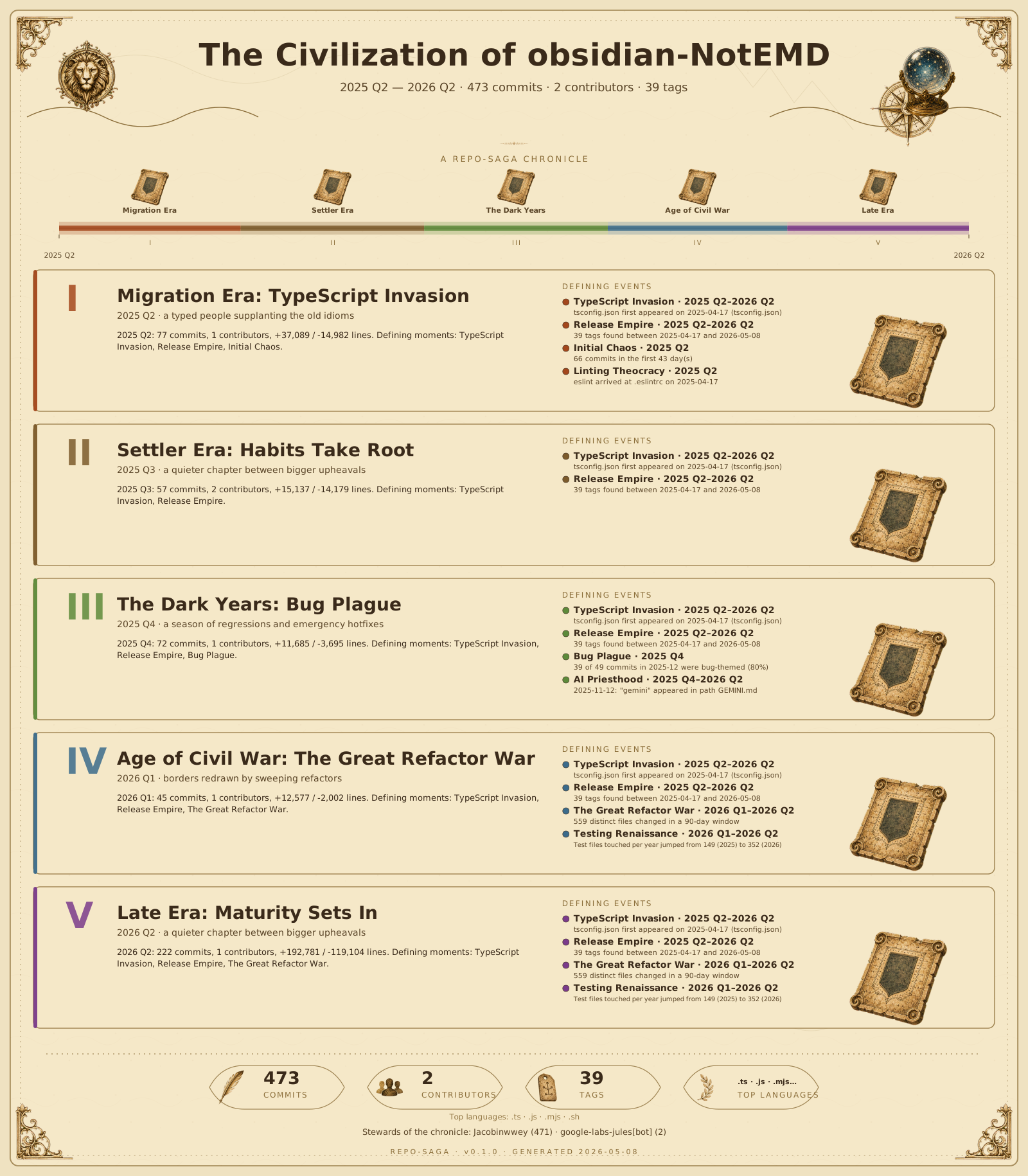
Last refreshed for release tag 1.9.7 on 2026-08-31. Latest commit date: 2026-08-31.