Meeting Tools
 extzzy168 downloads
Native meeting notes, quick journals, and an editable task dashboard without external services.
- Overview
- Scorecard
- Updates3
Meeting Tools is an Obsidian plugin for creating fast, consistent Minutes of Meeting (MoM) without leaving your notes. It provides template-driven meeting forms, a lightweight meeting journal, and a task dashboard.
Why Meeting Tools?
The plugin was created to reduce the effort required to write a useful MoM. Instead of creating a file, choosing a folder, copying headings, formatting tasks, and renaming the note manually, you fill in one compact form and Meeting Tools creates the Markdown note in the configured location.
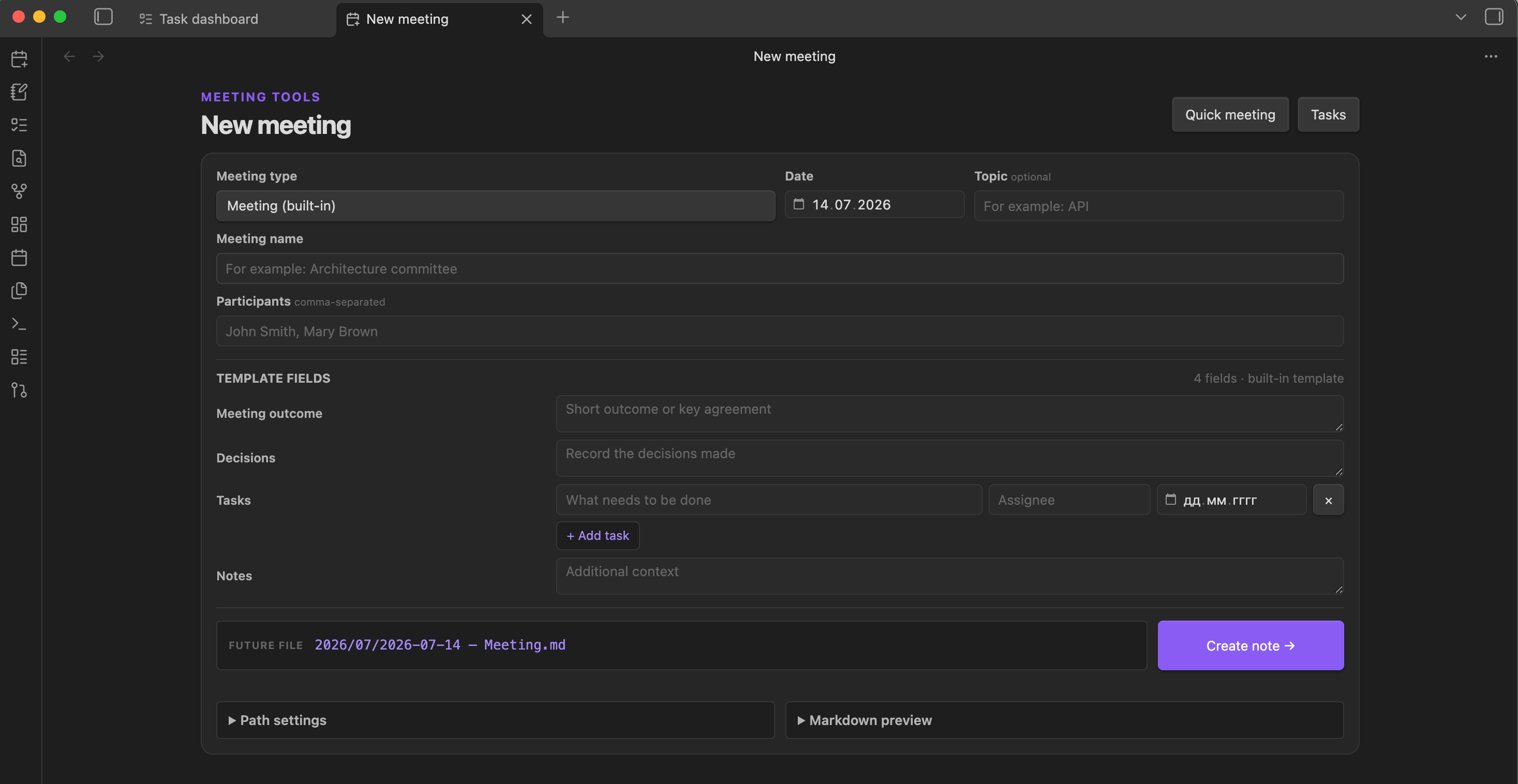
For a meeting that only needs a date and a short outcome, use Quick meeting. For a structured MoM with participants, decisions, tasks, and custom sections, use New meeting.
Features
- Create structured meeting notes from Markdown templates.
- Fall back to a built-in template when no external templates exist.
- Organize notes by year/month, year only, or without subfolders.
- Add tasks through a dynamic form with title, assignee, and due date.
- Append lightweight “date + outcome” entries to meeting journals.
- Review and update tasks in a searchable dashboard.
- Add standalone tasks directly from the dashboard.
- Configure template, meeting, journal, and task folders independently.
- Use the interface in English or Russian, automatically matched to Obsidian or selected manually.
- Work locally through the Obsidian Vault API, without a server, container, account, or network connection.
What is an Obsidian vault?
An Obsidian vault is the regular folder on your computer that you open in Obsidian. It contains your Markdown (.md) notes, attachments, and the hidden .obsidian configuration folder.
For example:
Work notes/                         ← vault folder
├── .obsidian/                      ← Obsidian settings and plugins
├── Templates/                      ← optional Meeting Tools templates
├── Meetings/                       ← notes created by Meeting Tools
└── Projects/
When this README says “copy a file to your vault”, it means copying it somewhere inside that folder.
Installation
Community plugins
After Meeting Tools is accepted into the official directory:
- Open Settings → Community plugins in Obsidian.
- Select Browse and search for Meeting Tools.
- Select Install, then Enable.
Manual installation
Download
main.js,manifest.json, andstyles.cssfrom the matching GitHub release.Inside your vault, create:
.obsidian/plugins/meeting-tools/Put the three files directly in that folder.
Restart Obsidian.
Enable Meeting Tools under Settings → Community plugins.
Do not copy data.json between vaults. It contains settings for one specific vault.
Quick start
After enabling the plugin, three ribbon icons appear in the left sidebar:
- New meeting creates a full MoM.
- Quick meeting appends a date and outcome to a journal.
- Task dashboard shows tasks found in the configured folder.
Open Settings → Community plugins → Meeting Tools to choose your folders and file structure.
Leaving the full meeting note folder or quick journal folder empty means the vault root. For example, an empty meeting folder with the year-only structure creates 2026/<meeting>.md; an empty journal folder creates 2026.md directly in the vault root.
Templates
Meeting Tools reads Markdown files located directly in the configured template folder. Copy any files you want from examples/templates/en or examples/templates/ru into a folder inside your vault, then select that folder in the plugin settings.
Example:
My vault/
└── Templates/
    ├── Meeting.md
    ├── Daily stand-up.md
    └── Weekly review.md
Template YAML defines metadata. Markdown headings become form fields, and the HTML comment below a heading becomes its placeholder:
---
tags:
  - area/work
  - type/meeting
project: "Team"
series: "Weekly review"
cadence: weekly
---

# Weekly review

> [!summary] Weekly outcome
> <!-- Key result and current risk. -->

## Decisions

<!-- Record the decisions made. -->

## Tasks

<!-- This section becomes a dynamic task form. -->

## Notes

<!-- Additional context. -->
## Tasks and ## Задачи are recognized as dynamic task sections. Meeting.md and Встреча.md are treated as generic meeting types, so the form also asks for a meeting name.
User templates are not translated automatically. Their headings and placeholders remain in the language in which they were written. The built-in template follows the selected interface language and remains available for manual selection even when external templates exist.
Meeting journals
Quick meeting stores only the date and the entered outcome. A one-line entry looks like:
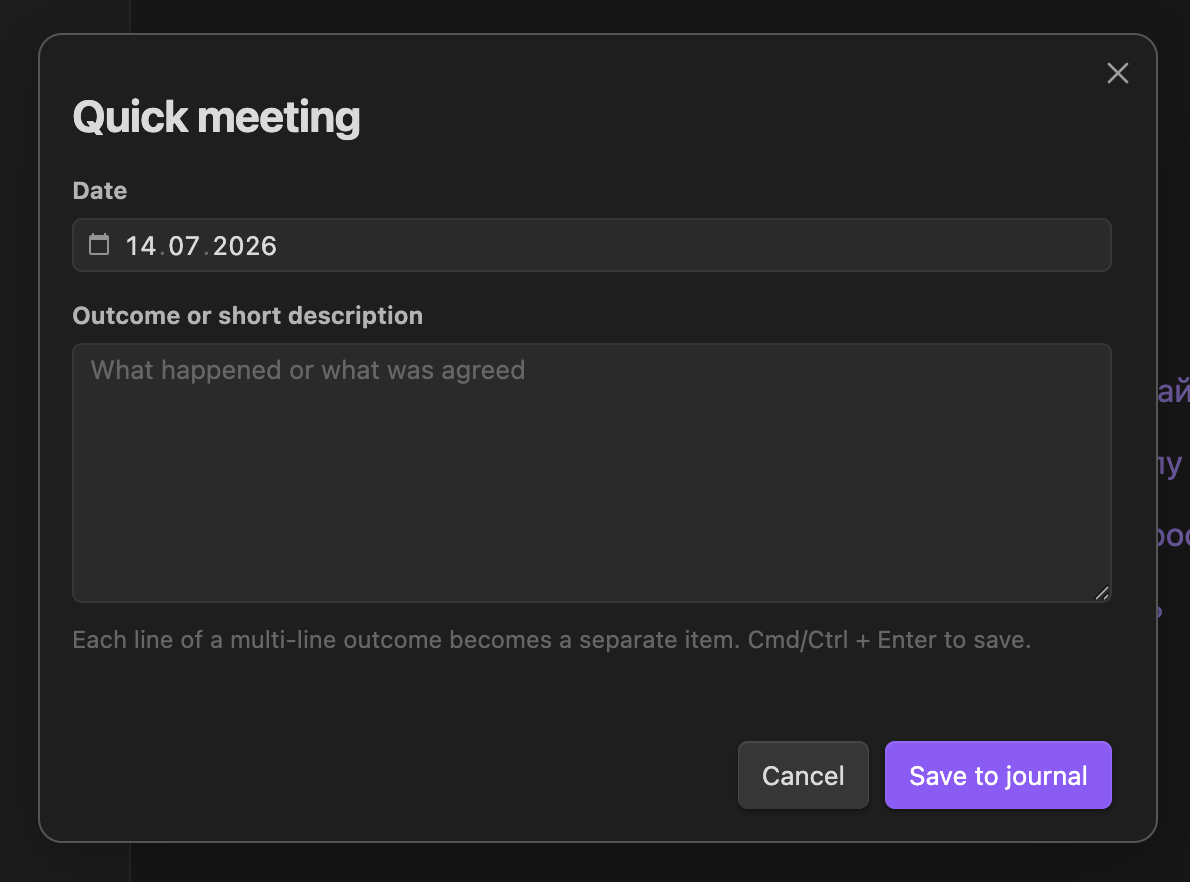
2026-07-14 — Architecture reviewed and next step agreed
Available journal structures:
- year/month:
<folder>/2026/07.md; - year only:
<folder>/2026.md; - no subfolders:
<folder>/Meetings.md.
Task dashboard
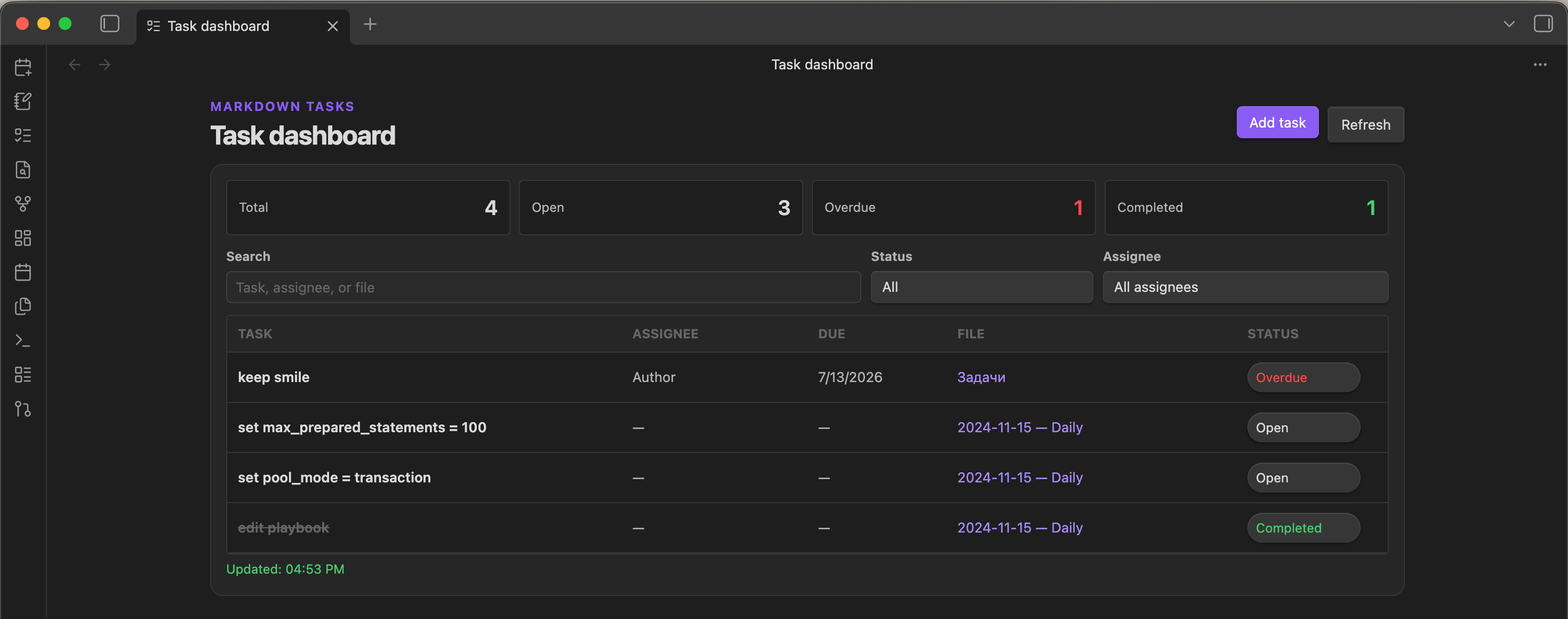
Tasks created by the meeting form are normal Markdown checkbox lines:
- [ ] Prepare the rollout plan — @Alex #assignee/alex 📅 2026-07-20
- [x] Review the architecture — @Sam #assignee/sam ✅ 2026-07-14
The dashboard shows task, assignee, due date, source file, and status. It includes search, status and assignee filters, overdue statistics, and direct status updates. Before changing a task, the plugin checks that the original source line has not changed.
The dashboard can also be used independently as a local task tracker. Point the task search folder to any folder in your vault that contains supported Markdown checkbox lines; those files do not have to be meeting notes or be created by Meeting Tools.
Use Add task in the dashboard to create a task with a title, assignee, and due date. The destination Markdown file is configured separately under Settings → Meeting Tools → Task dashboard and must be located inside the dashboard search folder.
Privacy and data access
Meeting Tools:
- does not use telemetry or analytics;
- does not require an account or payment;
- does not make network requests;
- does not access files outside the current vault;
- reads templates and task notes from folders selected in settings;
- writes only when you create a meeting, append a journal entry, or explicitly change a task status.
Development and releases
Source files are in src. Development requires Node.js 18+ and pnpm. Install the dependencies once:
pnpm install
Create a minified production bundle:
pnpm build
For development with automatic rebuilds and inline source maps, use pnpm dev.
The production command creates a minified main.js. For an Obsidian release, attach main.js, manifest.json, and styles.css to a GitHub release whose tag exactly matches the version in manifest.json.
License
Meeting Tools is available under the MIT License.