Aether Memory

Give your AI agents memory from your vault via MCP. Syncs notes to a local aether-mcp server and keeps private notes on disk.
- Overview
- Scorecard
- Updates6
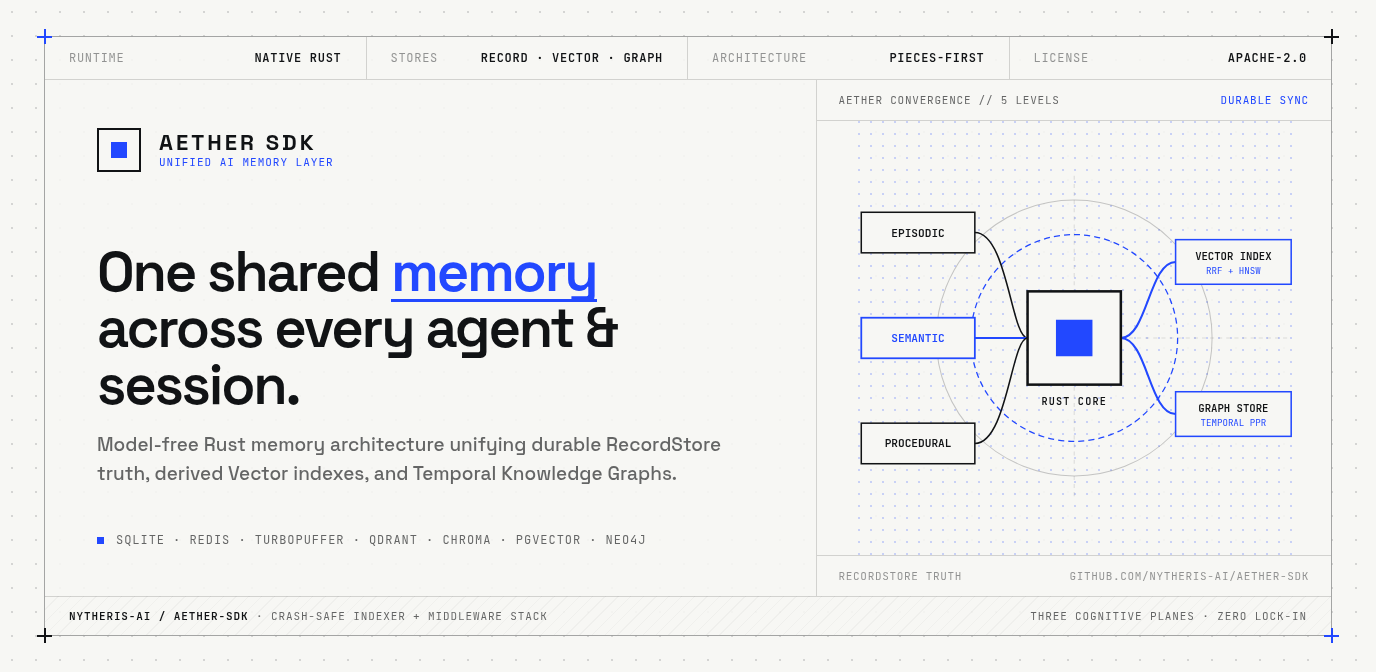

Aether Memory
Your Obsidian vault, every AI agent's memory.
Privacy-preserving two-way vault sync, Inbox memory review, Git lattice sync, and KV-cache warming for aether-mcp.
Launch video · How it works · Installation · Configuration · Commands · Privacy · Aether SDK · Docs
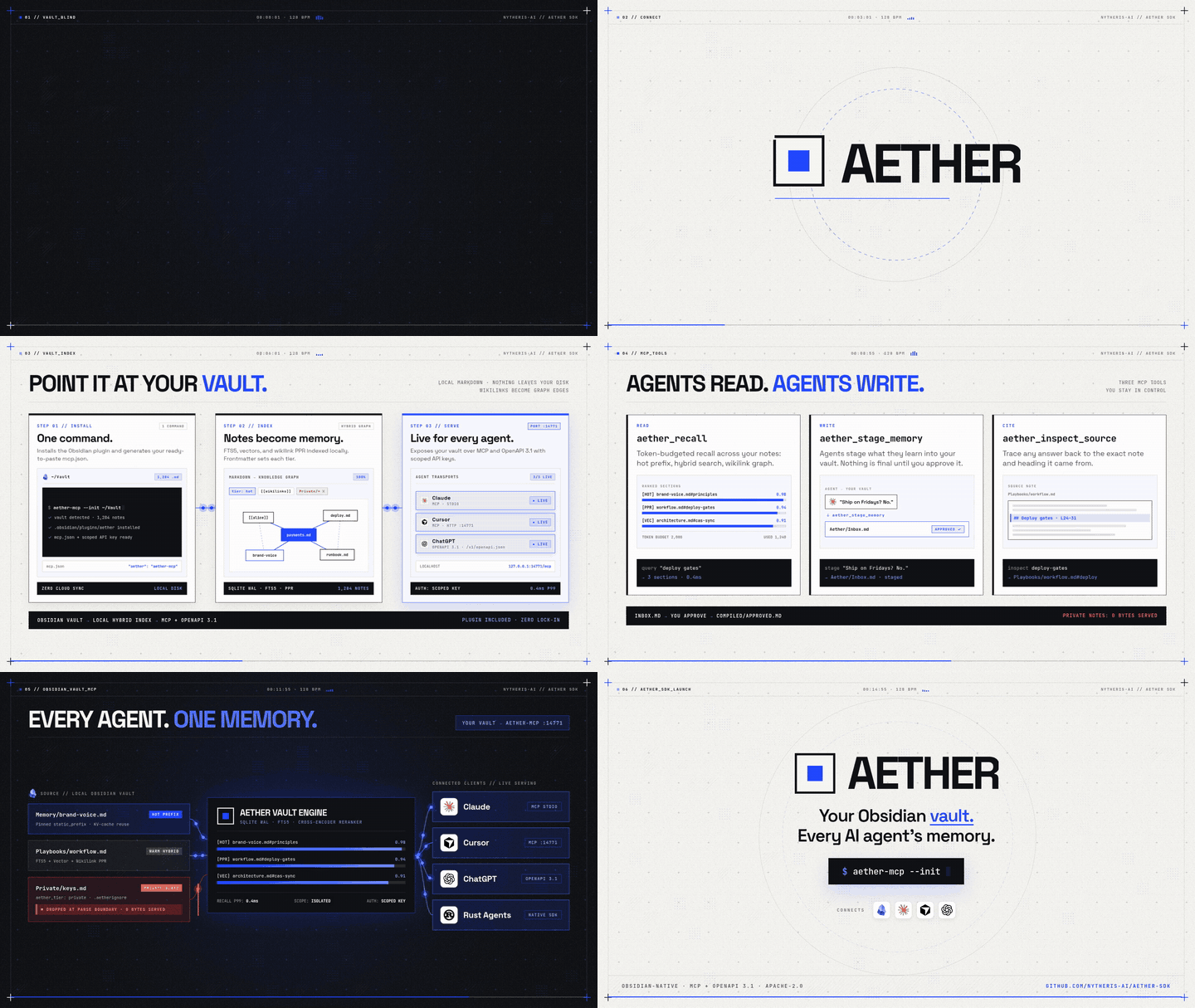
Launch video
How it works
AMC connects Obsidian Desktop to an aether-mcp control-plane server so your public notes stay indexed for AI agents while private notes never leave disk.
flowchart LR
    Vault["Obsidian Vault"] -->|"Client-side filter: aether_tier: private & .aetherignore"| Filter["AMC Plugin"]
    Filter -->|"Public notes (SHA-256 delta push)"| Server["aether-mcp (127.0.0.1:14771 or HTTPS)"]
    Server -->|"Aether/Inbox.md & Aether/Compiled/Approved.md"| Filter
    Server <-->|"MCP / OpenAPI 3.1"| Agents["Claude · Cursor · ChatGPT · Rust Agents"]
- Client-side privacy boundary. Notes marked
aether_tier: privateor matched by.aetherignoreare filtered locally before any HTTP request is built. - Human-in-the-loop memory review. AI agents propose new memories to
aether-mcp, and you approve or reject them from the Aether inbox sidebar pane before they enterAether/Compiled/Approved.md. - Local-first or team gateway. Run
aether-mcplocally over loopback HTTP (http://127.0.0.1:14771) or connect to a remote team gateway over HTTPS with a scoped bearer API key (aek_...).
Installation
You can install Aether Memory directly from Obsidian Community plugins, manually from a GitHub release, or with the aether-mcp CLI.
Obsidian Community plugins (recommended)
- Open Settings → Community plugins in Obsidian Desktop (
1.7.2or later) and turn off Restricted Mode if prompted. - Select Browse, search for Aether Memory (or open Aether Memory in the Obsidian Community directory), and select Install.
- Select Enable.
Manual release installation
- Download
main.js,manifest.json, andstyles.cssfrom the latest release. - Create the directory
<vault>/.obsidian/plugins/aether-memory/. - Copy
main.js,manifest.json, andstyles.cssinto that directory. - Reload Obsidian and enable Aether Memory under Community plugins.
CLI setup with aether-mcp --init
Install aether-mcp and run --init to install the plugin bundle into your vault and generate your mcp.json configuration snippet:
aether-mcp --init --vault /path/to/vault --http-addr 127.0.0.1:14771
Start the HTTP control plane before syncing in Obsidian, or install it as an auto-starting service with aether-mcp service install --vault /path/to/vault. The Local server quickstart buttons in plugin settings copy these commands with your vault path pre-filled.
aether-mcp --vault /path/to/vault --http-addr 127.0.0.1:14771 --http-only
Configuration
Open Settings and select Aether Memory to configure the connection, sync behavior, and optional KV-cache warming. The settings tab stores values in AetherPluginSettings.
Connection and authentication
- Aether control-plane URL. Sets
endpointUrl(defaulthttp://127.0.0.1:14771). Accepts loopbackhttp://URLs (127.0.0.1,localhost,::1) or remotehttps://endpoints foraether-mcp --http-addr. - API key. Sets
apiKey(default empty) using a masked password input. Remote hosts and loopbackhttps://endpoints require a bearer token (aek_...). - Connection card. Checks the server with
GET /v1/vault/pullwhenever you open the settings tab and after you change the URL or API key. It shows Connected to aether-mcp with the number of indexed notes, Can't reach aether-mcp with how to start it, or The server rejected the API key. Select Test connection to check again.
Live sync
- Live vault sync. Sets
liveSyncEnabled(defaulttrue). Automatically pushes note creates, edits, deletions, and renames after Obsidian finishes loading the workspace layout. - Sync debounce (ms). Sets
syncDebounceMs(default1500, range500to10000). Delays rapid create and modify pushes per path while executing deletions and renames immediately in order. - Auto-pull interval (seconds). Sets
autoPullIntervalSec(default0). Polls the server in the background to refreshAether/Inbox.mdandAether/Compiled/Approved.md, or disables polling when set to0. - Run Dream consolidation on push. Sets
runDreamOnPush(defaultfalse). Requests Dream consolidation during manual vault sync. Requires an Admin-scoped API key whenaether-mcpenforces authentication.
Advanced: GPU KV-cache warming
This section is for users who run their own vLLM or SGLang server and want the vault's most-used context kept warm in its KV cache. Most users can leave this off.
- Enable GPU KV-cache warming. Sets
kvWarmingEnabled(defaultfalse). Shows the two settings below and adds the Warm GPU KV cache command. Existing installs that already set a KV endpoint or model keep the feature on after upgrading. - KV endpoint (optional). Sets
kvEndpoint(default empty). Records the inference endpoint associated with KV-cache warming telemetry. - Default KV model. Sets
kvModel(default empty in settings, falling back tollama-3.1-8binAetherCompanionPlugin). Sets themodel_idparameter sent by the Warm GPU KV cache command.
Obsidian commands
The plugin registers four commands in the Obsidian Command Palette, plus a fifth when GPU KV-cache warming is enabled. The status bar updates between Aether: Idle, Aether: Syncing…, Aether: Synced (HH:mm), Aether: Offline, and Aether: N to review when AI agents propose memories. Clicking the status bar item opens the inbox when memories are waiting, and otherwise triggers a vault sync.
- Open Aether inbox review (
aether-open-inbox-review). CallsGET /v1/inboxand opens the Aether inbox pane in the right sidebar with Approve and Reject buttons. - Trigger dream pass (
aether-trigger-dream-pass). CallsPOST /v1/dream, refreshes local mirror notes and pending Inbox counts, and displays a summary notice. - Sync vault with Aether (
aether-sync-vault). Pulls the server manifest (GET /v1/vault/pull), hashes local Markdown files with SHA-256, pushes changed public notes (POST /v1/vault/push), and writes updatedAether/Inbox.mdandAether/Compiled/Approved.mdfiles back to the vault. - Git sync team vault (
aether-git-sync). CallsPOST /v1/git/syncto fetch, merge, and reconcile vault and Aether lattice conflicts, then refreshes local mirror notes. - Warm GPU KV cache (
aether-warm-kv-cache, only when Enable GPU KV-cache warming is on). CallsPOST /v1/kv/warmfor the configured default KV model and reports warmed blocks, tokens, and estimated time-to-first-token reduction.
Frontmatter and exclusions
You control which notes sync to aether-mcp with YAML frontmatter, ignore files, and built-in path rules.
Frontmatter
Add aether_tier: private in YAML frontmatter to keep a note exclusively on disk.
---
aether_tier: private
---
When isPrivateMarkdownNote detects aether_tier: private, the plugin omits the note body from all HTTP requests and sends only the relative path in private_paths and deleted_paths so aether-mcp drops any earlier copy from its index. Notes without private may also set aether_tier (hot, warm, cold), aether_scope, aether_kind, aether_status, valid_from, superseded_by, and tags for aether-mcp indexing.
.aetherignore and .aetherhot
Create .aetherignore at the vault root with newline-separated path rules, directory rules ending with /, or * and ? globs. The parser skips blank lines and # comments. Editing or deleting .aetherignore triggers a delta sync so aether-mcp removes excluded paths from its index.
Create .aetherhot at the vault root using the same pattern syntax to promote matching notes into the hot profile tier on aether-mcp when frontmatter does not specify an explicit aether_tier.
Built-in exclusions
isIgnoredVaultPath skips these paths before reading or uploading file contents:
- Non-Markdown files.
- Any path containing
.obsidian,.git,.trash, or.aether. - Vault mirror and plugin state prefixes
Aether/Inbox.md,Aether/Compiled, and.obsidian/plugins/aether-memory/data.json. - Drawing files ending with
.canvas,.excalidraw, or.excalidraw.md.
Privacy and network disclosure
- Configured endpoint only. Outbound HTTP requests go strictly to your configured
endpointUrlthrough Obsidian'srequestUrlAPI. The plugin sends zero telemetry, crash reports, or third-party requests. - Client-side private note filtering. The plugin evaluates
aether_tier: privatefrontmatter,.aetherignorerules, and built-in exclusions locally before buildingPOST /v1/vault/pushrequests. Excluded note bodies never leave your disk. - Transport policy.
assertControlPlaneBaseUrlrejects non-loopback plainhttp://URLs by default and requires an API key for any non-loopback endpoint or loopbackhttps://endpoint. - Local credential storage. Obsidian stores your
apiKeyand plugin configuration locally in<vault>/.obsidian/plugins/aether-memory/data.jsonthroughsaveData. Keep.obsidian/plugins/aether-memory/data.jsonout of version control.
Development
Install dependencies, run unit tests, check types, build the production bundle main.js, and verify release compliance:
npm ci
npm test
npm run typecheck
npm run build
npm run verify:release
To verify a tagged release archive against a specific SemVer release tag, pass --tag without a v prefix:
node scripts/verify-release.mjs --tag 0.4.5
License
Apache-2.0. See LICENSE.