Tinymist
 Wilfried AGO35 downloads
Edit, preview, and export Typst documents using the Tinymist language server.
- Overview
- Scorecard
- Updates10
Write Typst in Obsidian. Properly.
A real Typst editor, a live preview in your workspace, and PDFs that stay ordinary vault files.
Typst is a modern typesetting system — the power of LaTeX
without the pain. This plugin makes .typ files a first-class document type in
your vault, backed by
Tinymist, the Typst language
server.
Your papers, theses, and reports live beside your notes. Not in another app.
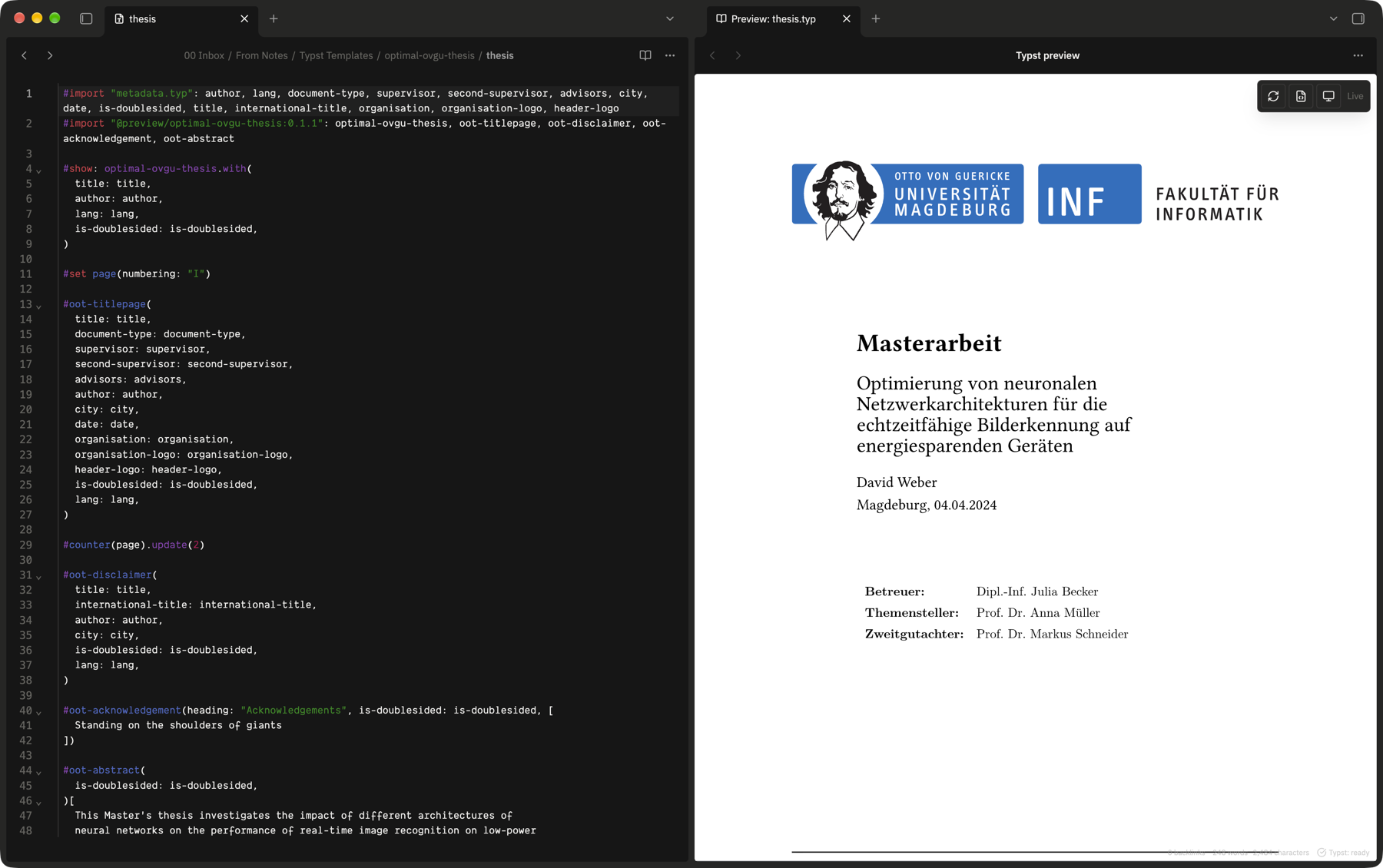
Source on the left, the real rendered document on the right, updating as you type.
What you get
| A real editor | Syntax highlighting, completion, hover docs, go-to-definition, symbols, folding, and formatting — answered by the Typst compiler itself, not by guesswork. |
| Errors as you type | Compiler diagnostics underlined in place, with the real message. No compile-and-squint cycle. |
| Live preview in your workspace | The rendered document in an ordinary Obsidian leaf. Split it, move it, pop it out. It updates as you type. |
| Click to navigate | Click the rendered page to jump to the source that produced it. Move the caret to scroll the preview. Both directions. |
| PDFs that are just files | Export writes a normal PDF into your vault. Obsidian's own viewer opens it, exactly like any other PDF. |
| Real Typst projects | A folder with a typst.toml, a template, a bibliography, and figures works the way Typst expects. |
| Offline | No account, no cloud, no telemetry, and no network requests. |
Install
From Obsidian — open Settings → Community plugins → Browse, search for Tinymist, install, and enable. Or use the directory page.
Then install Tinymist itself. The plugin drives the real Typst engine, which you install separately — Obsidian's developer policies do not allow a plugin to install or update its own dependencies.
| Platform | Command |
|---|---|
| macOS / Linux | brew install tinymist |
| Any | cargo install tinymist-cli |
| Windows | scoop install tinymist · winget install Myriad-Dreamin.tinymist |
| Manual | GitHub releases |
Check it worked:
tinymist -V # tinymist 0.15.8
That is the whole setup. The plugin finds it automatically, including the package-manager locations a desktop app does not normally see.
Requirements
- Obsidian 1.13.0+, desktop. The plugin launches a native executable, which Obsidian mobile cannot do.
- A vault stored on the filesystem.
- Tinymist 0.13.0+.
Using it
Open any .typ file. Tinymist starts on first use, and the status bar shows
what it is doing.
Press the book button in the editor's tab bar to open the preview beside your source. Everything else lives in the command palette:
| Command | |
|---|---|
| Typst: Open preview | Show the rendered document |
| Typst: Toggle preview | Show or hide it |
| Typst: Export PDF | Compile and write a PDF into the vault |
| Typst: Format document | Reformat the source |
| Typst: Create new Typst file | Add a .typ file where new notes go |
| Typst: Show project root | Which folder this document compiles against |
| Typst: Restart language server | Restart Tinymist |
No default hotkeys are set, so nothing collides with yours. Bind your own under Settings → Hotkeys.
The preview's own controls float over the page: refresh, open source, and a theme button that steps between following the app, light, and dark.
To start a document, right-click any folder in the file explorer and choose New Typst file, or run Typst: Create new Typst file. Obsidian's own New note always makes Markdown and its menu cannot be extended, so Typst files get their own entry right beside it.
The status bar
| Typst: ready | Running; the document compiles |
| Typst: compiling | Working |
| Typst: 2 errors | Problems, underlined in the editor |
| Typst: disconnected | Tinymist stopped — select to restart |
| Typst: unavailable | It could not start — select for the reason |
Not only papers
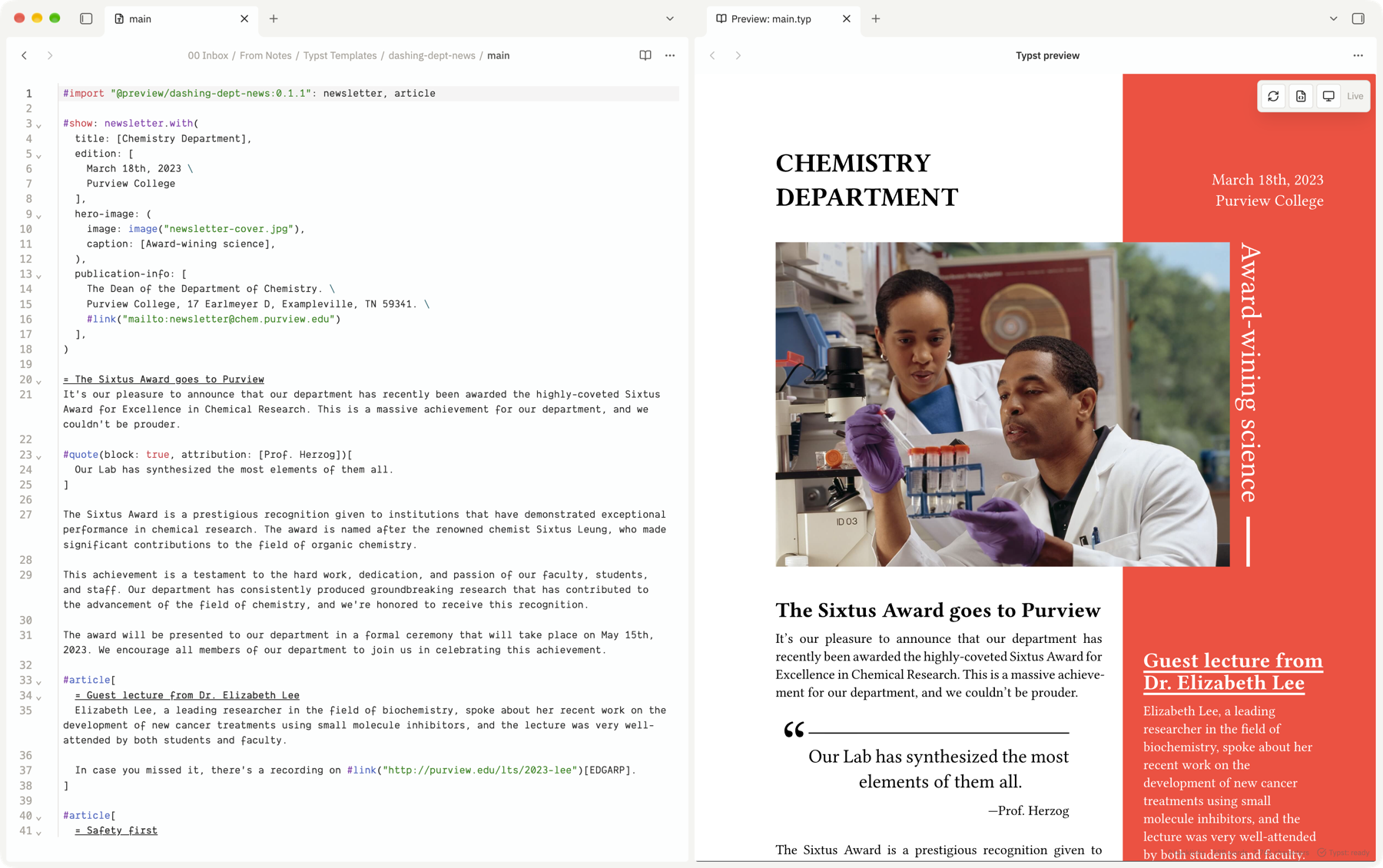
Typst does full layout — columns, floats, images, colour, and the package ecosystem. Anything Typst can typeset, this previews.
Projects
Typst resolves imports and absolute paths against a project root, which is
not necessarily your vault root. By default the root is the nearest folder
containing a typst.toml, and otherwise the document's own folder:
vault/
├── notes/
└── papers/
    └── distributed-systems/
        ├── typst.toml          ← makes this folder a project
        ├── main.typ
        ├── bibliography.bib
        └── figures/
Without a typst.toml, papers/distributed-systems/main.typ still gets its own
folder as the root — so two papers never collide.
The alternatives are Always the vault root (one project; /-absolute
imports reach anywhere) and A folder I choose. Changing this restarts
Tinymist, which reads it at startup.
PDF export
Export writes a normal file into your vault, and Obsidian takes it from there.
This plugin does not register a PDF view, intercept .pdf files, or bundle
a PDF renderer — opening any PDF uses Obsidian's own viewer.
- By default the PDF lands beside its source; set a folder in settings to collect them elsewhere.
- With Replace existing PDFs off, an existing
name.pdfis never clobbered: the export goes toname-1.pdf. - Intermediate files stay in the plugin's own folder, never in your notes.
Settings
| Setting | Default | |
|---|---|---|
| Tinymist executable | empty | Empty means "find it automatically" |
| Project root | Automatic | See Projects |
| Preview refresh | As you type | Or on save |
| Preview theme | Follow the app | Light, dark, or follow Obsidian |
| Sync with the editor | on | Click the preview to move the caret, and back |
| Show diagnostics | on | Underline compiler errors |
| Enable the formatter | on | |
| PDF folder | empty | Empty means "beside the document" |
| Replace existing PDFs | off | |
| Use system fonts | on | |
| Logging | Off | Raise to debug when reporting a problem |
Privacy and network use
This plugin makes no network requests. No telemetry, no analytics, no accounts, no remote code or styles. Once Tinymist is installed, everything works offline.
Obsidian's automated review flags two capabilities. Both are inherent to driving an external compiler, and here is exactly what they amount to:
- It launches one external program.
child_process.spawnstarts the Tinymist executable, always withshell: falseand an argument array, so no string from a document, filename, or setting is ever handed to a shell. No shell is run, and no program other than the one you configured. - It has no filesystem access outside your vault. The plugin imports no
filesystem module at all —
node:child_processis the only Node module in the bundle. Everything it reads or writes in your vault goes through Obsidian's Vault API.
Inside your vault it reads the .typ files you open, writes PDFs you export,
and keeps its settings in .obsidian/plugins/tinymist/.
What Tinymist itself reads once launched is Typst's own behaviour: system
fonts, and Typst's package cache for any #import from a package. Tinymist may
fetch a Typst package the first time a document imports one — a Typst feature,
outside the plugin's control, and the only route by which anything here reaches
the internet.
The preview runs a loopback HTTP server that Tinymist starts on an ephemeral port while a preview tab is open. It is not reachable from other machines, and has no authentication, so on a shared machine another local process could read a document you are previewing.
Why an automated scan reports "network calls"
Obsidian's review counts network calls by pattern-matching the built main.js.
None of the matches is a request to a remote server:
| What the scanner sees | What it is |
|---|---|
http://127.0.0.1:<port>/ |
The loopback preview server on your own machine |
https://github.com/... |
A URL in the build banner comment. Not fetched |
"http://", "https://" |
String literals in the bundled Typst grammar, used to recognize links while highlighting |
.open( |
DocumentSession.open(), the plugin's own method. The pattern also matches XMLHttpRequest.open, which is not used |
Confirm it yourself:
grep -c 'fetch(\|XMLHttpRequest\|new WebSocket\|requestUrl' main.js   # 0
grep -o 'require("[^"]*")' main.js | sort -u                          # no http module
Troubleshooting
Tinymist is not found
If tinymist -V works in a terminal but the plugin says it is missing: an app
launched from Finder, the Dock, or a desktop shortcut does not inherit your
shell's PATH. On macOS it gets /usr/bin:/bin:/usr/sbin:/sbin, which
excludes Homebrew's /opt/homebrew/bin.
which tinymist        # /opt/homebrew/bin/tinymist
launchctl getenv PATH # usually empty — the GUI default is used instead
The plugin works around this by also searching where package managers install
(Homebrew, MacPorts, Cargo, ~/.local/bin, Snap, Flatpak, scoop, winget). If
yours lives elsewhere, set the full path in settings — that always wins.
The developer console is full of preview messages
Lines like recv diff-v1 1388 and parse 0.20 ms, rerender 2.20 ms come from
Tinymist's preview frontend, not from this plugin. They are prefixed (index)
and originate from http://127.0.0.1:<port>.
The preview deliberately runs in a cross-origin iframe, which is what keeps
rendered documents away from Obsidian's DOM and APIs, and a page cannot silence
the console of a frame it does not share an origin with. Filter the console on
[tinymist: to see only this plugin's output.
Something else is wrong
Set Logging to debug in settings, reproduce, and open the developer
console (Ctrl/Cmd+Shift+I). Plugin lines are prefixed [tinymist:…].
Document contents are never logged.
Then open an issue.
Known limitations
- Desktop only.
- Obsidian's find bar does not reach the Typst editor; CodeMirror's own search panel (Ctrl/Cmd+F) is provided instead.
- Markdown features — backlinks, tags, the outline — do not apply to
.typ. - Only one plugin can own the
.typextension. Do not enable another Typst editor plugin in the same vault. - Changing the executable, project, font, or formatter settings restarts Tinymist.
Contributing
Issues and pull requests are welcome — see CONTRIBUTING.md for the development setup, and SECURITY.md to report a vulnerability privately.
| Roadmap | What is planned, what is not, and why |
| Architecture | How the pieces fit, and why |
| Research | Evidence behind the design decisions |
| Testing | The automated suite and the manual pass |
| Compliance | Against Obsidian's developer policies |
| Risks | Known weak points, honestly |
Credits
Built on Tinymist by Myriad-Dreamin, and Typst. Typst syntax highlighting comes from codemirror-lang-typst.
This is an independent, unofficial integration. It is not affiliated with or endorsed by the Tinymist project, the Typst project, or Obsidian.
License
MIT — see LICENSE. Third-party components are listed in THIRD_PARTY_NOTICES.md. Tinymist is Apache-2.0 and is not bundled with or modified by this plugin.