Sync Deck
 Ismail Ivanov158 downloads
Realtime vault sync and live team presence across your devices.
- Overview
- Scorecard
- Updates11
Sync Deck keeps an Obsidian vault in sync across your devices and, when you choose, with your team. Sign in with Google, open or create a synced vault, and Sync Deck handles background file sync, recoverable deletes, invites, roles, and live presence.
It is also the cloud companion to Task Deck: Task Deck boards are Markdown files, so Sync Deck can carry them across devices and add collaboration without a separate board database.
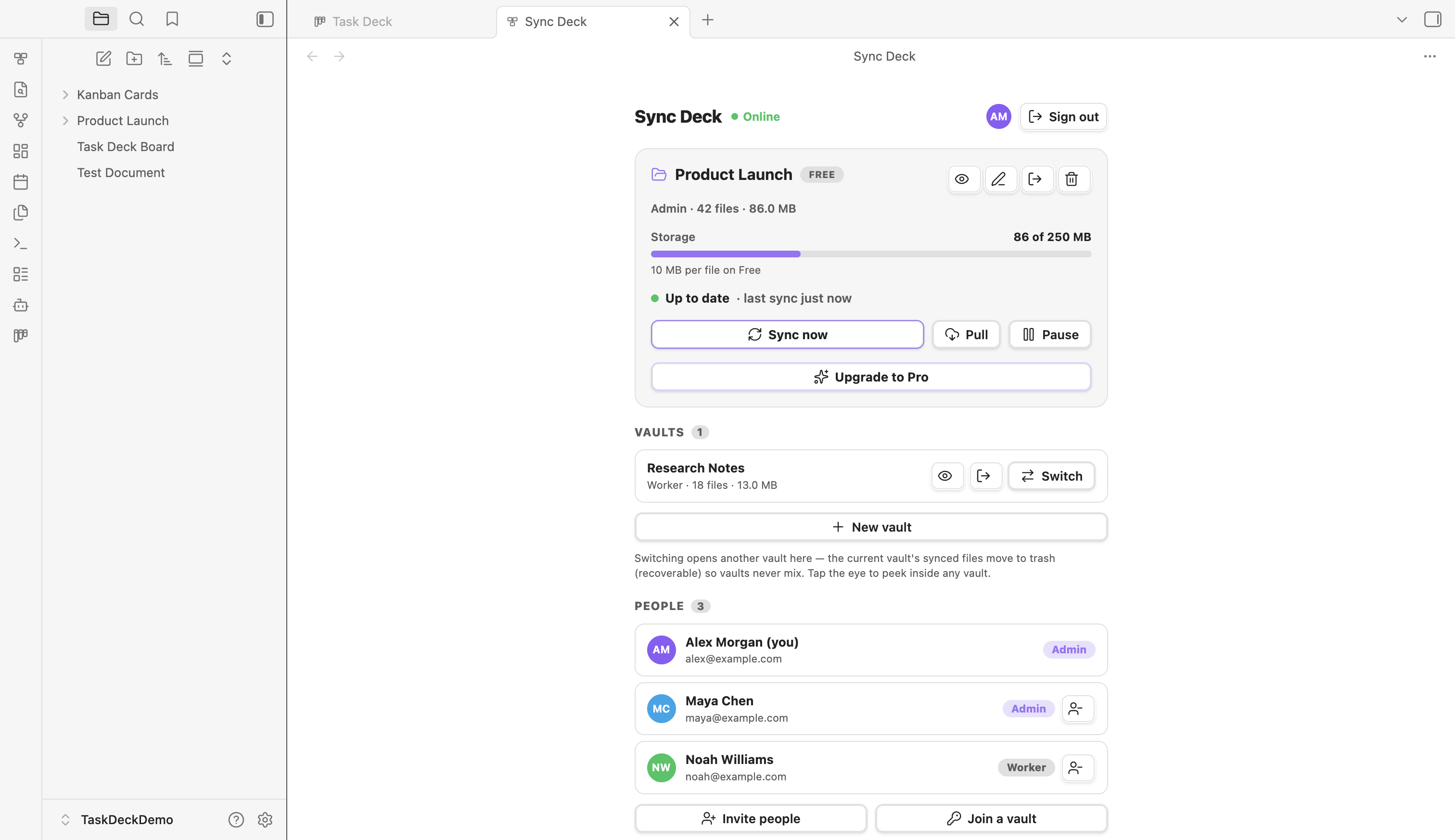
The dashboard uses demo names, addresses, and vault data.
Features
- Google sign-in with no additional Sync Deck password.
- Automatic vault sync for files and folders, plus manual Sync now and Pull controls.
- End-to-end encryption for file contents, filenames, folder paths, and synced Task Deck board/card identifiers. Keys are created and kept on member devices, not on the Sync Deck server.
- Multiple synced vaults that can be inspected, opened, renamed, switched, closed, or deleted without mixing their contents.
- Explicit first sync: nothing is uploaded until you create or open a vault and choose whether to include the files already on the device.
- Shared vaults with invite codes, Admin and Worker roles, a visible member list, and live editor presence.
- Encrypted sharing and recovery with
SD1invite codes and user-heldSDK1recovery keys. - Owner-controlled key rotation through a fully verified replacement vault when a recovery key or member access needs to be retired.
- Recoverable file handling: files removed during a vault switch or leave flow go through Obsidian's trash.
- Storage visibility with current usage, per-file limits, sync state, and recent activity in one panel.
- Task Deck integration for synced boards, card assignments, and collaborative presence.
Quick start
- Install and enable Sync Deck.
- Open it from the Obsidian ribbon.
- Read and accept the Terms & Privacy Notice.
- Continue with Google.
- Create a synced vault, open an existing one, or join with an invite code.
- Choose whether the first sync should include the files already in this Obsidian vault.
After setup, local edits are queued in the background. Use Sync now for an immediate scan, Pull to check the remote vault, or Pause when you want to stop syncing temporarily.
Plans
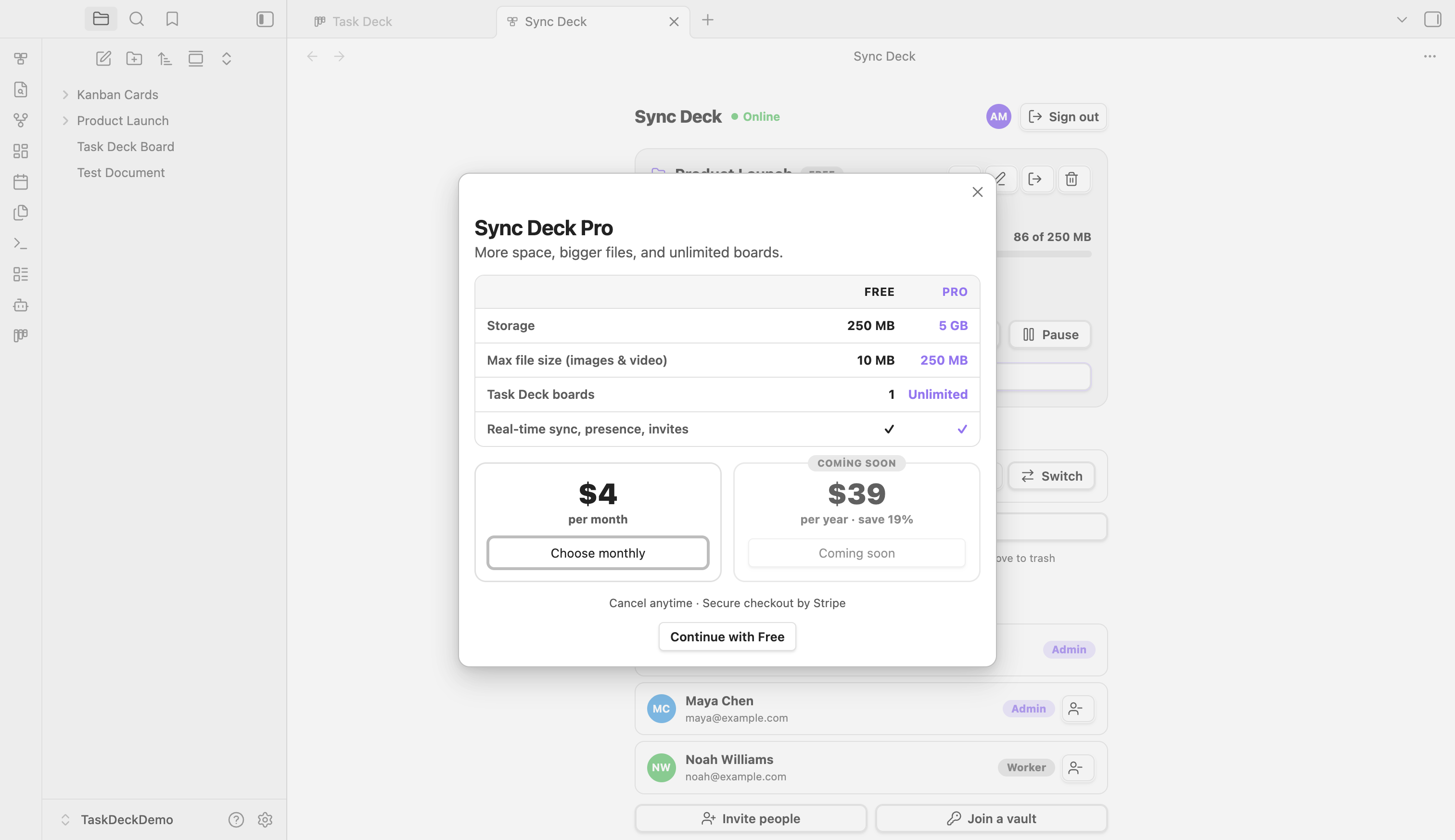
| Free | Pro | |
|---|---|---|
| Storage | 250 MB | 5 GB |
| Max file size (images, video) | 10 MB | 250 MB |
| Synced Task Deck boards | 1 | Unlimited |
| Real-time sync, presence, invites, roles | ✓ | ✓ |
Pro checkout is $4 / month. A $39 / year option is shown in the plugin when yearly billing is available. The in-app upgrade panel is the source of truth for currently available billing intervals.
Account, network use & privacy
Sync Deck is a hosted cloud service, so a few things to know up front:
- An account is required. You sign in with your Google account; syncing does not work without signing in.
- Payment is required for Pro. The free plan works without paying. Pro is a paid subscription (see Plans), billed through Stripe.
- Network use. Sync Deck sends data over HTTPS to:
api.syncdeck.cloud— the Sync Deck backend (hosted in Germany, EU) that stores and delivers the files you choose to sync and powers presence, invites, and roles.- Google — to sign you in (Sync Deck receives your email, name, and profile picture).
- Stripe — to process Pro payments (your full card details are never sent to Sync Deck).
- End-to-end encrypted vault data. New vaults encrypt file contents, filenames, folder paths, and Task Deck board/card identifiers before upload. The server stores ciphertext and does not receive the vault key.
- Metadata remains visible. The service still processes account identity, vault display name, membership and roles, billing status, IP address, file counts and encrypted sizes, server timestamps, and presence timing/coordinates. Read the E2EE design and threat model before relying on it for sensitive work.
- Recovery is your responsibility. Keep the
SDK1recovery key somewhere safe. Sync Deck cannot reset it or decrypt the vault if every member loses it. AnSD1invite contains the vault key, so share it through a private channel. - Legacy vaults. Vaults created before E2EE remain marked Legacy until the owner selects Enable E2EE. Migration verifies an encrypted replacement before deleting the old server copy and requires existing members to be invited again.
- Privacy & terms. What is collected and your rights (including GDPR and CCPA) are set out in the Terms of Service & Privacy Notice. You accept these in the plugin before syncing begins.
Install
Until Sync Deck is available in the Obsidian community plugin directory:
- Download
main.js,manifest.json, andstyles.cssfrom the latest release. - Put them in your vault under
.obsidian/plugins/sync-deck/. - Enable Sync Deck in Obsidian under Settings → Community plugins.
Or clone straight into your plugins folder for the latest source:
git clone https://github.com/ismailivanov/sync-deck.git "/path/to/vault/.obsidian/plugins/sync-deck"
How it works
Sync Deck scans the active Obsidian vault, encrypts syncable data on the device, compares local and remote file state, and transfers ciphertext over HTTPS through https://api.syncdeck.cloud. Each synced vault has its own random 256-bit key, identity, files, membership, and activity. Only one is open in a local Obsidian vault at a time.
When you switch synced vaults, Sync Deck moves the previous vault's synced files to Obsidian trash before opening the next one. This prevents two remote vaults from being merged accidentally and keeps the removed files recoverable.
Works with Task Deck
Task Deck is a kanban and table workflow for Obsidian where each card is a Markdown note. Install both plugins to sync board structure, cards, and attachments, assign shared-vault members to cards, and see live presence while teammates work.
Support
Sync Deck is built and maintained by one developer. If it's useful to you, you can support the work: Buy me a coffee.
License
MIT © Ismail Ivanov