Weekly Schedule
 xwtaidev23 downloads
Plan each week in four priority quadrants, stored as plain Markdown you can edit by hand.
- Overview
- Scorecard
- Updates5
Plan and review your week inside Obsidian. One board per week, every day split into four priority quadrants, and a whole year you can scan at a glance.
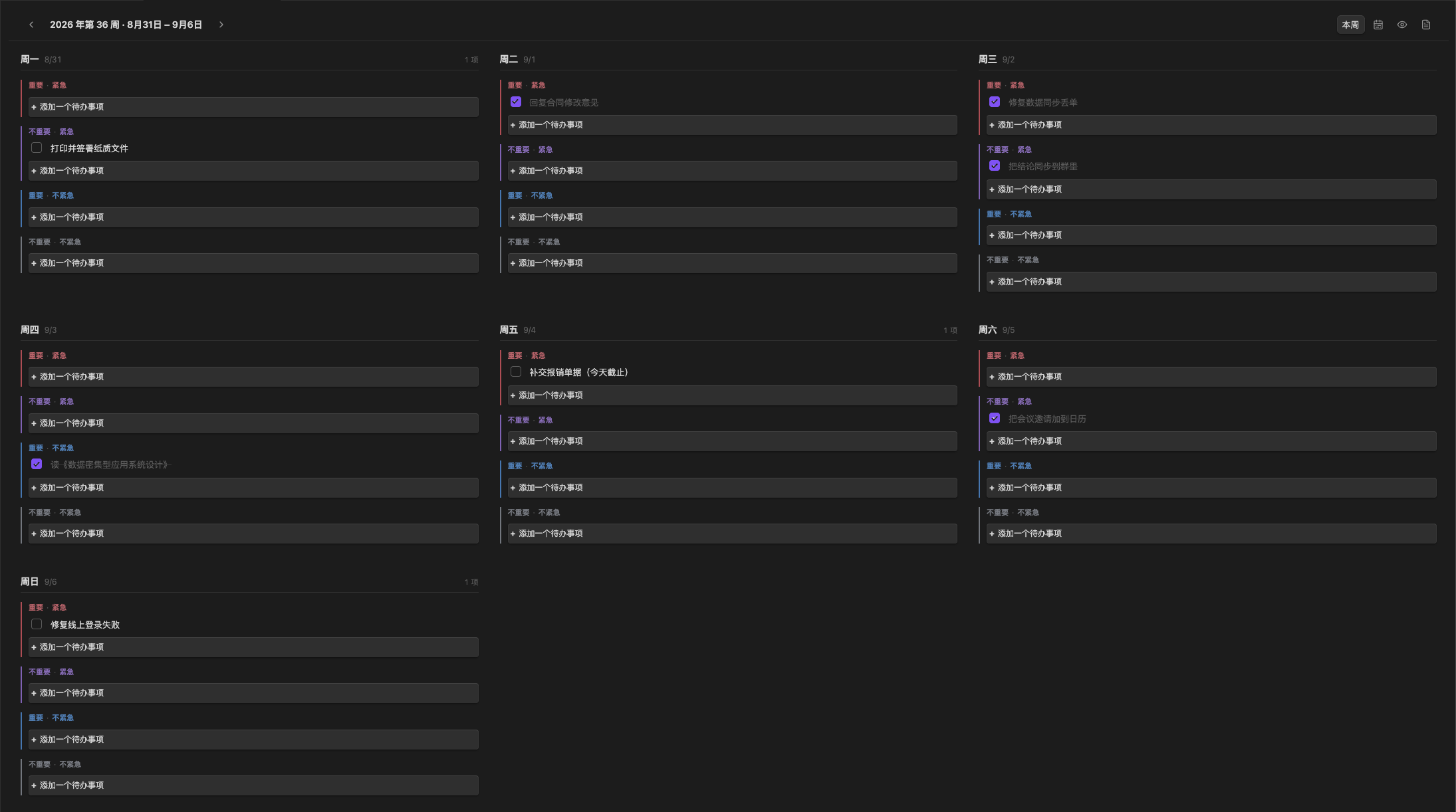
Each day holds four cells — important and urgent, not important but urgent,
important but not urgent, and neither. Every cell has a 添加一个待办事项 button
that appends a task and puts the cursor in it. Press Enter to commit, Esc to
discard; a task left empty is never written to the file.
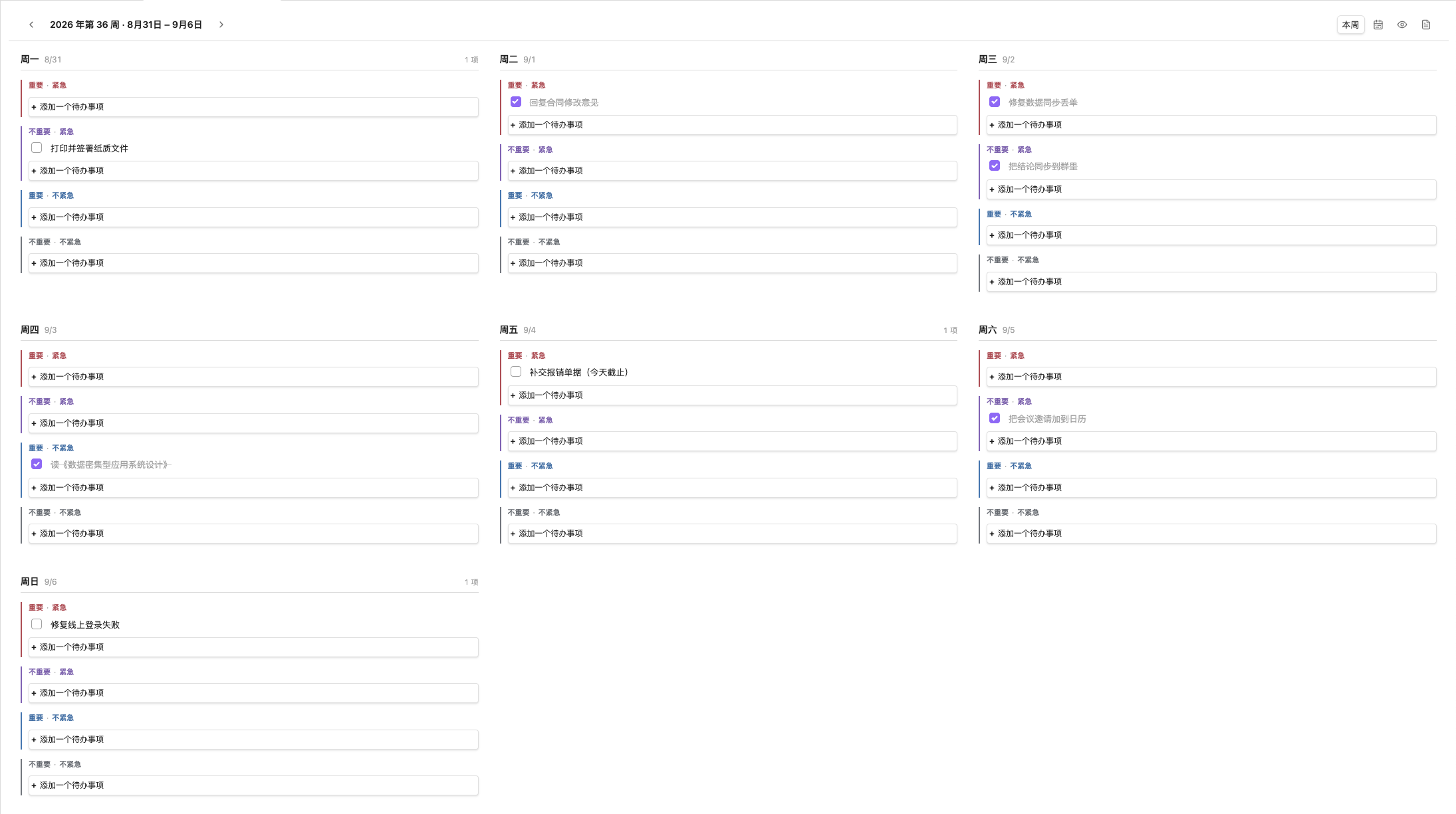
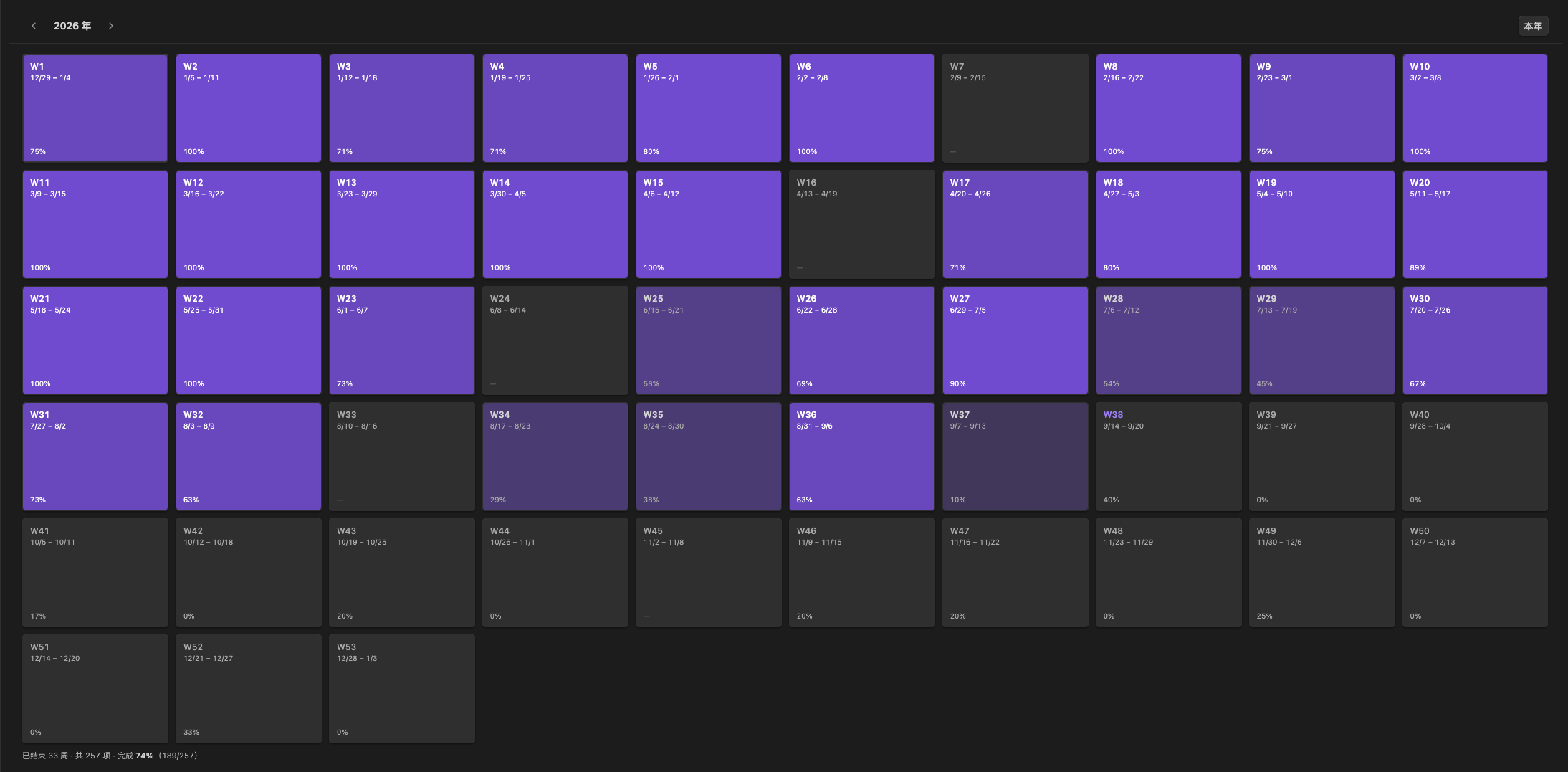
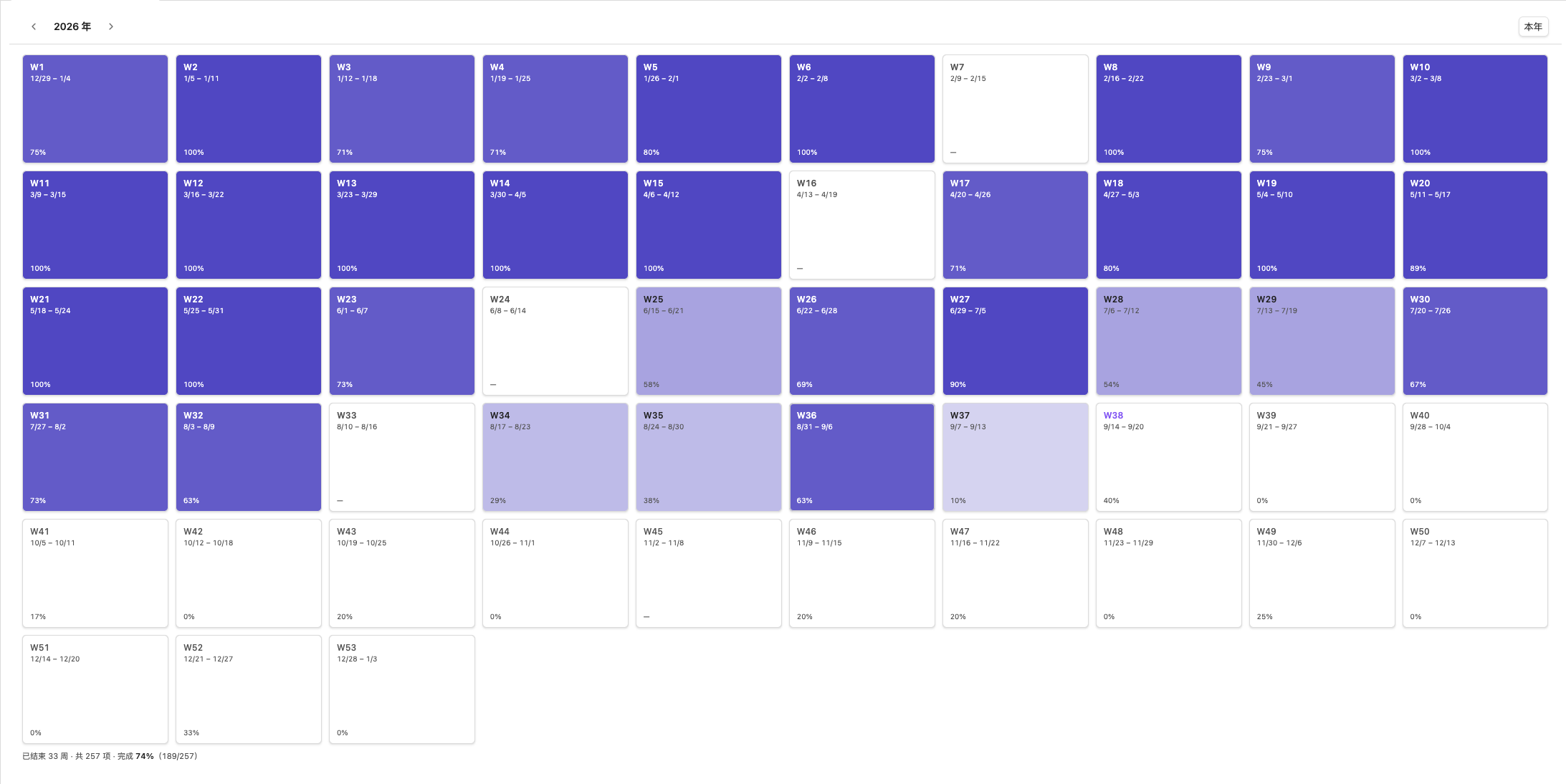
Both views follow your Obsidian theme; the screenshots above and below are dark and light respectively. Expand for the board in light mode and the year overview in dark mode:
Both views in the other theme
Jump to any week
Stepping a week at a time is fine for a week or two, and useless for reaching a
distant one. Open year overview shows the whole year: one tile per ISO week,
each with its week number, date range and completion rate. Select a tile to open
that week; ← → ↑ ↓ move between tiles and Enter opens one.
Fill depth is the completion rate, in six steps. Finished weeks are filled, weeks still to come are not, and weeks with no tasks show a dash. The year overview is a separate pane, so it can stay open beside the board while you work.
How tasks are stored
Standard Markdown checkboxes, one file per week, grouped in a folder per ISO year:
weekly-schedule/
  2025/
    2025-W52.md
  2026/
    2026-W01.md
    2026-W12.md
# 2026-W12

## 周一

### 重要 · 紧急
- [ ] 交周报
- [x] 修线上 bug

### 不重要 · 不紧急
- [ ] 整理书签
Cells with no tasks are omitted, so the file stays short. Because it is ordinary Markdown, these tasks are searchable, readable by other task plugins, editable by hand, and safe to sync or version. The plugin keeps the file and the board in step: editing the file outside the board reloads it, and an unsaved edit in the board wins over the file rather than being discarded.
The folder is the week's ISO year, not its calendar year, so the week of
2025-12-29 — week 1 of 2026 — lives in 2026/, matching how the year overview
presents it.
Files written before year folders
Files used to sit directly in the schedule folder (weekly-schedule/2026-W12.md).
The plugin still reads them from there, so an existing vault does not look empty
after updating. Run the Move week files into year folders command (or use the
button in settings) to move them. Only files in the schedule folder named like
YYYY-Www.md are touched, so notes you keep there are left alone.
Privacy
The plugin runs entirely offline. It makes no network requests, collects no telemetry, and reads and writes only its own files inside your vault.
Installation
Once listed in the community catalog, install it from Settings → Community plugins → Browse.
To install a release by hand, download main.js, manifest.json and
styles.css from the latest release and put them in:
<Vault>/.obsidian/plugins/weekly-schedule/
Then enable Weekly Schedule in Settings → Community plugins.
Requires Obsidian 1.5.7 or later.
Development
Requires Node.js 18+.
npm install
npm run dev        # rebuild main.js on change
npm run build      # type check + production build
npm run lint       # ESLint with Obsidian-specific rules
npm run deploy -- "<Vault>"   # build output into a vault, with verification
npm run deploy copies the three release files into the vault, then compares them
byte for byte and checks that the stylesheet still carries the current design's
markers. A half-finished copy is a real failure mode: an old styles.css next to a
new main.js renders the previous design with no error anywhere.
Reload the plugin after any change — Obsidian reads main.js only when a plugin
loads.
Layout
src/
  main.ts                        # Lifecycle, view registration, commands, vault events
  settings.ts                    # Settings interface, defaults, settings tab
  store.ts                       # Reading/writing week files, caching, debounced saves
  markdown.ts                    # Markdown <-> board conversion
  migrate.ts                     # Moving week files into year folders
  constants.ts                   # View types, quadrants, days, defaults
  types.ts                       # Data model
  ui/
    weekly-schedule-view.ts      # The board
    weekly-schedule-year-view.ts # Year overview
    inline-editor.ts             # Inline plain-text editing for task rows
  utils/
    date.ts                      # Week arithmetic and file naming
    helpers.ts                   # Shared helpers, including grid fitting
scripts/
  deploy.mjs                     # The npm run deploy helper
  diagnose-year-view.js          # Console snippet for troubleshooting layout
Both views size their grid from the pane they are in rather than from the window, because an Obsidian pane is often a sidebar or half a split.
Releasing
# 1. Bump the version. This rewrites manifest.json and versions.json for you, and
#    npm rewrites the version in package-lock.json along with package.json.
npm version 0.1.2 --no-git-tag-version
git add manifest.json versions.json package.json package-lock.json
git commit -m "release: 0.1.2"

# 2. Tag with the exact manifest version, no leading "v".
git tag 0.1.2

# 3. Push the branch and the tag, naming the tag explicitly. Do not reach for
#    --follow-tags here: it carries annotated tags only, so it skips a
#    lightweight tag like this one without any error or warning, the branch
#    lands, and no release is ever created.
git push origin main 0.1.2
Pushing the tag runs .github/workflows/release.yml, which builds the plugin and
creates a draft release with main.js, manifest.json and styles.css
attached. Review the draft, then publish it — the tag and manifest.json's
version must match exactly, and versions.json must map that version to
minAppVersion.
Getting listed in the community catalog
- Release at least one version and confirm the three release assets exist.
- Confirm
id,name,descriptionandauthorinmanifest.jsonare what you want shown publicly — the catalog entry is built from them, plusrepo. - Open a pull request against
obsidianmd/obsidian-releases
that appends one entry to
community-plugins.json:{ "id": "weekly-schedule", "name": "Weekly Schedule", "author": "xwtaidev", "description": "Plan and review your week inside Obsidian.", "repo": "xwtaidev/obsidian-weekly-schedule-plugin" } - Keep
idstable forever: it is the key Obsidian uses to update installed plugins. Changing it later breaks every existing installation.
Before submitting, check that LICENSE and README.md are present, that there are
no network calls or telemetry, and that minAppVersion is honest. The
obsidianmd/no-unsupported-api lint rule enforces that last one against
manifest.json, so lowering it without checking will fail npm run lint.
Why the settings tab is not declarative
The declarative settings API added in Obsidian 1.13 would put these options into
Obsidian's settings search, but it would raise minAppVersion to 1.13 and shut out
everyone on an older release. Two dropdowns do not justify that, so the tab uses
the imperative Setting API and the lint rule asking for the declarative one
reports a warning that is accepted on purpose.