Vault Intelligence
 cybaea5k downloads
Maintain your vault as a self-updating knowledge system by running AI agents that find gaps, audit and unify tags, and retrieve context based on similarity and explicit links via Graph RAG
- Overview
- Scorecard
- Updates98
Don't just query your vault. Maintain it.
Vault Intelligence is a different AI plugin for Obsidian. It transforms your vault into a dynamic, self-maintaining knowledge system. It goes beyond simple Q&A by introducing agents that maintain your vault's structure, retrieve information based on your explicit connections, and ground your knowledge in the real world.
Obsidian vaults naturally degrade. As facts change, your notes become outdated. As the vault grows, connections are forgotten and tagging becomes inconsistent. Standard AI plugins function as search engines for this static data.
Vault Intelligence functions as a maintenance system. It identifies gaps in your notes by cross-referencing your writing with live web searches. It retrieves information based on the explicit structural links you built, rather than just matching text. It audits your tags to connect notes to existing topics, proposing new ones when needed. It connects to external tools—like local scripts or databases—under strict cryptographic security.
- Frontier or local — your choice: Reason with Google Gemini (the recommended default), Ollama (local or Ollama Cloud), or any OpenAI-compatible server (OpenAI, OpenRouter, LM Studio, vLLM, and more). Embed notes with Gemini, Voyage AI, Ollama, any OpenAI-compatible server, or fully local Transformers.js.
- 100% offline capable: With Transformers.js embeddings and a local Ollama model, nothing ever leaves your device.
It is designed to keep your knowledge current, connected, and secure.
Vault Intelligence is free and open source.
Install
Vault Intelligence is published in the official Obsidian Community Plugins directory at https://community.obsidian.md/plugins/vault-intelligence — the fastest and safest way to install and to stay updated:
- Open Settings > Community plugins in Obsidian (select Turn on community plugins first if they are restricted).
- Select Browse, search for "Vault Intelligence", and select Install.
- Select Enable.
Prefer a manual install? Download main.js, manifest.json, and styles.css from the latest release into <your vault>/.obsidian/plugins/vault-intelligence/, then enable Vault Intelligence in Settings > Community plugins.
Why use Vault Intelligence?
Standard AI plugins retrieve text. Vault Intelligence is designed to actively maintain and update your knowledge base.
- Refresh outdated knowledge: Notes become obsolete as facts change. Ask the agent to read your existing files on a topic, run a live web search to find recent developments, and draft an update to bridge the gap between your archived notes and current reality.
- Retrieve context, not just text: Using Graph Retrieval-Augmented Generation (Graph RAG), the plugin reads the explicit links connecting your files and topics. It retrieves information based on how you structured your ideas, finding relevant concepts even if they use different terminology.
- Automate vault organisation: Maintaining consistent tags and links across thousands of files is unmanageable. The Gardener agent audits your notes against your topics, suggests new ones only when needed, and provides an actionable checklist of missing links to keep your taxonomy intact.
- Execute external tools securely: Connect local databases or scripts using the Model Context Protocol (MCP). To prevent unauthorised code execution, the plugin operates within strict cryptographic and environmental boundaries, requiring explicit approval before modifying any file.
See also Strategic Positioning and Competitor Comparison.
How It Works for you
To achieve this, we built Vault Intelligence around four distinct personas that act as stewards of your knowledge:
1. The Explorer (Finding the Hidden Threads)
Traditional search is a "bag of words." If you search for "automobile," it won't find notes about "cars." The Explorer understands meaning. By combining state-of-the-art semantic vector search with your graph's structural connections, it finds the invisible threads between your ideas. It knows that two notes are related not just because they share text, but because they share a conceptual sibling in your personal ontology. It brings serendipity back to your research. See the Explorer guide for hands-on steps.
2. The Researcher (Your Intellectual Partner)
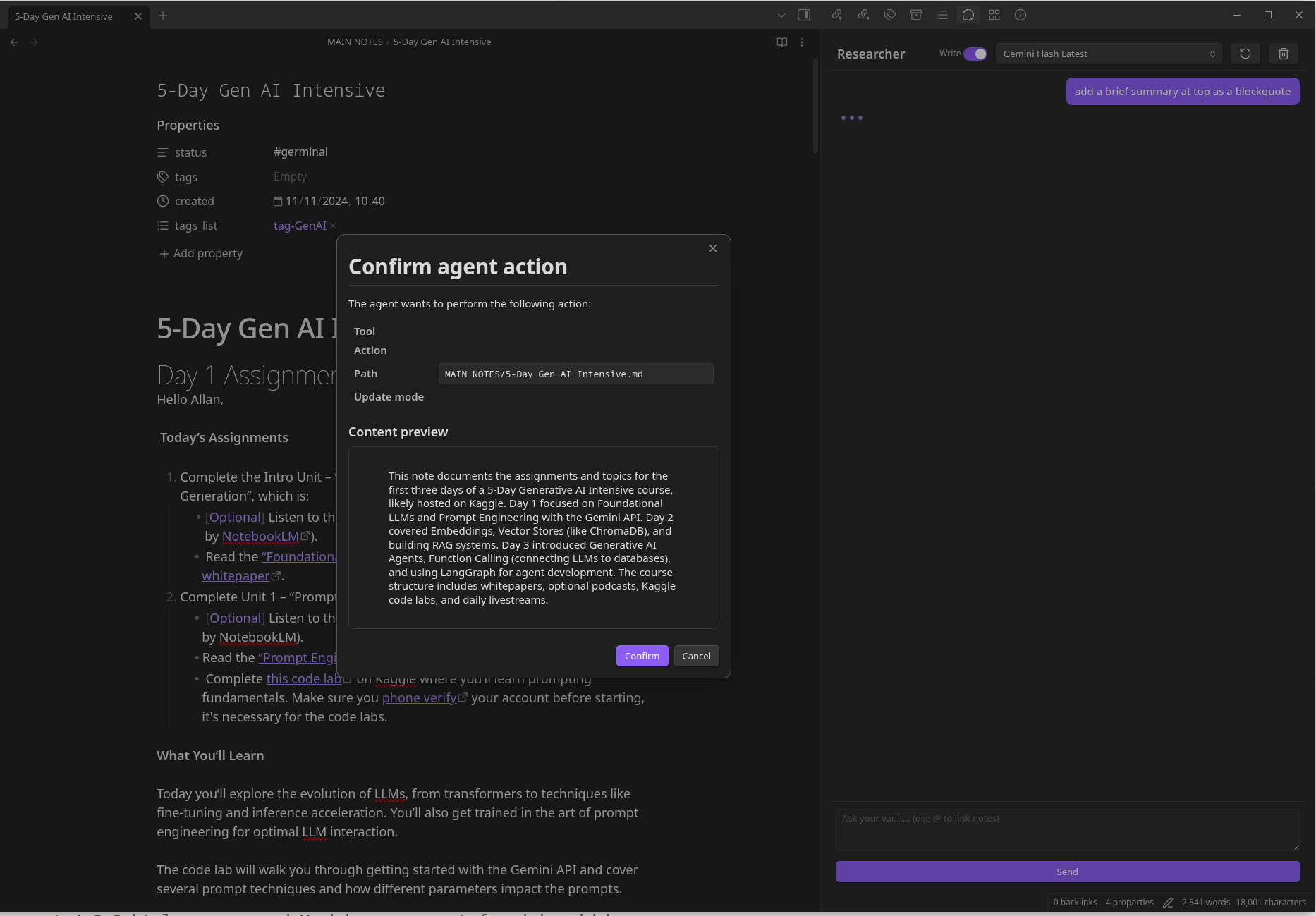
Imagine having a research assistant who has memorised every note you’ve ever written. The Researcher doesn't just answer questions; it grounds its reasoning entirely in your vault. If it needs to crunch numbers, it can write and execute Python code. If it needs to verify a real-world fact, it can search the web. But crucially, it is bound by your context. It reads your files, understands your specific terminology, and can even draft or update notes—always asking for your final approval via a "Trust but Verify" prompt before writing a single word. See the Researcher guide for hands-on patterns.
3. The Gardener (The Guardian of Your Graph)
A garden left untended becomes a jungle. The Gardener is a proactive agent that understands your personal ontology. It works in the background, analysing your notes to find missing tags, suggesting new conceptual links, and proposing structural improvements. It never alters your files silently. Instead, it generates an interactive "Gardening Plan" for you to review, approve, or reject. It takes the chore out of Personal Knowledge Management. See the Gardener guide for hands-on steps.
4. The Solver (Advanced Analysis in your Vault)
Words are only half the story. If you track habits, log expenses, or compile research data in Markdown tables, that information usually sits dead on the page. The Solver brings it to life. When faced with a complex analytical question, it doesn't just guess—it acts as your personal data scientist. It can read your structured data, write Python code, and execute it inside a secure sandbox to crunch numbers, calculate trends, and forecast outcomes right inside your chat window. It turns static logs into actionable insights. See the Solver guide with worked examples.
How It Works (The Technical Edge)
To make this seamless, Vault Intelligence uses a "Slim-Sync" Hybrid Architecture rather than acting as a standard LLM wrapper:
- Flexible Privacy (Local, Server, or Cloud): Choose how your vault is mapped. Use the default Gemini embeddings for unmatched multilingual support and mobile performance, or switch to Ollama, any OpenAI-compatible server, or 100% local WASM embeddings to ensure your raw notes never leave your device.
- Zero Sync Bloat: Full vector indexes are kept in your device's local IndexedDB, while only a feather-light blueprint is synced across your devices.
- Dynamic Context: An "Accordion" assembly system dynamically scales from reading full documents to just reading headers, ensuring the AI never hallucinates due to context overload.
- Rigorous Security: We implement a strict "Human-in-the-Loop" model with SSRF protection, command injection prevention, and cryptographically signed tool configurations. Read our Security and Robustness Standards for the full technical breakdown.
Security & Supply Chain Integrity
We adhere to industry-standard security and supply chain integrity practices:
- SLSA Build Provenance: Our build process generates cryptographically signed attestations for all release artifacts, ensuring build integrity.
- OpenSSF Scorecard: We monitor our security posture via the OpenSSF Scorecard.
- Automated Scanning: We use CodeQL and Renovate to identify and remediate vulnerabilities and outdated dependencies.
- Hardened Workflows: All CI/CD workflows are pinned to full commit SHAs and follow the principle of least privilege.
For more details, see our Security Policy and Security and Robustness Standards.
Documentation
- Getting Started: Install from the Community Plugins directory, connect Gemini, Ollama, or any OpenAI-compatible provider, and run your first query in five minutes.
- How-To Guides: Master specific workflows like data analysis and context management.
- Reference & Troubleshooting: Detailed configuration options.
- Explanation: Understand the Hybrid Search and GARS engine.
Network Connectivity
To provide its features, Vault Intelligence may connect to several external or local services depending on your configuration:
- AI Providers (Inference & Embeddings):
- Google Gemini: Connects to
generativelanguage.googleapis.comfor chat, embeddings, and model management. - Voyage AI: Connects to
api.voyageai.comfor high-performance embeddings. - Ollama: Connects to your local or remote Ollama instance (default:
http://localhost:11434), including Ollama Cloud (ollama.com). Supports custom HTTP headers for authentication. - OpenAI-compatible endpoints: Connects to any OpenAI Chat Completions server you configure, such as the Kilo Gateway (
ai-gateway.kilo.ai), LM Studio, llama.cpp, vLLM, OpenRouter, or the OpenAI API. Supports custom HTTP headers for authentication.
- Google Gemini: Connects to
- Local Model Support:
- HuggingFace & JSDelivr: When using local embeddings (Transformers.js), the plugin downloads model weights and WASM binaries from
huggingface.coandcdn.jsdelivr.net.
- HuggingFace & JSDelivr: When using local embeddings (Transformers.js), the plugin downloads model weights and WASM binaries from
- Agent Capabilities:
- Web Grounding / URL Reader: If the Researcher agent is asked to search the web or read a URL, it will connect to the specific addresses provided (e.g., via Google Search or direct URL access).
- MCP Servers: Connects to external Model Context Protocol servers via Stdio (local binaries) or HTTP/SSE as configured in your settings.
- Plugin Updates & Documentation:
- GitHub API: Connects to
api.github.comto fetch the latest release notes and update information.
- GitHub API: Connects to
WebAssembly (WASM) Disclosures
To deliver high-performance, local-first AI features directly inside the desktop application without requiring native, platform-dependent installation binaries, this plugin utilises standard, open-source WebAssembly (WASM) modules.
The 9 referenced .wasm files originate entirely from our upstream production dependencies:
- ONNX Runtime Web (
onnxruntime-webvia@xenova/transformers): Handles local tokenization and vector embedding generation on your CPU. The multiple.wasmreferences represent different pre-compiled execution targets (e.g., base WASM, SIMD-accelerated, and multi-threaded variants) that the engine dynamically switches between to optimise performance based on your computer's hardware. - Sharp Graphics Engine (@img/sharp-wasm32): Carried strictly as a transient sub-dependency of
@xenova/transformersv2. While the vault intelligence plugin only handles local text tokenization and embedding generation, the upstream Hugging Face framework bundles sharp by default to support image vision architectures. It remains entirely unused by our production plugin code. See also issue #566. - Orama Search Engine (
@orama/orama): Powers ultra-fast, local full-text keyword slicing and indexing.
No custom or un-audited WASM modules are packaged or compiled within this repository. All underlying source code for these execution environments is fully public and maintained by their respective open-source foundations.
Contributing
We welcome contributions from developers, designers, and prompt engineers!
🛠️ Developers: Please read our Architecture & Standards Guide (ARCHITECTURE.md) and our Security and Robustness Standards (security-and-robustness.md) before submitting a pull request to understand our Web Worker constraints, strict SSRF protections, and internal API contracts.
See CONTRIBUTING.md for general guidelines.
License: MIT