Nous
 Andy Ho1k downloads
Turns meetings, voice notes, photos, and PDFs into a tagged, linked knowledge base - built as context your AI assistant can use.
- Overview
- Scorecard
- Updates100

Nous
Nous — Greek νοῦς, "mind." Capture anything. Get tagged, linked notes back. You run no command.
Install · Tutorial · Docs · Issues · Changelog · Contributing
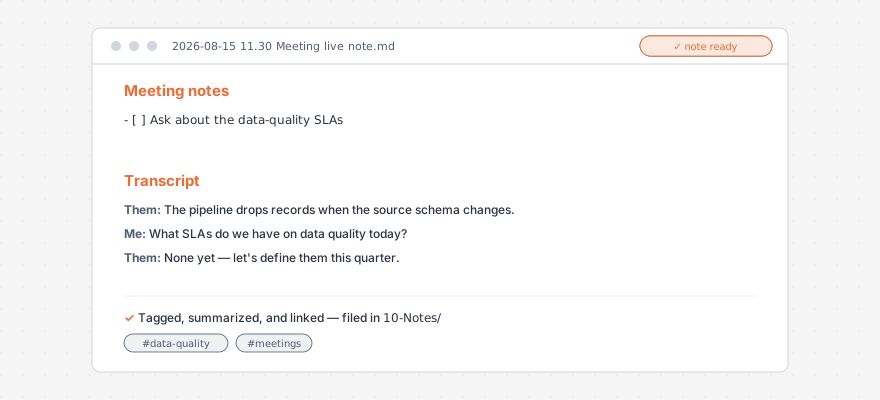
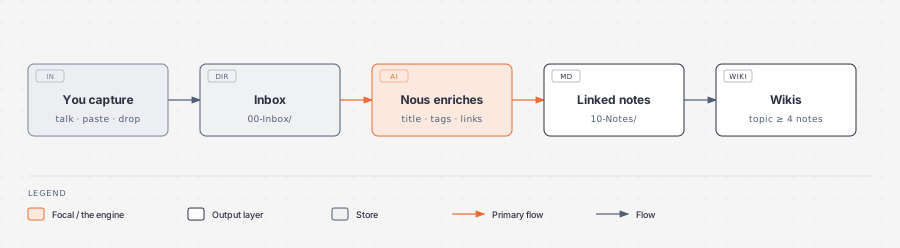
Nous turns anything you capture into a tagged note. A capture can be a thought, a voice memo, a call, a photo, or a PDF.
Nous can write your notes through the Claude Code app, a direct API key, or a free local model in Ollama. Only local speech-to-text and Ollama keep your notes on your machine. The Claude Code app and a direct API key both send your notes to that provider.
Tags and links turn scattered captures into one connected picture, with no manual sorting. A tag groups every note on the same topic. A link connects a note to the notes near it, so you can trace an idea across time. Once a topic has enough notes, Nous writes one wiki page that pulls them together, and keeps it current as you capture more.
Notes get a clean, editorial look by default - see the Nous look. You can also point Claude Code at your vault, so every coding project gets your tagged notes as background context, for free - why this works.
Works on: Mac, Windows, and Linux computers. Meeting capture needs a Mac.
Get started
Just go through the wizard. It walks you through every step below.
1. Install Nous.
- Open Obsidian.
- Go to Settings, then Community plugins.
- Turn on community plugins.
- Click Browse.
- Search for "Nous."
- Click Install, then click Enable.
2. Go through the wizard.
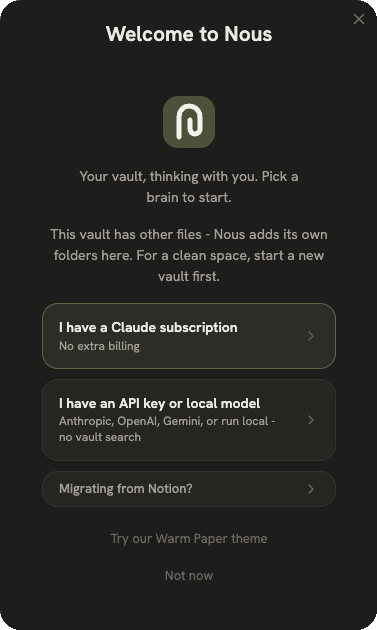
A wizard opens on its own. Follow it, screen by screen.
- Pick how Nous writes your notes. Choose a Claude subscription, an API key, or a free local model.
- The wizard offers two more setups: voice notes and meeting capture. Each needs one click to install. You can skip both for now and finish them later, in Settings → Nous.
3. Capture something.
- Click the microphone icon for a voice note.
- Click the waveform icon for a meeting. Mac only.
- Drop any other file into the
00-Inboxfolder.
4. Check your note.
Wait a few seconds. Open the 10-Notes folder. Your new note is there,
tagged and linked to related notes.
Note: Obsidian must stay open for Nous to work. If Obsidian is closed, a
new capture waits in 00-Inbox until you open it again.
How it works
- Voice notes turn to text in one of two ways. With a Gemini or OpenAI key, Nous needs no extra install. Without a key, whisper.cpp does the work on your Mac instead, and your voice never leaves your computer. This way needs a two-click install.
- Meeting capture uses a small helper program,
nous-recorder. It needs one click to install. A live note opens while Nous records. When you stop, an online call becomes aMe:/Them:dialogue. An in-person meeting becomes one plain transcript. - Privacy. Nous sends only your captured notes and tag names to the provider you picked. Local mode sends nothing anywhere. Nous collects no usage data.
- Limits. In a group call, Nous shows every other speaker as one
Them:voice. Meeting capture needs macOS 15 or later. Live voice transcription is a beta feature and needs an OpenAI key.
License
MIT — see LICENSE.