Nested Ordered Numbering
 spark142 downloads
Create and maintain hierarchical plain-text numbering with a trailing period at every depth.
- Overview
- Scorecard
- Updates4
Wiki · Usage · Development · Publishing · Issues
Create and maintain plain-text hierarchical numbering in Obsidian with a required trailing period at every depth.
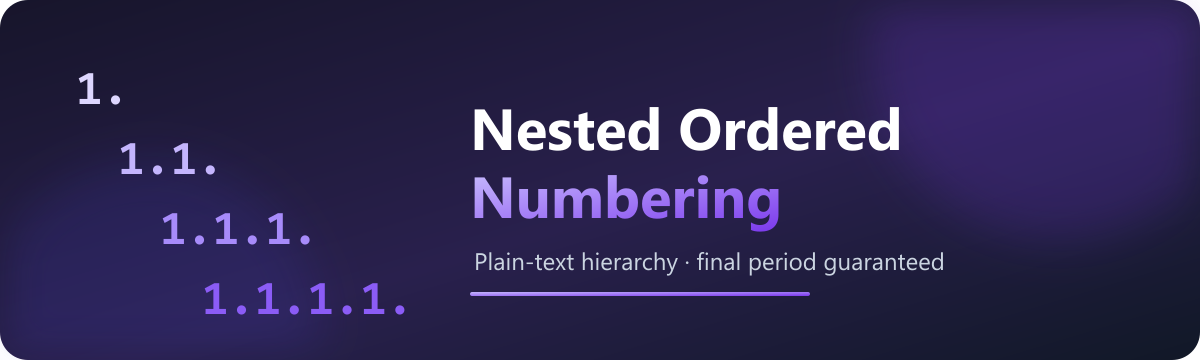
1. First item
  1.1. Child item
    1.1.1. Grandchild item
  1.2. Another child
2. Second item
Unlike standard Markdown ordered lists, this plugin owns the entire numeric prefix.
1.1. and 1.1.1. are treated as text numbering rather than Markdown list markers.
Why this plugin?
Markdown only recognizes a single integer such as 1. as an ordered-list marker.
Nested Ordered Numbering manages the complete hierarchy as readable plain text,
keeps the required final period at every depth, and recalculates the surrounding
block in one undoable editor transaction.
Features
- Always emits
1.,1.1.,1.1.1., and deeper forms with a final period. - Enter creates the next item at the same depth when the current item has content.
- Enter on a prefix-only item such as
1.3.removes the prefix and leaves one plain blank line, so the next input can be ordinary text or a Markdown heading. - Tab indents the current item or selected subtree.
- Shift+Tab outdents a subtree; at the root it converts the item to plain text.
- Multi-line selections are supported.
- Insert, delete, and renumber commands update the related contiguous block.
- Blank lines may separate items inside one numbered block; ordinary text still starts a new block.
- Each operation uses one editor transaction, so one undo restores the entire edit.
- Recognized numbering is handled before conflicting Outliner keymaps.
- Legacy four-space or tab-indented blocks normalize automatically.
- Live Preview neutralizes Obsidian's Markdown-list and indented-code offsets on recognized lines, so the first, second, and deeper Tab levels stay uniform.
Fixed-width hierarchy layout
Each additional numeric component adds two visible characters (.1). The plugin
therefore uses two leading spaces per hierarchy level. The combined result moves
the content start by exactly four columns per level:
1. text             content column 3
  1.1. text         content column 7
    1.1.1. text     content column 11
      1.1.1.1. text content column 15
Run Renumber nested ordered block on an existing block to normalize older four-space indentation immediately.
Obsidian normally treats 1. as a Markdown list marker and four leading spaces
as a list continuation or code block. styles.css and a parser-scoped editor
decoration remove only those visual offsets from recognized numbering lines.
Keyboard controls
| Key | Action |
|---|---|
| Enter | Create the next sibling; on a prefix-only item, exit numbering |
| Tab | Indent the item/selected subtree |
| Shift+Tab | Outdent, or remove numbering at root |
| Ctrl+Z | Undo the complete operation |
Ctrl+P is Obsidian's Command Palette shortcut. Open it and search for
Nested Ordered Numbering to run the same Insert, Delete, and Renumber commands.
To avoid conflicts, the public plugin does not claim default shortcuts. Assign your
preferred keys under Settings → Hotkeys; Ctrl+Alt+N/D/R are suggested choices.
Parser contract
The trailing period and following whitespace are mandatory:
^[\t ]*(\d+(?:\.\d+)*\.)[\t ]+
Recognized: 1. item, 1.1. item, 12.3.7. item
Ignored: 1 item, 1.1 item, 1.1.1 item
Installation
Community directory
This section becomes applicable after the plugin is accepted into the Obsidian Community directory.
- Open Settings → Community plugins → Browse.
- Search for Nested Ordered Numbering.
- Select Install, then Enable.
Manual installation
- Create
.obsidian/plugins/nested-ordered-numbering/in a test vault. - Copy
main.js,manifest.json, andstyles.cssfrom a matching GitHub release. - Reload Obsidian and enable the plugin under Community plugins.
For screenshots, detailed examples, troubleshooting, and marketplace information, visit the project Wiki.
Privacy and security
Nested Ordered Numbering is local-only. It has:
- no network requests;
- no telemetry or analytics;
- no accounts, payments, or advertising;
- no access to files outside the active Obsidian vault;
- no self-update or dependency-install behavior at runtime.
Development
Requirements: Node.js 22.13+ and pnpm 11.
pnpm install
pnpm test
pnpm lint
pnpm build
pnpm release:check
main.js is generated locally and intentionally excluded from the source branch.
Each GitHub release publishes the built main.js together with manifest.json
and styles.css, which are the files Obsidian installs.
See Development, Usage, and Publishing for details.
Release status
Release 0.3.4
is the current Community directory submission candidate. Its release assets are
rebuilt from source by GitHub Actions. Run the release gate before every future
tag as described in Publishing.