Knowledge Atlas
 Eason38467269 downloads
Explore every Markdown note in your vault as an interactive, searchable knowledge map.
- Overview
- Scorecard
- Updates5
Knowledge Atlas
Turn your Obsidian vault into a living, interactive knowledge galaxy.
English · 简体中文
Knowledge Atlas is a visual navigation and review plugin for Obsidian. It reads Markdown files through Obsidian's native API and presents the vault as an animated galaxy, a structured tree, and a set of activity and knowledge-health panels. It does not require Dataview, generated index notes, or a network service.
Availability: Knowledge Atlas is available from Obsidian's Community Plugins directory. Manual installation from GitHub Releases is also supported.
Screenshots
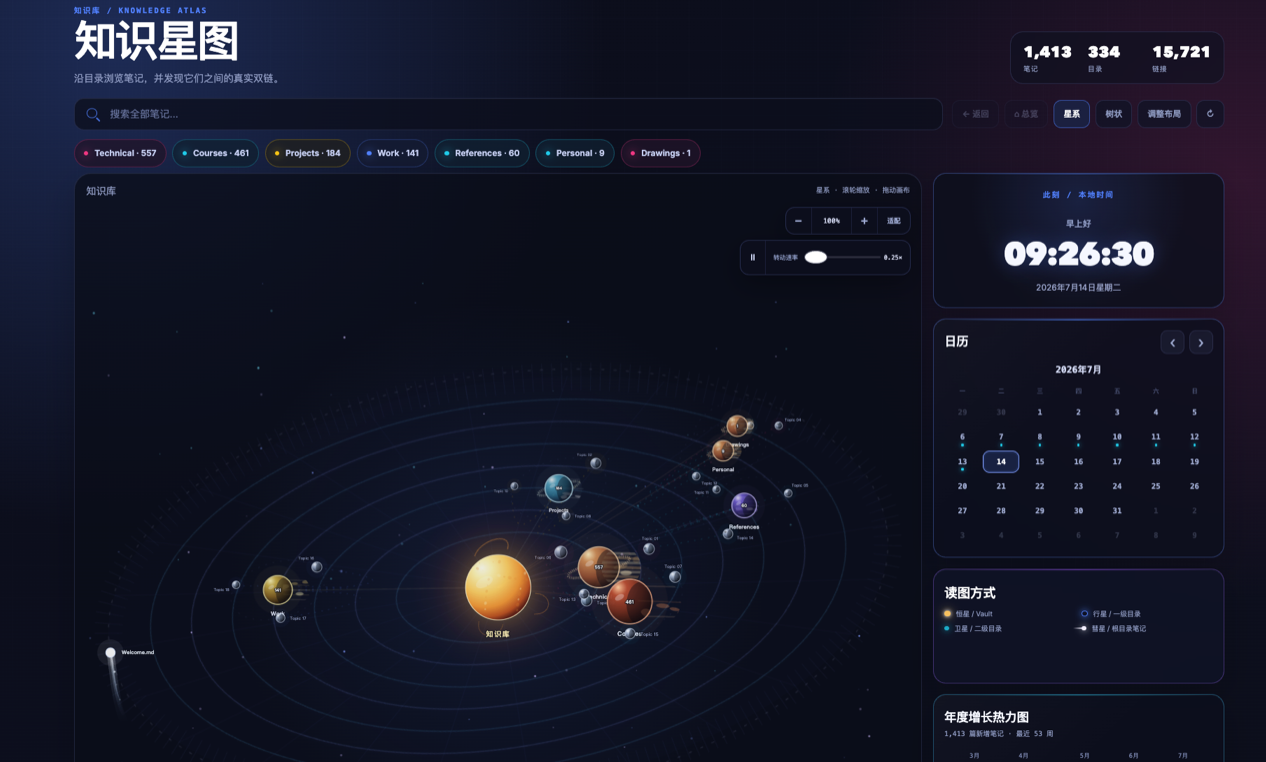
Galaxy overview
Tree view
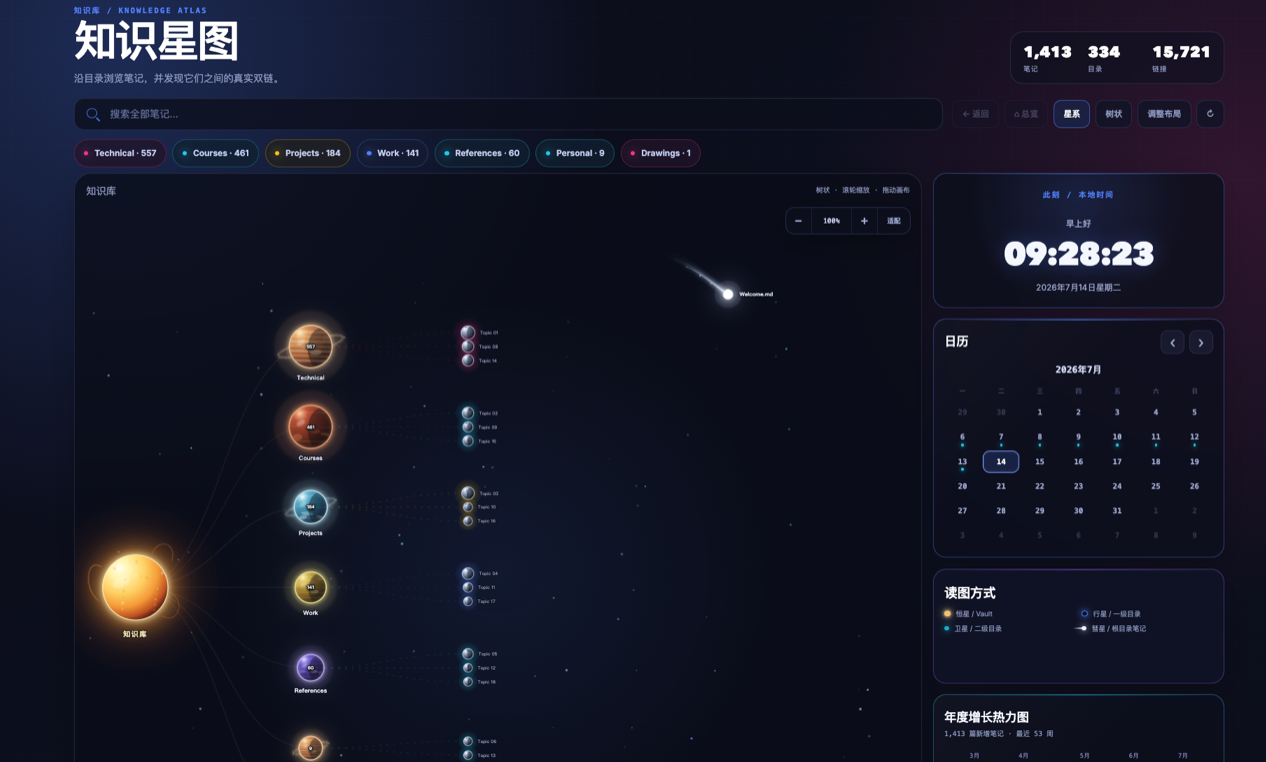
The screenshots use anonymized labels. Knowledge Atlas never changes note names to render the atlas.
Highlights
| Area | What it provides |
|---|---|
| Galaxy navigation | The vault is a star, top-level folders are planets, and second-level folders are moons. Node size reflects the amount of knowledge below it. |
| Celestial motion | Mercury-to-Neptune period references with perceptual time compression, smooth revolution and self-rotation, adjustable speed, hover-to-pause inspection, atmospheric shading, rings, and a soft solar corona. |
| Root-note comet | One root-level Markdown note becomes a comet. The selection is stable during the day and can rotate on another day; no special filename is required. |
| Focused satellites | The overview shows at most three representative second-level folders per planet on one readable moon track; drill down to see the rest. |
| Tree and drill-down views | Switch to a readable hierarchy, enter folders, inspect note nodes, and follow real links resolved by Obsidian. |
| Search and recency | Search the full vault, open notes directly, and browse recently updated notes. |
| Activity insights | A conventional 53-week heatmap, 12-month growth trajectory, weekday rhythm, local clock, and activity-aware calendar. |
| Knowledge health | Find orphan notes, unresolved links, and notes that have not been updated for a configurable period. |
| Review workflow | Open every note created on a heatmap day and receive a stable daily review of three older notes. |
| Flexible workspace | Drag and resize the canvas and panels, save the layout, reset it, zoom, pan, and fit the graph to the viewport. |
| Internationalization | Chinese and English interfaces, selected from the plugin settings. |
How the galaxy is organized
Vault                         → star
├── Top-level folder          → planet
│   ├── Second-level folder   → moon
│   └── Notes and subfolders  → influence celestial size
└── Root-level Markdown note  → daily stable comet selection
The overview intentionally stops at the second folder level so a large vault remains readable. Enter a folder or use search to reach deeper folders and individual notes.
Installation
Install the packaged version
Download
knowledge-atlas-1.11.4.zip.Extract it. The archive contains a folder named
knowledge-atlas.Copy that folder into your vault:
<your-vault>/.obsidian/plugins/knowledge-atlas/In Obsidian, open Settings → Community plugins.
Select Reload installed plugins if Knowledge Atlas is not shown, then enable Knowledge Atlas.
Build from source
Clone the repository, then build the release file:
npm install
npm run build
Create <your-vault>/.obsidian/plugins/knowledge-atlas/ and copy these generated/runtime files into it:
main.js
manifest.json
styles.css
versions.json, README.md, and LICENSE are useful for distribution but are not required at runtime.
Open and use the atlas
- Select the Knowledge Atlas ribbon icon.
- Or run Knowledge Atlas: Open atlas from the command palette.
- Select a planet or moon to drill into a folder.
- Select a note node, search result, heatmap day, health result, or review card to open the corresponding note.
Canvas controls
| Control | Action |
|---|---|
| Mouse wheel | Zoom in or out |
| Drag empty canvas | Pan the graph |
− / + |
Adjust zoom |
| Fit | Fit the current graph to the canvas |
| Play / pause | Start or stop celestial motion |
| Speed slider | Set motion from 0.25× to 3× |
| Hover a celestial body | Pause the system for inspection |
| Galaxy / Tree | Switch between orbital and hierarchical layouts |
| Arrange layout | Move and resize the canvas and dashboard panels |
Settings
- Excluded folders — comma-separated vault paths or prefixes that should not appear in the atlas.
- Maximum folders — maximum folder nodes rendered in one view.
- Maximum notes — maximum note nodes rendered in one view.
- Recent notes — number of recently modified notes shown in the panel.
- Open notes in a new tab — keep the atlas open when navigating to a note.
- Interface language — follow the system language or use Chinese/English.
- Open Atlas on startup — open Knowledge Atlas when the Obsidian workspace loads.
- Stale note threshold — number of inactive days before a note is considered stale.
Custom panel positions, sizes, stacking order, and motion speed are saved in the plugin settings. Compact screens automatically fall back to a responsive layout.
Dates and activity data
Knowledge Atlas prefers a note's created, created_at, or date-created frontmatter value. When those properties are unavailable, it falls back to the file creation time reported by Obsidian. Frontmatter is therefore optional.
Heatmaps and trajectories follow the conventional chronological direction: older activity is on the left and newer activity is on the right.
Performance and accessibility
- Celestial positions stay on a 60 FPS
requestAnimationFramepath while mutable orbit data is reused instead of rebuilt every frame. - Static stars and spokes are batched into compact SVG paths, and redundant DOM writes are skipped.
- Hidden atlas views suspend animation and defer refresh work until they become visible again.
- Blur, shadows, micro-textures, and secondary satellite links are reduced while moving, then restored immediately when paused or hovered.
- Tree mode pauses orbital animation automatically.
- The operating system's reduced-motion preference disables automatic animation.
- The plugin supports desktop and mobile according to the manifest, while the full free-layout experience is most comfortable on larger screens.
Privacy
Knowledge Atlas runs locally inside Obsidian. It does not upload vault content, call external APIs, create generated index notes, or require a third-party database. Search, links, activity, and health checks are derived from Obsidian's local vault and metadata cache.
Development and releases
The readable source is in src/main.js. The production bundle is generated with esbuild and is attached to GitHub Releases rather than tracked in the repository.
Before publishing a version to GitHub Releases or submitting it to the Obsidian Community Plugins directory:
- Update
versioninmanifest.json. - Add the version mapping to
versions.json. - Run
npm run lintandnpm run build. - Verify the generated bundle with
node --check main.js. - Test the plugin in Obsidian and check developer errors.
- Create a GitHub release whose tag exactly matches the manifest version.
- Attach
main.js,manifest.json, andstyles.cssto the release.
Contributing
Issues and focused pull requests are welcome. When reporting a visual or performance issue, include the Obsidian version, operating system, approximate vault size, layout mode, and a screenshot with private note names removed.
License
MIT © 2026 Eason38467