Dot Navigator
 jeansordes1k downloads
A Dendron-like hierarchical note management system for your vault.
- Overview
- Scorecard
- Updates141
A hierarchical note management system with Dendron-like features.
This tool brings hierarchical note management capabilities to your vault, inspired by Dendron. It allows you to organize your notes in a tree-like structure, making it easier to navigate and manage large knowledge bases.
(While Dot Navigator maintains some compatibility with Dendron-structured notes, future compatibility is not guaranteed. It is primarily intended for use with notes in your vault, utilizing a Dendron-like structure)
Installation
Until the plugin is officially released, you can install it through BRAT (Beta Review and Testing)
- Install the BRAT plugin if you don't have it already
- Install Dot Navigator using BRAT
Features
- Hierarchical note organization with a tree-like interface
- Instant loading with IndexedDB caching, the tree view loads instantly even for large vaults by caching the tree structure
- Performance optimized for very large vaults, meaning you can expand all 10K notes from your vault at once on your phone, it will still run and scroll smoothly 👌
- Designed and optimized for mobile before desktop with lazy loading of suggestions for better mobile performance
- Rule-based suggestions with an in-app rules editor in settings — define patterns and children, preview matches, reorder rules, and import/export JSON so you can scaffold structures before the notes exist
Hierarchical suggestions from dotted children - when a rule specifies children like
["foo.bar"], it creates nested suggestion nodes where "foo" contains "bar" as a child, allowing for deeper scaffolding of note hierarchiesDouble-click to create notes from suggestions - quickly create suggested notes by double-clicking on them in the tree view
Persistent expanded state across sessions (the tree view will remember which nodes are expanded or collapsed when you close/reopen the app)
Horizontal scrolling support for deeply nested structures (you can write very long path notes and scroll horizontally to see the full path of the note)
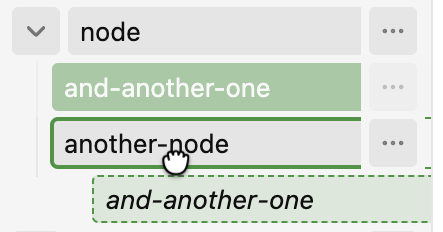
Drag-and-drop to move files, folders, and virtual nodes directly in the tree (children are moved/renamed along with their parent). Press Escape while dragging to cancel.
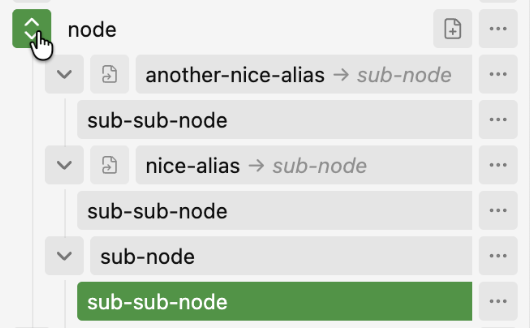
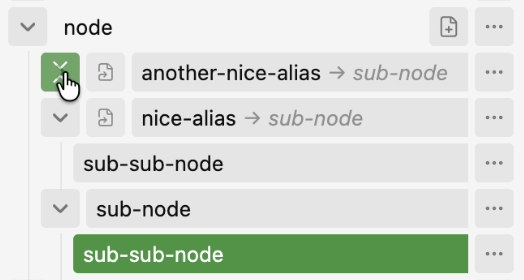
- Folder rows behave like expand/collapse controls — hover a folder row to reveal its chevron; click the title to toggle, or double-click the title to expand or collapse all descendants (same as double-clicking the chevron). Rename folders from the context menu.
- Expand or collapse all descendants at once by double-clicking a node's chevron or folder title, or via the context menu
- CMD/Ctrl+click to open a file in a new tab
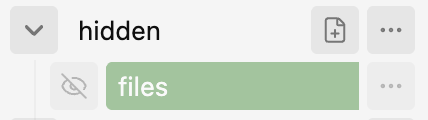
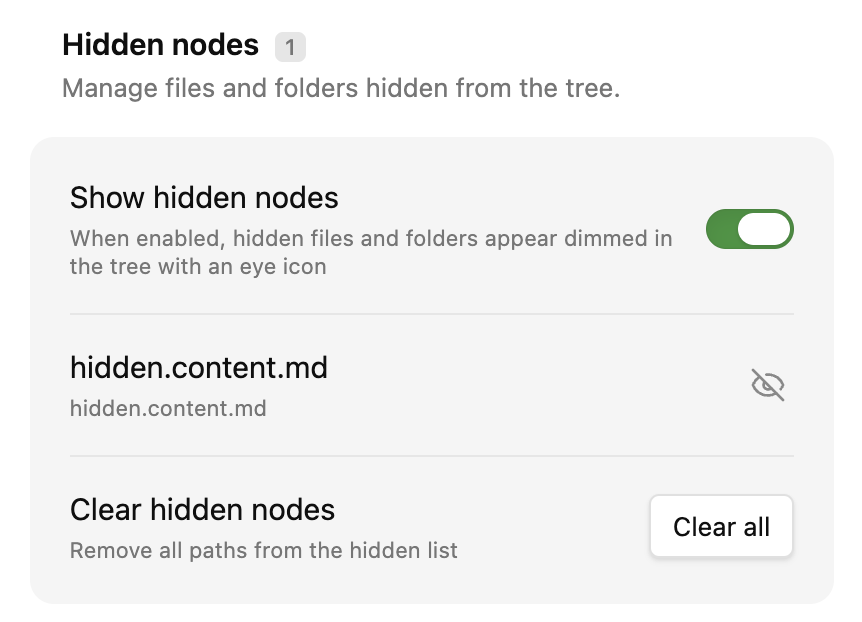
- Hide files and folders from the tree - hide any node from the context menu to declutter your tree. A header toggle lets you reveal hidden nodes (shown dimmed, with a crossed-eye icon that turns into an open eye on hover to reveal them again), and they can be managed or cleared from the settings. Dot-prefixed filesystem items (
.git/,.gitignore,.obsidian/, etc.) are included in the tree and hidden by default; use the header eye toggle or Settings → Dot Navigator → Hidden nodes to reveal them. You can also define glob hide patterns (e.g.archive/**).

- Redirect shortcut stubs - create
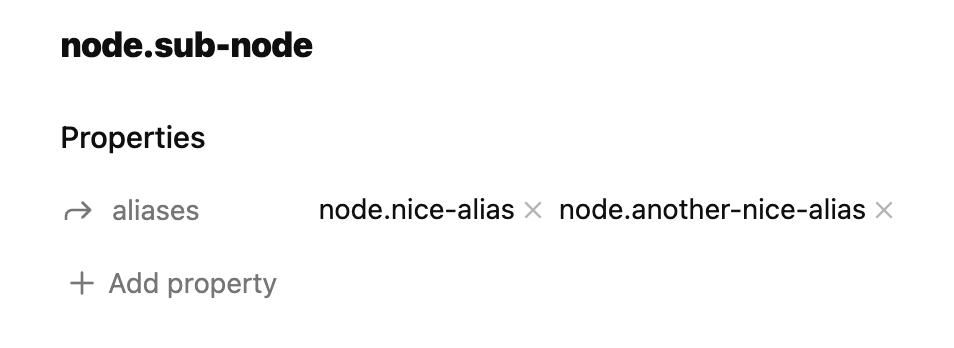
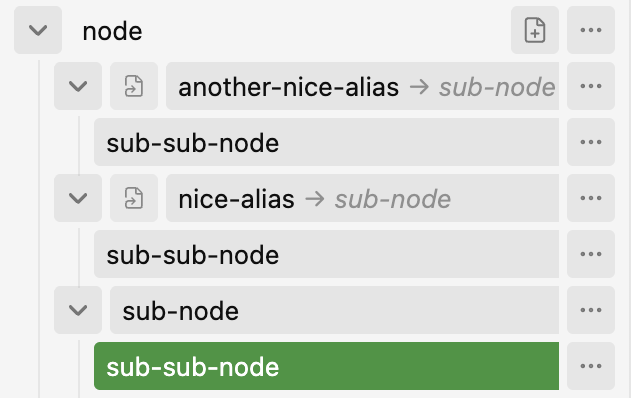
.mdstub files withredirectfrontmatter to place a note at alternate locations in the tree. Shift+drag (or Alt+Cmd/Ctrl+drag) onto another node to create a stub; drag the stub row to move it; delete stubs from the context menu without deleting the target note. Title click opens the redirect target; use the symlink icon to open the stub file.
The redirect value accepts a vault path, a note name, or a wikilink. Ambiguous names follow Obsidian wikilink resolution relative to the stub file.
---
redirect: notes/target.md   # full vault path
redirect: notes/target      # path without extension
redirect: target            # note name (no folder, no .md)
redirect: "[[My Note]]"     # wikilink
---
- UI for renaming a note and its children with a nice UI
- Undo the last rename operation that was done in the rename dialog of the plugin (through the UI, with Cmd/Ctrl+Z when undo is available, or with a command dedicated for that). The dialog auto-closes when the rename finishes and restores undo state when reopened.
- Customizable context menus (click the "…" button or do a right click on a file or folder) - add your own commands and drag to reorder menu items
- Easy access to global commands in UI
- Support for all file types with appropriate icons and extensions
- Theme-aware styling with proper dark mode support
Child count badges — optionally show direct children, total descendants, or both on tree rows (configurable in settings under Tree display)
YAML title support - displays custom titles from frontmatter instead of filenames (e.g.
prj.mdwith the propertytitle = "Projects"will be displayed asProjectsin the tree view)
- Internationalization support, based on the language set in the settings, defaulting to English. (As of now, only English and French 🇫🇷 are supported, you can request a new language by creating an issue)
Rule Configuration
Dot Navigator supports rule-based suggestions that automatically suggest virtual child notes and folders for existing notes or folders. This allows you to scaffold complete hierarchies before they exist.
Setting Up Rules
- Open Dot Navigator settings in Obsidian
- Go to the Note suggestion schema section
- Add rules with the in-app editor, or Import JSON to load an existing configuration
Each rule is edited as a card with pattern, exclude, and children fields. You can preview which notes and folders match a pattern, drag to reorder rules, and use View JSON to copy or back up your configuration.
If you previously used a dot-navigator-rules.json file in your vault, rules are migrated automatically into plugin settings on first load after upgrading.
Rule Syntax
Each rule object can have these properties:
pattern(required): String or array of strings defining which note or folder paths to matchexclude(optional): String or array of strings defining paths to exclude from matchingchildren(required): Array of strings defining suggested child paths. A trailing/marks a folder.
Pattern Syntax
Dot Navigator uses enhanced glob patterns with special wildcards:
*matches any sequence of characters within a single path segment (stops at dots)**matches any sequence of characters across multiple path segments (matches dots)
For more complex pattern matching, you can use regex patterns by prefixing with /.
Examples
[
  {
    "pattern": ["prj.*"],
    "children": ["roadmap", "ideas", "issues", "architecture.backend", "architecture.frontend"]
  },
  {
    "pattern": ["work.**"],
    "exclude": ["work.archives"],
    "children": ["notes", "tasks"]
  },
  {
    "pattern": ["Projects/**"],
    "children": ["brief", "assets/", "research/sources/", "research/summary"]
  },
  {
    "pattern": ["/^blog\\.2025\\.[0-9]$/"],
    "children": ["draft", "published"]
  }
]
What this does:
- Files matching
prj.*(likeprj.frontend,prj.backend) will suggest childrenroadmap,ideas,issues, and hierarchical childrenarchitecture.backendandarchitecture.frontend - Files matching
work.**(likework.tasks,work.2024.tasks,work.deep.nested) will suggestnotes,tasks(exceptwork.archives) - Folders matching
Projects/**will suggestbrief.md, anassets/folder, nestedresearch/sources/folders, andresearch/summary.md - Files matching
/^blog\.2025\.[0-9]$/(regex for single-digit months) will suggestdraft,published
Hierarchical Children:
For dotted children like "architecture.backend", the plugin creates nested suggestion nodes. In the tree view, you'll see:
architecture/(intermediate folder-like node)backend(clickable suggestion that createsbackend.md)
You can create deeply nested hierarchies by using multiple dots, such as "a.b.c.d".
Folder children:
folder/suggests a direct folder.parent/child/suggests nested folders.parent/child/notesuggests nested folders ending innote.md.- A rule may mix files and folders, for example
["file", "new-folder/"].
Folder-requiring children are only shown when the rule matched a real folder. When the same rule matches a note, direct file children still use the existing dotted Dendron hierarchy and folder children are omitted.
Importing and Exporting Rules
- View JSON — copy your current rules as a JSON array for backup or sharing
- Import JSON — paste a JSON array of rules to add them to your existing configuration (unknown fields are preserved)
Rules are stored in plugin settings and reload immediately when you save changes in the editor.
Available Commands
Dot Navigator provides several commands that can be accessed via the Command Palette (Ctrl/Cmd+P):
Core Navigation
- Open Tree View: Opens the Dot Navigator View in the left sidebar
- Show File in Tree View: Highlights and reveals the current file in the tree view
- Collapse All Nodes in Tree: Collapses all nodes in the tree view
- Expand All Nodes in Tree: Expands all nodes in the tree view
- Toggle show hidden nodes: Shows or hides nodes that have been hidden from the tree
- Open Closest Parent Note: Opens the nearest existing parent note of the current file (checks dotted parents like
a.b.c→a.b→a)
Note creation
- Create Child Note: Creates a new child note for the currently active file with the node name being "untitled" (e.g. if you trigger this command on
a.md, it will createa.untitled.md). Use Rename Current File or the tree context menu to rename it afterward (you can customize the default name in settings)
Suggestion Interaction
- Double-click suggestions: Quickly create suggested notes or folders by double-clicking on them in the tree view
- Single-click suggestions: Focus/navigate to the suggestion in the tree
Rename
- Rename Current File: Opens the rename dialog for the current file or folder
- Undo Last Rename Operation: Reverses the most recent rename operation
Acknowledgments
- Dendron for the inspiration on hierarchical note management
Other tools that inspired this one:
Select several files and folders
Use Select items in the tree toolbar or the Dot Navigator: Select items command to select without opening files, including on touch screens. The open file keeps its usual highlight; selected rows have a lighter background and a check mark. The keyboard focus has a separate outline.
- Cmd+click on macOS (Ctrl+click on Windows/Linux): add or remove an item.
- Shift+click: select a range in the expanded tree. Cmd/Ctrl+Shift+click adds a range.
- Up/Down, Home/End: move keyboard focus without opening a file. Left/Right: navigate or collapse/expand branches.
- Space: toggle the focused item. Shift+Up/Down extends a range; adding Cmd/Ctrl keeps other selections.
- Cmd/Ctrl+A: select all selectable rows in the expanded tree, including rows outside the viewport. Escape clears the selection.
- Enter: open the focused file. Cmd/Ctrl+Enter, middle-click, or Open in new tabs replace the former Cmd/Ctrl+click shortcut for opening tabs.
Use Selection actions, or right-click a selected member, to copy paths, hide/show, expand/collapse eligible branches, move, or send the selection to trash. A files-only selection can be opened in new tabs. A normal title click resumes opening files and clears the group. Selections inside collapsed or hidden branches are retained, with a hidden-item count in the toolbar. Selection is local to each view and is not saved across reloads.
Dragging a selected member moves the group. Moves show a preview, check all destinations before starting, and share one undo action. If a move fails, the plugin attempts to restore earlier moves and reports any remaining changes. Group drag does not create shortcuts. Delete previews include folder contents and use Obsidian's configured trash behavior. Deleting a dotted parent note does not implicitly delete its sibling files; moving a note retains the existing behavior of moving its dotted descendants. Already included descendants are processed only once.
Group selection currently supports indexed physical files and folders. Virtual branches, suggestions, aliases, redirect shortcuts, and projected nodes retain their individual actions. Bulk renaming and custom commands are not included.