Modern Amiga Workbench 1.3 inspired
 Anthony Fitzpatrick325 downloads
Amiga Workbench Community Theme for Obsidian
- Overview
- Scorecard
- Updates5
A blue screen, ivory windows and an orange highlight. The flattest, boldest and most compact of the three.
This is an independent, unofficial, fan-made theme. It is not affiliated with, endorsed by, sponsored by, approved by, or connected to Amiga Corporation, Amiga Inc., Cloanto, Hyperion Entertainment, the former Commodore International, or any other present or former owner of the Amiga, Commodore, Kickstart or Workbench trademarks. Nothing here is official. The developer has no relationship with any of those parties. The theme is inspired by a remembered visual style — it is not a reproduction of one, and it ships no original Amiga assets of any kind.
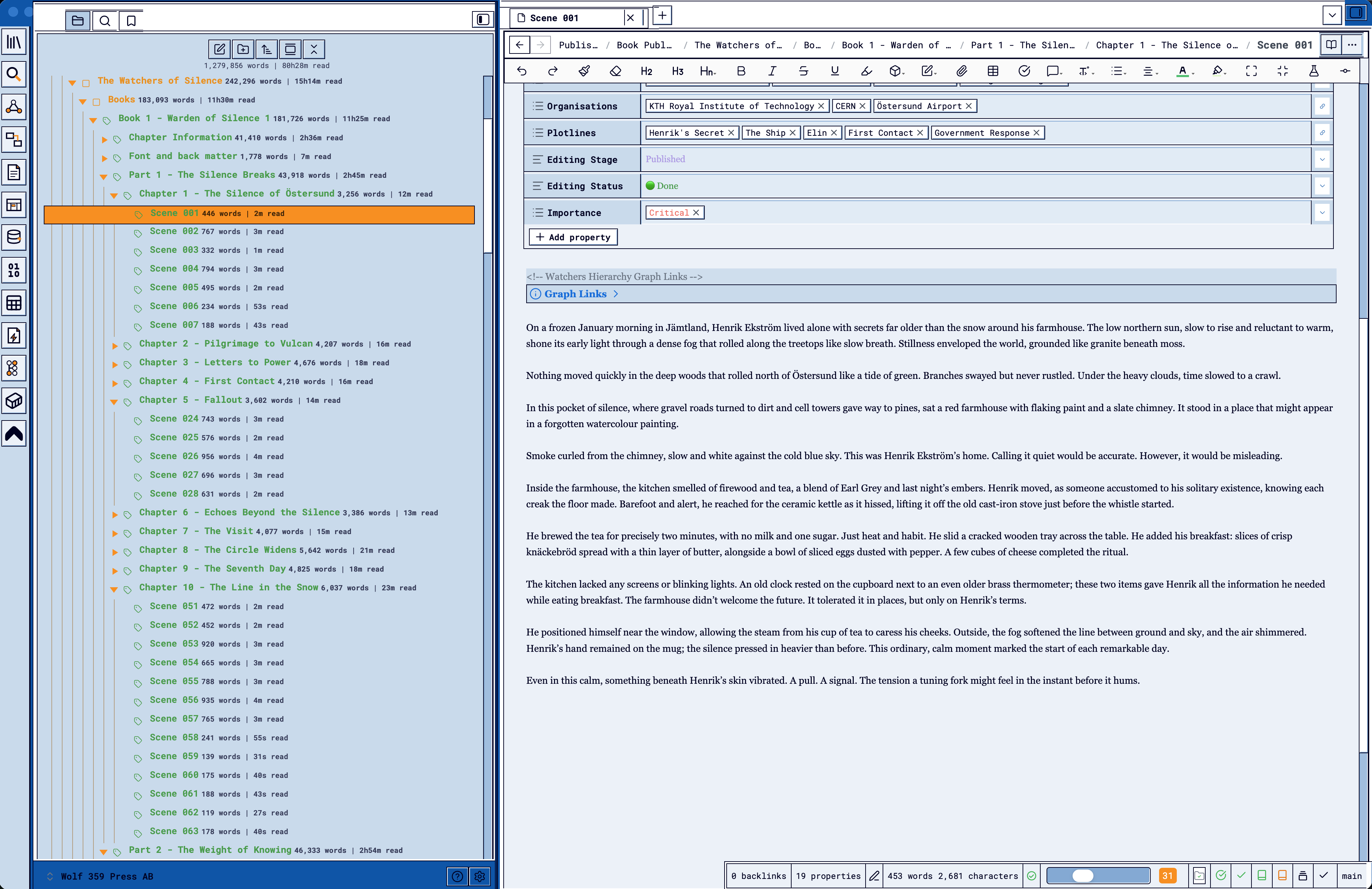
Workbench 1.3 in light mode. The saturated blue desktop sits behind pale windows, title strips are white carrying dark text, and orange marks the one thing that is selected — here the open scene in the file tree and its tab above.
What this is
Workbench 1.3 is the one people picture when they picture an Amiga. Boot an A500 in 1988 and this is what filled the screen: a saturated blue desktop, hard white window frames, black text, and a single warm orange used sparingly to mean this one. Four colours, and not one of them wasted.
That constraint is the whole character. There is no shading here, no soft edges and no gradients — the three-dimensional gadget had not been invented yet, and would not arrive until Workbench 2.0 two years later. Everything is drawn with flat fills and hard one-pixel outlines, relieved by no more than a single pixel of highlight and shade. Controls are compact and square. The interface does not try to look like a physical object; it looks like what it is, which is pixels arranged with conviction.
This theme takes that language and applies it to a modern writing application. The blue sits behind your panes, the windows are light and calm, the title strips are white with dark text, and orange marks whatever is currently selected — the active tab, the open note, the highlighted command. Nothing else is orange, which is precisely why it works.
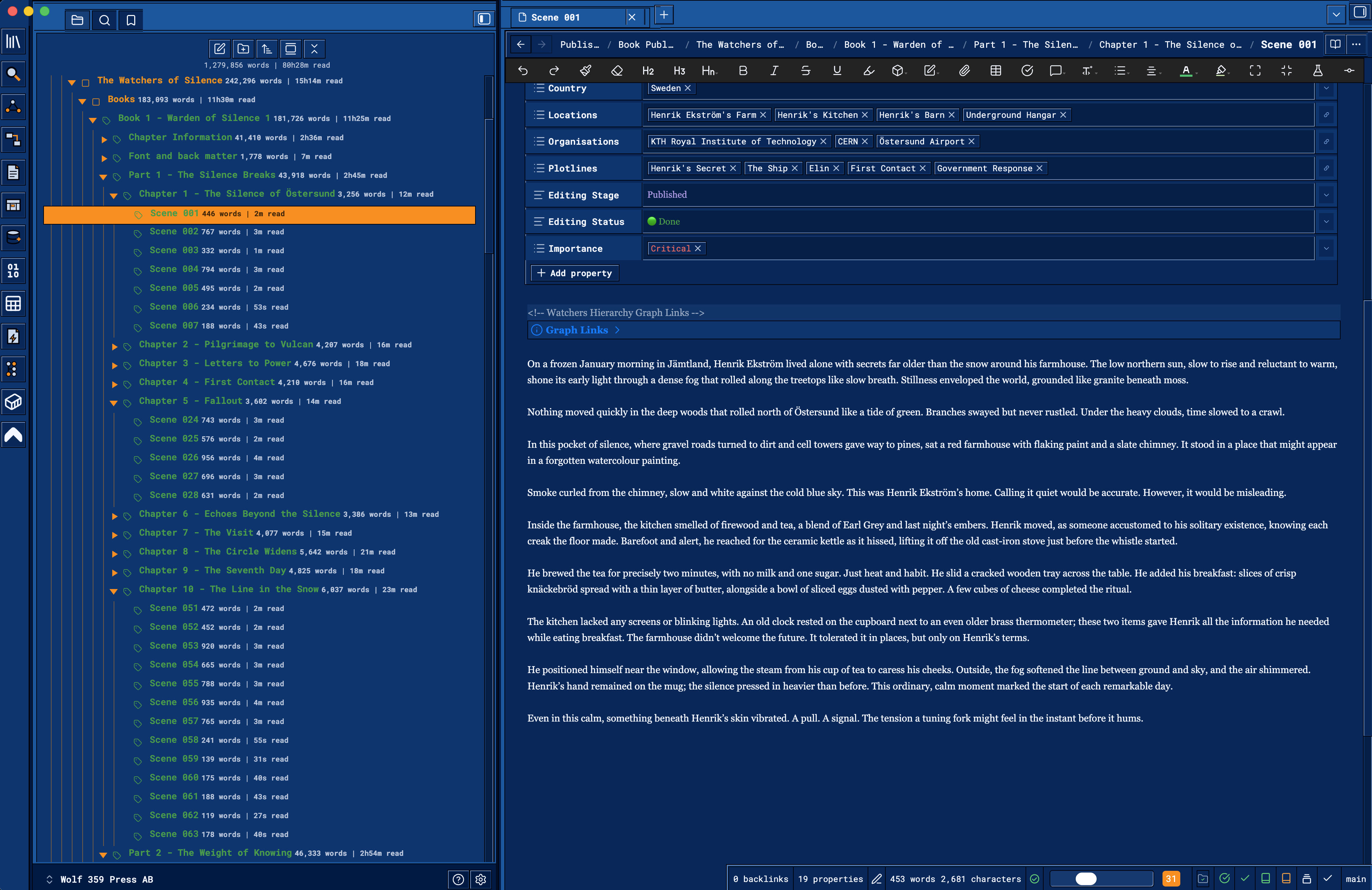
The same workspace in dark mode. Workbench 1.3 never had one, so this is an invention rather than a reconstruction: the screen drops to deep navy and windows become dark blue, but the orange still marks selection and nothing else, exactly as it does in light.
Why you might choose this one
If you are choosing between the three, pick 1.3 when you want the strongest character. It is by far the flattest, the only one with a coloured screen, and the only one that uses orange. Beside 2.04 and 3.1 — which are both grey, bevelled and descended from the same 1990 redesign — it looks like a different machine, because it was.
The palette
Every colour below is stated plainly so you can see exactly what the theme does. Nothing is hidden behind a gradient or an image.
| Role | Value | Notes |
|---|---|---|
| Screen | #0055aa |
The blue behind every pane, and the one colour you see before anything else |
| Windows | #ebf1f8 |
The writing surface. The screen white, dithered with a little of the screen blue |
| Panels | #c7daec |
Explorer, sidebars and the ribbon, so the chrome sits back from the page |
| Title strips | #ffffff |
White with dark text, as Workbench 1.3 drew them |
| Highlight | #ff8800 |
Selection and active state. Used sparingly and never decoratively |
| Ink | #000022 |
Text and outlines |
The geometry
| Property | Value | Notes |
|---|---|---|
| Relief | 1px, minimal | A single-pixel highlight and shade, never 2.0's full relief |
| Border width | 1px | Hard, square, single-pixel outlines |
| Corner radius | 0 | Nothing is rounded anywhere |
| Spacing unit | 0.25rem | The most compact of the three |
| Control height | 1.75rem | Small, dense gadgets |
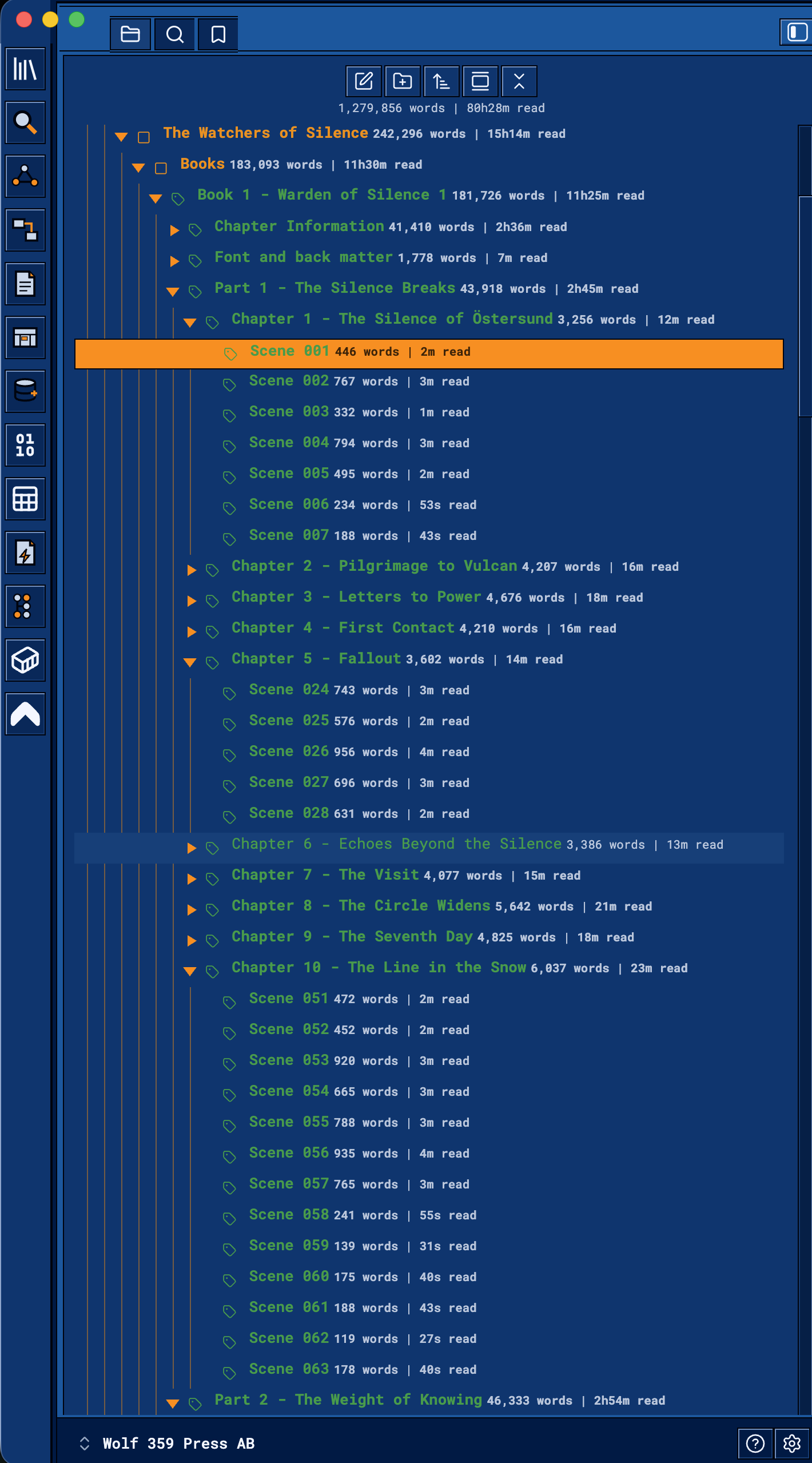
The ribbon and the file tree at depth. Every nesting level drops a connector rail from beneath its parent's disclosure triangle, so folder and file labels stay aligned however deep the structure runs. The ribbon pictograms are original drawings, not Obsidian's default line icons.
What is covered
The theme styles the whole application, not just the editor:
- Workspace shell — ribbon, tab bar, view headers, status bar, pane dividers
- File explorer — indentation, disclosure triangles, connector rails, selection
- Editor and reading view — headings, lists, links, code, tables, callouts, quotes
- Properties — rebuilt as a Workbench-style requester with a keyed column
- Command palette and quick switcher — recessed entry field, square result rows, keyboard hints drawn as small raised gadgets
- Menus, modals, notices and tooltips — hard frames, title strips, solid selection
- Canvas, graph, Bases and backlinks — consistent surface and control treatment
- Settings — including when opened in its own window

The tab strip, the breadcrumb path and the toolbar row beneath them. Tabs are drawn as attached rectangular selectors over the title bar, with the new-tab gadget sharing their top and bottom edges. The path is plain clickable text rather than a row of boxes, and the current note is the only bold segment.
Installation
From Obsidian's Community Themes browser
- Open Settings → Appearance.
- Under Themes, choose Manage.
- Search for Amiga Workbench 1.3.
- Select it and choose Use.
Manually
- Download
theme.cssandmanifest.jsonfrom this repository. - Place both in
YourVault/.obsidian/themes/Modern Amiga Workbench 1.3 inspired/— the folder name must match exactly. - In Obsidian, go to Settings → Appearance → Themes and select Amiga Workbench 1.3.
- If it does not appear, close and reopen Obsidian.
Light and dark
Both modes are designed, not generated. Switch with Settings → Appearance → Base theme. No plugin is involved.
Workbench 1.3 never had a dark mode; the hardware barely had the colours for one. This one is an invention, but a disciplined one: it keeps 1.3's signatures rather than inverting into generic charcoal. The screen goes deep navy, windows become dark blue, title strips stay light with dark text, and orange remains the highlight.
Fonts
The theme follows your typography settings. Set Settings → Appearance → Interface font, Text font, Monospace font and Font size, and the entire interface follows — including the tab bar, view headers, file explorer and status bar.
Leave them unset and the theme's own stack applies. It never overrides a font you have chosen.
Requirements
- Obsidian 1.6.0 or later
- No plugins. The theme is plain CSS and works on its own.
Accessibility
- Every text and background pair is contrast-checked in both light and dark modes
- Keyboard focus is always visible, with a dedicated focus colour
prefers-reduced-motionis respectedprefers-contrast: morestrengthens frames and removes muted text- Printing and PDF export drop the screen palette for black on white
Documentation
- User Guide — a fuller walkthrough, including customisation and troubleshooting
Building from source
This repository is self-contained. The CSS is authored as modules under src/ and
theme.css is generated from them:
npm run build    # regenerate theme.css from src/
npm test         # verify packaging, isolation, tokens and contrast
There are no dependencies to install — the build is plain Node. src/variants/ holds this
theme's light and dark palettes; src/components/workbench-chrome.css holds the shared
Workbench structure; src/icons/ holds the ribbon pictograms, which are coloured from the
palette at build time so they can never drift from it.
theme.css is generated. Edit the modules under src/ and rebuild rather than editing it
directly; the pre-commit hook enforces this if you enable it with
git config core.hooksPath .githooks.
Trademarks, affiliation and intellectual property
Please read this section in full. It matters.
No affiliation whatsoever
Amiga Workbench 1.3 for Obsidian is an independent, unofficial, community-created theme. The developer is a private individual with no relationship of any kind to:
- Amiga Corporation, Amiga Inc., or any entity trading under the Amiga name
- Cloanto Corporation, holders of Commodore/Amiga ROM and Workbench copyrights
- Hyperion Entertainment, developers and rights-holders of later AmigaOS releases
- The former Commodore International, Commodore Business Machines, or their successors
- Haage & Partner, or any other historical Amiga software publisher
- Any present, former or claimed owner of the Amiga, Commodore, Kickstart, AmigaOS or Workbench trademarks, in any territory
There is no endorsement, sponsorship, approval, licence, partnership, or association, express or implied. Nothing in this project should be read as suggesting otherwise. If you have arrived here believing this is an official product, it is not.
Why the name refers to Workbench at all
The name is descriptive, not proprietary. It tells you which remembered look the palette and proportions are drawn from — the Workbench of the late 1980s — in the same way a paint colour might be called "racing green" without any claim on a car manufacturer. This is nominative use: naming a thing in order to describe a resemblance to it. It is not a claim of origin, authorship or authority.
The project's own framing is "Amiga Inspired". Inspired by. Not a port, not a recreation, not a replica, not a continuation, and not a substitute for anything real.
No original assets are used or distributed
This theme is CSS only. It contains no copyrighted material from any Amiga or Commodore product. Specifically, it does not contain, embed, adapt, trace, or redistribute:
- Workbench, AmigaOS or Kickstart ROM code, or any part of any operating system
- Original Workbench icons, or any icon set derived from them
- MagicWB, NewIcons, GlowIcons, or any other third-party Amiga icon set
- Topaz or any other Amiga bitmap font, or any digitisation of one
- Original wallpapers, backdrops, pointers, brand marks or logos
- Screenshots of any Amiga system, used as an asset or otherwise
Every graphic in this theme is an original drawing, authored for this project as inline SVG, using ordinary geometry. Colour values are stated as plain numbers. Colours themselves are not copyrightable, and no artwork has been copied.
Trademark acknowledgement
Amiga, AmigaOS, Kickstart and Workbench are trademarks or registered trademarks of their respective owners. Commodore is a trademark of its respective owner. All such marks are acknowledged as the property of those owners, and are used here only descriptively, to identify the historical visual style that inspired this work.
Obsidian is a trademark of Dynalist Inc. This theme is a community theme for Obsidian and is not produced by, endorsed by, or affiliated with Dynalist Inc.
If you are a rights-holder
If you represent any rights-holder and consider anything in this project to overstep, please open an issue on the repository. The developer's intention is respectful homage within the bounds of independent creative work, and any specific, good-faith concern will be addressed promptly and without argument.
Licence
This theme is released under the MIT Licence. See LICENSE for the full text. The MIT Licence covers only the original CSS and documentation in this repository. It does not, and cannot, grant any rights in any third party's trademarks or copyrighted works, and confers no rights in anything owned by the parties named above.