Syncher
 racoon44 downloads
Live two-way sync of your vault with a folder on your own server over SSH and SFTP. Works on Windows, Linux and Android.
- Overview
- Scorecard
- Updates3
Syncher
Live two-way sync of your Obsidian vault with a folder on your own server — over plain SSH. No cloud, no subscription, no third party: just your notes, your devices and your server.
Features · Screenshots · How it works · Quick start · Server setup · Installation · Settings · Disclosures · Troubleshooting · FAQ
✨ Features
- 🔄 Live sync — every change (even a single space) reaches the server a moment after you stop typing; your other open devices receive it within seconds.
- 💾 Local and remote copies — work offline as long as you like, everything catches up on reconnect.
- 🔐 Your own server, plain SSH/SFTP — any Linux box, NAS, VPS or Raspberry Pi with OpenSSH will do.
- 📱 Windows, Linux and Android — the same plugin on every device.
- 🗑️ Mirror deletions, with a pop-up "Device X deleted file Y" when another online device deletes something.
- ✍️ Last writer wins when two devices edit the same note; different notes can be edited at the same time.
- 🚚 Renames and moves are applied as renames (nothing is downloaded again).
- 🛡️ Permanent save — a per-device switch: "never delete anything here".
- 🧯 Safety nets — asks before a sync would delete many files, never lets one broken file stop the rest,
pins the server key like
sshdoes, encrypts stored passwords and keys.
📸 Screenshots
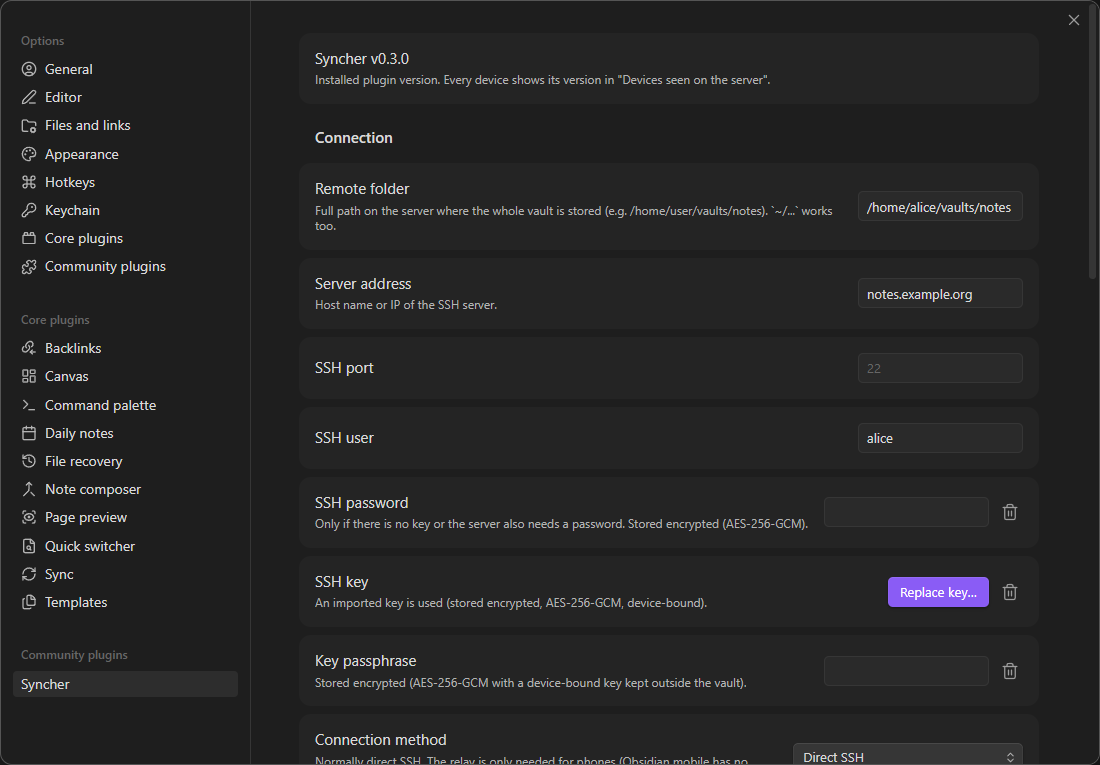
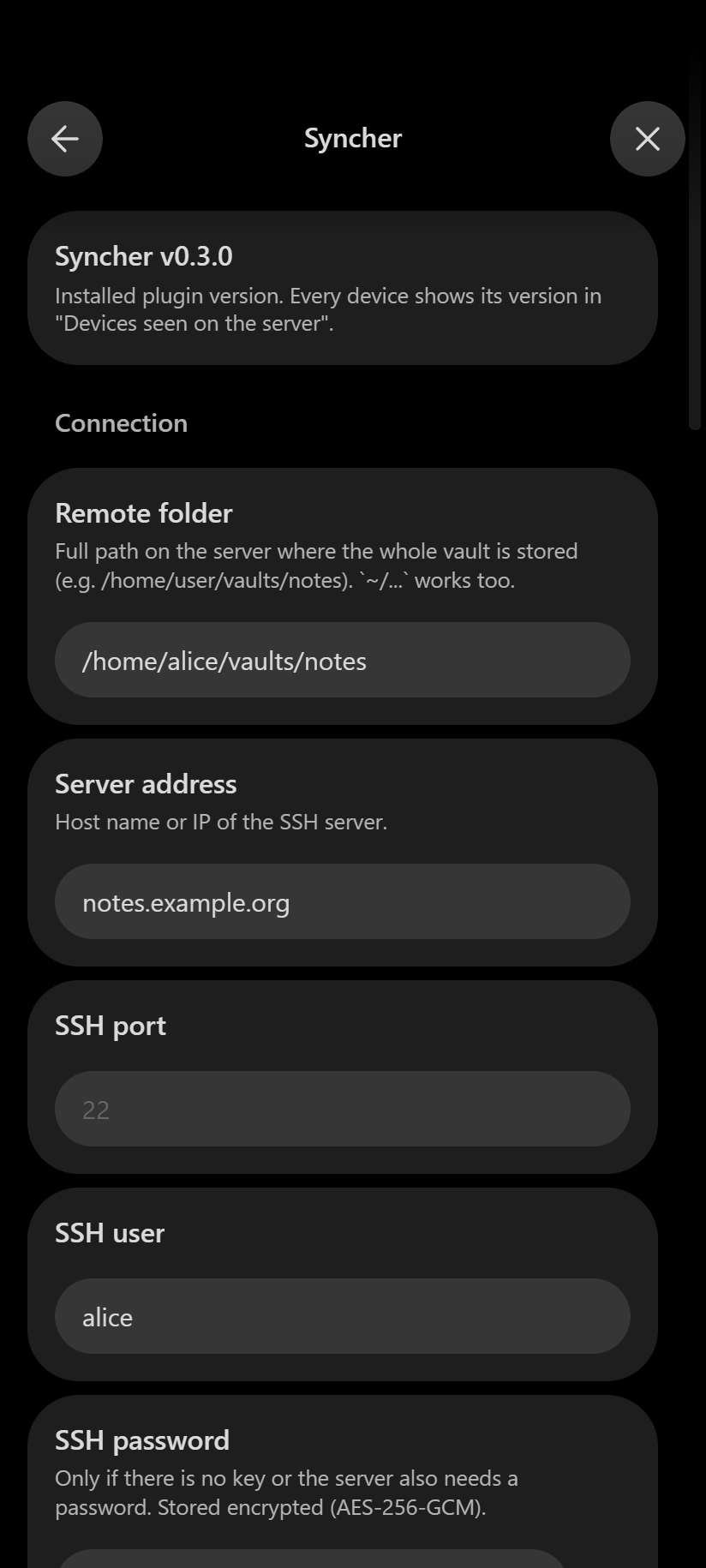
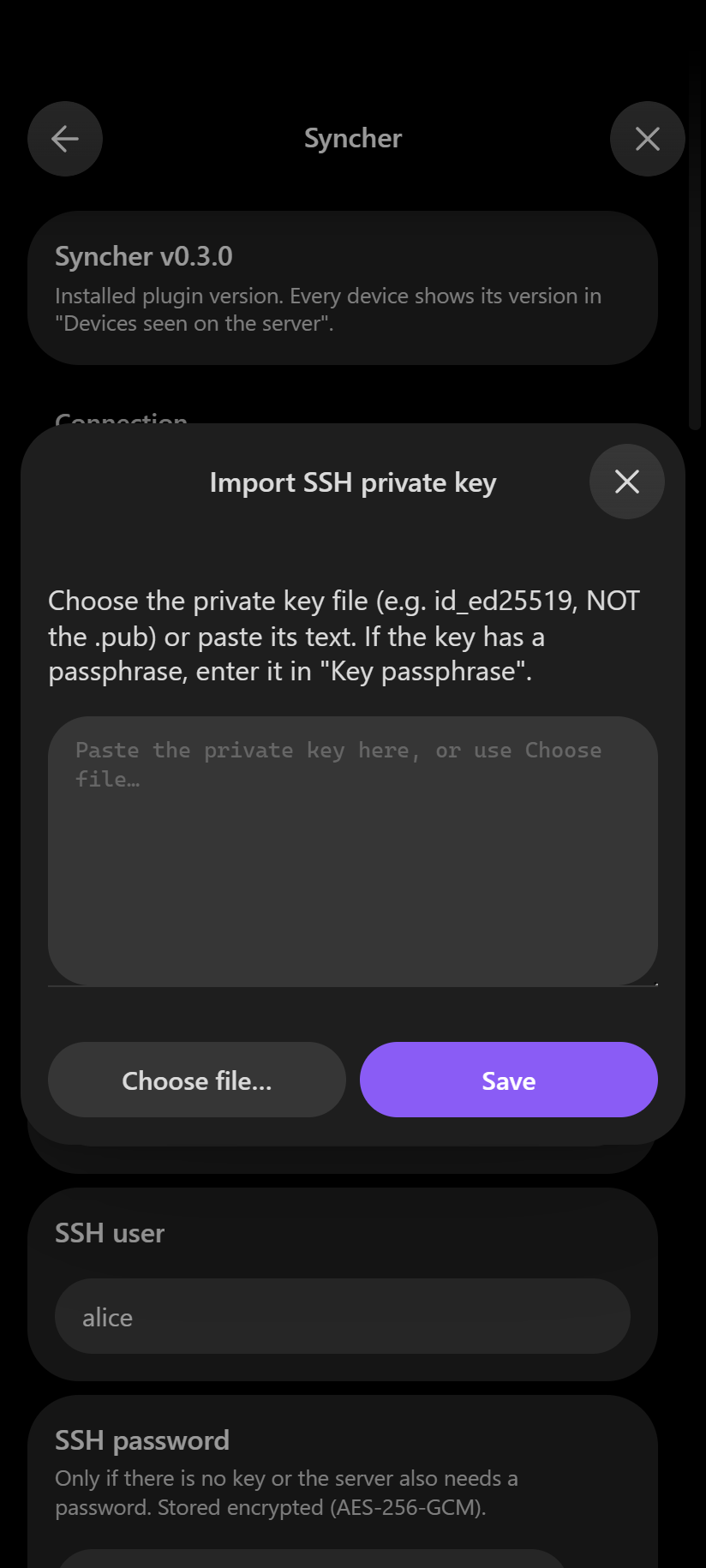
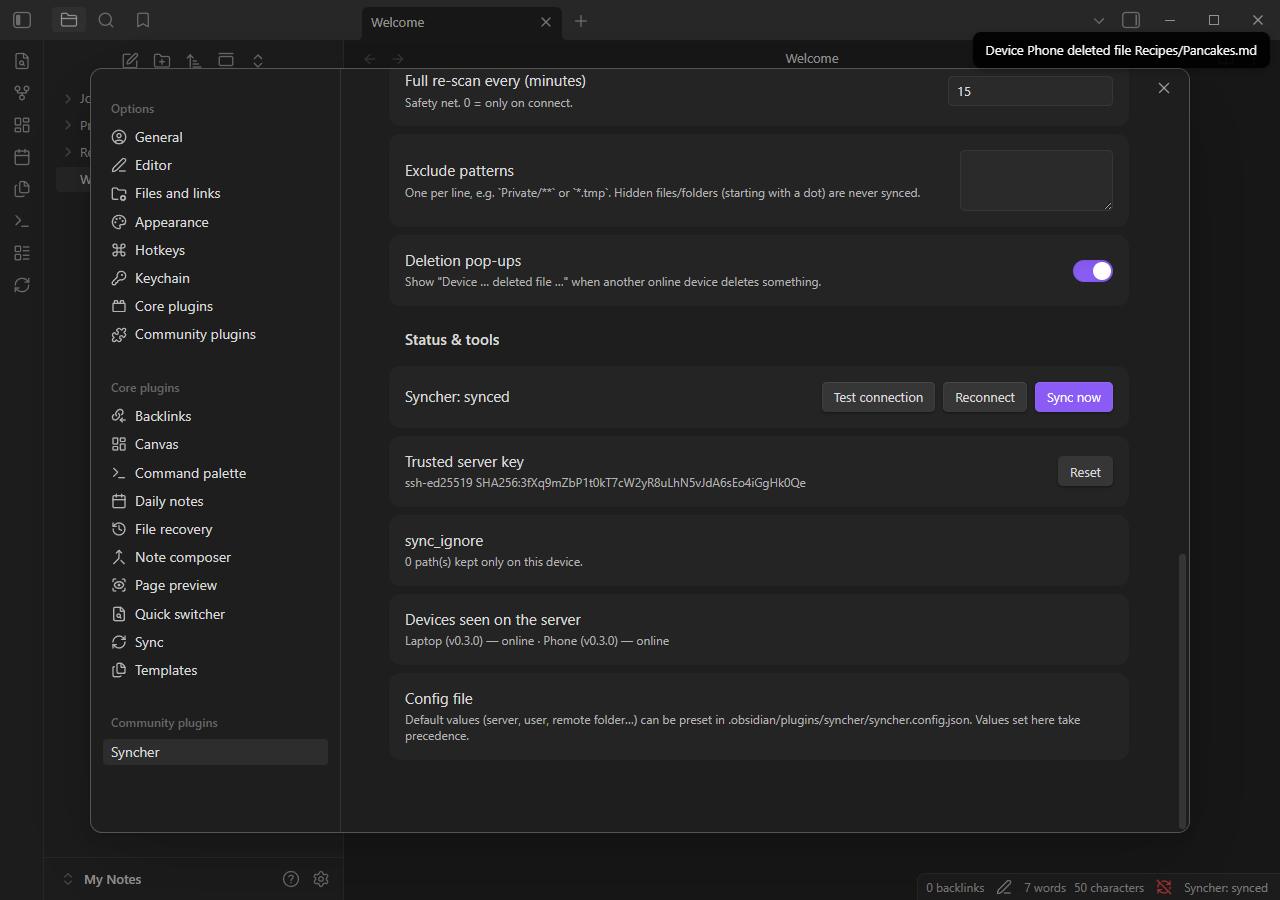
🧭 How it works
 [ laptop ] ──┐
              ├── SSH/SFTP ──►  [ your server: /path/to/vault ]  ◄── SSH (through a small relay) ── [ phone ]
 [ desktop ] ─┘
- Every device keeps a small, private "hash base" (
.obsidian/plugins/syncher/state.json) that remembers what each file looked like at the last sync. Comparing then with now on both sides tells exactly who changed what. - A changed file is uploaded right away and a line is added to a change journal on the server. Other online devices read that journal every few seconds and fetch only what changed.
- When a device connects (and every 15 minutes, as a safety net) it does a full comparison of both sides.
Hidden files and folders (names starting with a dot, such as .obsidian, .trash, .git) are never synced:
every device keeps its own Obsidian settings.
[!NOTE] Why a relay for phones? Obsidian on Android does not let plugins open network connections of their own, so a phone cannot talk SSH directly. The plugin sends the very same encrypted SSH stream through a WebSocket to a tiny relay next to your SSH server, and the relay just passes the bytes on. The relay never sees your data unencrypted, and the plugin still checks your server's key. Computers do not need the relay at all.
🚀 Quick start
| # | What | Where | Time |
|---|---|---|---|
| 1 | Prepare the server: a folder, an SSH key, (for phones) the relay | server | 5 min |
| 2 | Install the plugin | each device | 2 min |
| 3 | Fill in the settings and press Test connection | each device | 2 min |
That's it — from then on it syncs by itself.
🖥️ Step 1 — Prepare the server
You need a computer that is always on and runs an SSH server (OpenSSH). A Linux server, a NAS, a VPS or a
Raspberry Pi are all fine. You must be able to log in to it with ssh.
1.1 Create a folder for the vault
Log in to the server and create an empty folder. One folder = one vault.
mkdir -p ~/vaults/notes
Write down the full path, you will need it later. To see it, run cd ~/vaults/notes && pwd
— it prints something like /home/<your user>/vaults/notes.
1.2 Create an SSH key (recommended)
A key is a file that lets the plugin log in without a password. Do this on your computer, not on the server.
🪟 Windows
- Press Win, type PowerShell, press Enter.
- Create the key (press Enter at every question; a passphrase is optional):
ssh-keygen -t ed25519 -f "$env:USERPROFILE\.ssh\syncher" - Put the public half on the server (replace
<user>and<server>; you will be asked for your server password once):type "$env:USERPROFILE\.ssh\syncher.pub" | ssh <user>@<server> "mkdir -p ~/.ssh && cat >> ~/.ssh/authorized_keys" - Check it:
ssh -i "$env:USERPROFILE\.ssh\syncher" <user>@<server>must log you in without the server password.
🐧 Linux / macOS
ssh-keygen -t ed25519 -f ~/.ssh/syncher        # press Enter at every question
ssh-copy-id -i ~/.ssh/syncher.pub <user>@<server>
ssh -i ~/.ssh/syncher <user>@<server>           # must log in without the server password
You now have two files: syncher (private — never share it) and syncher.pub (public, already on the server).
[!TIP] No key? The plugin can also log in with the server password, if your server allows password logins.
1.3 Install the relay (only if you use a phone)
Skip this if you only sync computers. On the server, from a copy of this repository:
git clone https://github.com/tequrity/syncher.git
cd syncher
sudo sh server/install-relay.sh
You should see Syncher relay is running: ws://<this server>:8022 -> 127.0.0.1:22.
The relay needs only Python 3 and systemd. If the script says a firewall is active, run the command it prints
to open port 8022 (or open it only to your home network / VPN).
Relay options, reinstall, update and removal
| Task | Command |
|---|---|
| Install (listens on 8022, forwards to the local SSH on port 22) | sudo sh server/install-relay.sh |
| SSH is on another port / use another relay port | sudo sh server/install-relay.sh --port 8022 --target 127.0.0.1:2222 |
Reinstall or update (after git pull, or to change options) |
run the install command again |
| Remove completely (stops it, disables it, deletes its files) | sudo sh server/install-relay.sh --uninstall |
| Is it running? | systemctl status syncher-relay |
| Live log (shows each phone connecting) | journalctl -u syncher-relay -f |
If you opened port 8022 in a firewall, close it again after removal (for example sudo ufw delete allow 8022/tcp).
Encrypted wss:// — recommended if the relay is reachable from the internet: start the relay with
--cert fullchain.pem --key privkey.pem (a certificate the phone trusts, e.g. Let's Encrypt — phones reject
self-signed ones) or put it behind Caddy/nginx with HTTPS, and enter wss://… as the relay address in the plugin.
An equivalent alternative to this relay is websockify 8022 127.0.0.1:22.
📦 Installation
Syncher is not in the Obsidian community store yet. Pick one of the two ways below.
Option A — with BRAT (easiest, works on every device, updates itself)
- Open Obsidian → Settings (⚙️ bottom left) → Community plugins.
- If you see Turn on community plugins, press it.
- Press Browse, search for BRAT, press Install, then Enable.
- Go back to Settings, open BRAT in the left list (under Community plugins).
- Press Add beta plugin, paste
tequrity/syncher, press Add plugin. - In Settings → Community plugins, make sure the switch next to Syncher is on.
Option B — by hand
Open the latest release and download
main.js,manifest.jsonandstyles.css.Find your vault folder (the folder you opened in Obsidian) and inside it the hidden folder
.obsidian/plugins. Create a folder namedsyncherthere and put the three files into it:<your vault>/.obsidian/plugins/syncher/main.js <your vault>/.obsidian/plugins/syncher/manifest.json <your vault>/.obsidian/plugins/syncher/styles.cssHow to see hidden folders
- Windows: File Explorer → View → Show → Hidden items.
- Linux: in most file managers press Ctrl+H.
- Android: copy the files over USB, or use a file manager app and turn on "show hidden files" in its menu.
Vaults usually live in
Documents/<vault name>in the internal storage.
Restart Obsidian → Settings → Community plugins → Turn on community plugins (if asked) → press the refresh button ⟳ next to Installed plugins → switch Syncher on.
From source (developers)
git clone https://github.com/tequrity/syncher.git && cd syncher
npm install
npm run release                          # builds main.js and copies it to dist/syncher
node scripts/install.mjs "<path to your vault>"
⚙️ Step 3 — Configure the plugin
Open Settings → Syncher (at the bottom of the left list). At the very top you see Syncher v… — the installed version.
🪟🐧 On a computer
- Remote folder — the full path from step 1.1, e.g.
/home/<user>/vaults/notes. - Server address — the name or IP of your server.
- SSH port — leave empty for the usual
22. - SSH user — your login on the server.
- SSH key — press Import key… → Choose file… → pick your private key
(
syncher, notsyncher.pub; on Windows it is inC:\Users\<you>\.ssh\) → Save. The key is stored encrypted on this device; the plugin never reads files outside your vault. The file picker hides the.sshfolder? Type%USERPROFILE%\.ssh(Windows) or~/.ssh(Linux) into its address bar, or paste the key text into the big field instead. - Key passphrase — only if you gave the key a passphrase.
- Connection method — keep Direct SSH.
- Press Test connection. You should see:
"Connection OK:
<user>via<server>:22, folder … is writable." - Close the settings window. The status bar at the bottom shows Syncher: syncing… and then Syncher: synced. Done!
📱 On an Android phone
- Copy your private key file (
syncher) to the phone (USB cable, a message to yourself, a cloud drive…). - Fill in Remote folder, Server address and SSH user exactly as on the computer (the SSH port is not used on the phone).
- SSH key → Import key… → Choose file… → pick the key file you copied → Save. The key is now stored encrypted inside Obsidian — delete the copied key file from the phone's storage. Can't find it in the picker? Open the key file on a computer in a text editor, copy all of its text, paste it into the big field of the import window and press Save.
- Key passphrase — only if the key has one.
- WebSocket relay URL — leave it empty if you installed the relay with the default settings
(it then uses
ws://<server address>:8022). - Press Test connection — you should see "Connection OK: … via ws://…:8022, folder … is writable."
- Close the settings. Syncing starts on its own. The first sync of a big vault takes a few minutes; keep Obsidian open.
✅ Check that everything works
- On one device create a note
Hello.mdand type something. - A few seconds later it appears on the other device.
- Delete it on the other device → it disappears on the first one, which shows "Device … deleted file Hello.md".
📖 Everyday use
- Just use Obsidian. The status is shown in the status bar (computer) and in the tooltip of the ⟳ icon in the left ribbon (phone). Hovering it also shows the plugin version.
- Click the status bar or the ⟳ icon to run a full sync now.
- Commands (Ctrl/Cmd+P → type Syncher): Sync now (full scan), Reconnect, Pause / resume auto-sync.
- Files deleted by the sync go to the trash (system trash or
.trash, as set in Settings → Files and links → Deleted files). - If a sync is about to delete more than half of your files (for example the server folder was emptied or you pointed the plugin at another folder), it asks first. Answering No, restore them (merge) keeps everything.
- On a phone, Android cuts the connection when Obsidian goes to the background; the plugin reconnects and catches up as soon as you come back.
What happens when…
| Situation | Result |
|---|---|
| You edit a note | Sent to the server a moment after you stop typing; other devices get it within seconds. |
| You create a note or folder | Appears on the server and on all devices. |
| You rename or move a note or folder | Renamed/moved everywhere (not downloaded again). |
| You delete a note or folder | Deleted on the server and on all devices — unless a device has Permanent save on. |
| Another online device deletes a note | Pop-up: "Device ⟨name⟩ deleted file ⟨file⟩". No pop-up for changes made while you were offline. |
| Two devices edit the same note | Last writer wins: the later edit is kept. |
| One device edits a note another one deleted | The edit wins; the note comes back with the new content. |
| A device was offline | On reconnect both sides are compared and merged. |
| A file cannot be synced (e.g. a name Windows does not allow) | It is skipped and listed under Not synced in the settings; everything else keeps syncing. |
🛡️ Permanent save
Permanent save is a switch you set per device. It means: "on this device the sync never deletes anything, it only adds and updates."
- Another device deletes a file → here it stays. Its path goes to the
sync_ignorelist (.obsidian/plugins/syncher/sync_ignore.json, also shown in the settings), so it is not uploaded again and does not come back on the other devices. - A new file with the same name arrives from the server → the kept one is renamed
note.md→note-1.old.md(then-2.old,-3.old, …) and stays insync_ignore; the new file syncs normally. - New and changed files from the server still arrive here.
- Turning it off clears
sync_ignore, re-reads all files and uploads everything that was kept (including the*.oldfiles) as new — so they reappear on all devices.
🧾 Settings reference
| Setting | What it does |
|---|---|
| Remote folder | Full path of the vault folder on the server (~/… works too). Created if missing. |
| Server address | Host name or IP of the SSH server. |
| SSH port | Default 22. Not used on phones (they go through the relay). |
| SSH user | Login on the server. |
| SSH password | Only if there is no key or the server also asks for a password. Stored encrypted. |
| SSH key → Import key… | Imports your private key once (file picker or pasted text); stored encrypted on this device. |
| Key passphrase | If the key is protected with a passphrase. Stored encrypted. |
| Connection method | Computers: Direct SSH (normal) or Through the relay (to test the relay from a computer). |
| WebSocket relay URL | Shown when the relay is used. Empty = ws://<server address>:8022; or wss://…. |
| Device name | Shown to the other devices, e.g. in deletion pop-ups. Defaults to Desktop-xxxx / Android-xxxx; give it a friendly name like "Laptop". |
| Permanent save | See above. |
| Auto-sync | Connect on start and sync every change. |
| Check server every (seconds) | How often to look for changes made by other devices (default 3). |
| Delay after typing (ms) | How long to wait after the last keystroke before sending (default 800). |
| Full re-scan every (minutes) | Safety net for missed events (default 15; 0 = only on connect). |
| Exclude patterns | Paths not to sync, one per line, e.g. Private/** or *.tmp. |
| Deletion pop-ups | Turns the "Device … deleted file …" pop-ups on or off. |
| Test connection | Checks everything a sync needs: connection, server key, login, SFTP, the remote folder and write access. |
| Trusted server key | The server key remembered on first connect. Reset only if the server was really reinstalled. |
| Not synced | Items that could not be synced and why (appears only when there are any). |
| Devices seen on the server | All devices with their plugin version and online state; ⚠ marks a device running another version. |
Config file — preset values without typing
On first start the plugin creates .obsidian/plugins/syncher/syncher.config.json:
{
    "remoteDir": "",
    "host": "",
    "port": 22,
    "username": "",
    "relayUrl": ""
}
- The fields are defaults; a value entered in the settings window always wins.
- The SSH key is not part of it: import it in the settings (it is stored encrypted, never as a plain file).
- The file belongs to one device and is never synced — handy for preparing a device in advance.
🔐 Security
- SSH is built into the plugin (pure TypeScript on top of the audited
@noblecrypto libraries), with modern algorithms only: curve25519 / ECDH key exchange, ed25519 / ECDSA / RSA-SHA2 keys, chacha20-poly1305 and AES-GCM/CTR ciphers, and "strict KEX" protection against the Terrapin attack. - The server key is pinned on first connect. If it ever changes, the plugin refuses to connect and warns you.
- Supported private keys: OpenSSH format (ed25519, ECDSA, RSA — with or without a passphrase), PEM RSA and
unencrypted PKCS#8. Convert PuTTY
.ppkkeys first (PuTTYgen → Conversions → Export OpenSSH key). - Passwords, passphrases and imported keys are encrypted with AES-256-GCM. The encryption key is derived with
HKDF-SHA-512 from a random 256-bit device key, with a fresh salt and nonce per secret. The device key lives in
Obsidian's secret storage (or the app's local storage on older Obsidian versions) — never in the plugin's
data.json, so a copieddata.jsonis useless on another device. - The relay only forwards encrypted SSH bytes. Prefer
wss://, or allow port 8022 only from your network / VPN. - Do not keep a private key in an ordinary (not hidden) folder of your vault: such files are synced to the server.
📢 Disclosures
As required by the Obsidian developer policies:
- Network use: the plugin connects only to the SSH server you enter in its settings (directly on a
computer, or through the relay address you enter /
ws://<server address>:8022on a phone). It sends your vault files there and nowhere else. No other server is ever contacted. - Files outside the vault: none. The plugin reads and writes only your vault (through Obsidian's API) and its own settings folder. Your SSH key gets in only when you choose it in the Import key… window yourself.
- System information: none. The plugin does not read the computer's name, user name or environment; the default
device name is
Desktop-xxxx/Android-xxxxwith a random suffix. - No account, no payment, no ads, no telemetry. Nothing is collected or sent anywhere except your own server.
- Open source: all code is in this repository under the MIT license.
🩺 Troubleshooting
| Message / symptom | What to do |
|---|---|
| fill in server address, user and remote folder | Fill in those three fields (or the config file). |
| SSH keys are no longer read from files on disk | You updated from an older version that used a key file: press Import key… once and pick the same key. |
| the SSH key is encrypted / wrong SSH key passphrase | Enter the (correct) passphrase in Key passphrase. |
| this is not a usable SSH private key | You picked the .pub file or a PuTTY .ppk; pick the private OpenSSH key. |
| authentication failed | Is the public key in ~/.ssh/authorized_keys on the server? Is the user right? |
| SERVER KEY CHANGED | If the server was really reinstalled, press Reset next to Trusted server key. Otherwise do not connect — something is wrong. |
| relay … is not reachable (phone) | Is the relay running (systemctl status syncher-relay)? Is port 8022 open? Is the address right (empty = ws://<server>:8022)? Test from a computer: Connection method → Through the relay → Test connection. |
| N item(s) could not be synced | Everything else is synced; see Not synced in the settings. Usual causes: a name with * " \ < > : | ? (not allowed on Windows/Android — rename it on the device that created it), two files differing only in letter case (Note.md and note.md are one file on Windows/Android — rename one), a server folder without read permission. |
| A file does not appear on another device | Press Sync now. Hidden files (starting with a dot) and excluded patterns are not synced by design. |
| Another device shows ⚠ in Devices seen on the server | It runs another plugin version — update it and restart Obsidian there. |
| Anything else | Desktop: Ctrl+Shift+I → Console shows messages starting with Syncher:. |
❓ FAQ
Do I need the relay?
Only for phones. Computers connect to SSH directly.
Does it work on iPhone / iPad?
It is built the same way as on Android and should work through the relay, but it has not been tested on iOS yet.
Is my data stored anywhere else?
No. The only places are your devices and the folder on your server. The plugin keeps some bookkeeping in a hidden
.syncher folder inside the server folder (device heartbeats, a change journal, temporary upload files).
Can I sync several vaults?
Yes: use one server folder per vault and set the matching Remote folder in each vault.
Can I use it together with another sync tool on the same folder?
Please don't. Two sync tools on the same vault undo each other's deletions and fight over renames.
I used this plugin when it was called "Obsyncher"
The plugin was renamed to Syncher (the Obsidian directory does not allow names containing parts of "Obsidian").
Install Syncher next to it and enable it: on its first start it takes over the old settings, sync base and
encrypted passwords, disables the old copy (you can then delete it in Settings → Community plugins), and renames
the old .obsyncher metadata folder on the server. If you used a key file, press Import key… once.
A relay installed with the old script is replaced automatically when you run sudo sh server/install-relay.sh again.
How do I update?
BRAT updates the plugin automatically. By hand: replace the three files with the ones from the latest release and restart Obsidian. The version shown at the top of the plugin settings tells you which one is running; see CHANGELOG.md for what changed.
🛠️ Development
npm install
npm run build        # type-check + bundle main.js
npm run release      # build + copy to dist/syncher (checks that all version numbers match CHANGELOG.md)
npm test             # unit tests + integration tests against a real OpenSSH server (skipped when none is running)
npm run e2e          # end-to-end test inside a real Obsidian (set SYNCHER_OBSIDIAN to its executable)
- Integration tests use a throw-away user-mode sshd:
test/sshd/start-wsl-sshd.sh <keys dir> [port](SYNCHER_TEST_SSH=host:port:user,SYNCHER_TEST_KEYS,SYNCHER_TEST_WSfor the relay test). - Releases: bump the version in
manifest.json,package.jsonandversions.json, add aCHANGELOG.mdsection, then push a tag equal to the version — GitHub Actions builds and publishes the release.
Project layout: src/ssh — SSH/SFTP client, src/sync — sync engine, src/*.ts — Obsidian plugin layer,
server/ — relay and its installer, test/ — tests, docs/screenshots — images used here.
📄 License
MIT © Mr.Racoon