EPUB Exporter
 Johannes Kaindl1k downloads
Export a note — or a book note with embedded chapters — as an EPUB.
- Overview
- Scorecard
- Updates9
Export notes as EPUB3 — a single note, or a whole book assembled from embedded chapters.
🇬🇧 English · 🇩🇪 Deutsch
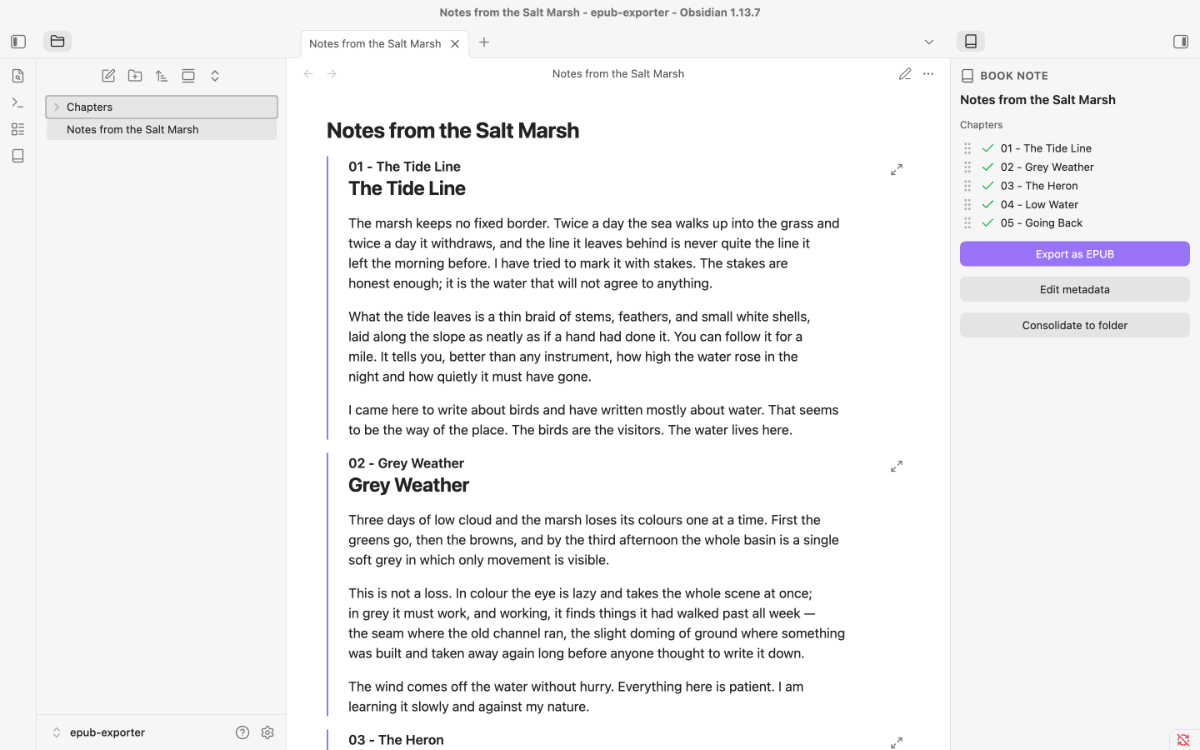
Features
- A book is a note. Frontmatter carries the metadata, the embedded chapters form the spine — no separate project file that drifts out of sync.
- Export a single note, a book note, or an entire folder as EPUB3.
- Sidebar with the chapter list; reordering by drag or
Alt+↑/↓writes the new order straight back into the book note's embed spine. - Import a folder as a book and consolidate a book note into a folder
(numbered chapter files +
_assets/). - Metadata fields in German or English (
autor/author,titelbild/cover, …). - Images, internal links and code blocks travel into the book; anything EPUB cannot represent is simplified rather than swallowed, and reported afterwards.
- Generate a cover from the book note when the Local Image Generator plugin is installed.
- Builds the EPUB without an external library — which is why it also runs on mobile.
Requirements
- Obsidian 1.8.7 or newer.
- Desktop and mobile — the plugin is not desktop-only.
- For the chapter spine: a note whose embeds (
![[…]]) name the chapters in the intended order. Everything else is optional.
Install
Community plugin list (recommended): Settings → Community plugins → Browse → search for "EPUB Exporter" → install and enable.
Manual install: copy main.js, manifest.json and styles.css from a
release into
<vault>/.obsidian/plugins/epub-exporter/.
From source: clone the repository, run npm install && npm run build, then copy the
same three files into the same folder.
Usage
The book model
A book note is the single source of truth. Its frontmatter carries the metadata, its ordered embeds form the chapter spine:
---
epub: true
title: Der Sandmann
author: E. T. A. Hoffmann
language: de
cover: assets/cover.png
---

![[01 Nathanael an Lothar]]
![[02 Clara an Nathanael]]
![[03 Nathanael an Lothar]]
The line epub: true (or book: true) marks the note as a book note; without it the note is exported as a single note and its embeds are not followed. Because the chapters are real embeds, the finished book is visible as such in reading
view — there is no separate project file that could drift out of sync with the note.
Recognized fields are title, author, language, identifier/isbn, description,
publisher, date, series + series_index, subject/tags, rights and cover —
each also under its German name (titel, autor, sprache, verlag, datum,
reihe + reihe_nr, schlagworte, rechte, titelbild). Without title the file
name is used; without identifier a UUID is generated. The command "Insert book
frontmatter into note" lays out the scaffold.
Ways into an export
- Sidebar — opens the book overview with the chapter list plus export and consolidate buttons.
- Reorder chapters — in the sidebar by dragging or with
Alt+↑/↓; the new order goes straight into the book note's embed spine, so the book reorders itself in reading view immediately. - Command "Export as EPUB" — exports the active note.
- A folder's context menu — exports the folder as a book or imports it as a book note (embed spine from the file name order).
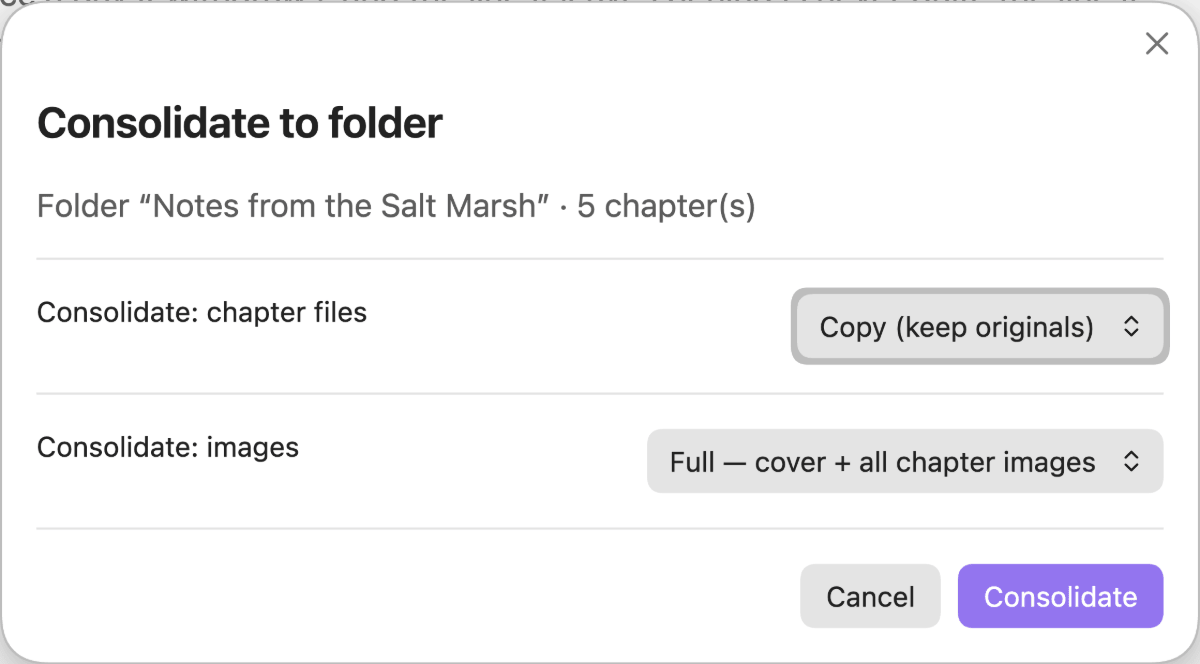
- Book note → "Consolidate book to folder" (command, sidebar or context menu) —
moves the book into a folder of its own: book note + numbered chapter files +
_assets/. A dialog picks whether chapters are copied or moved, and how many images come along.
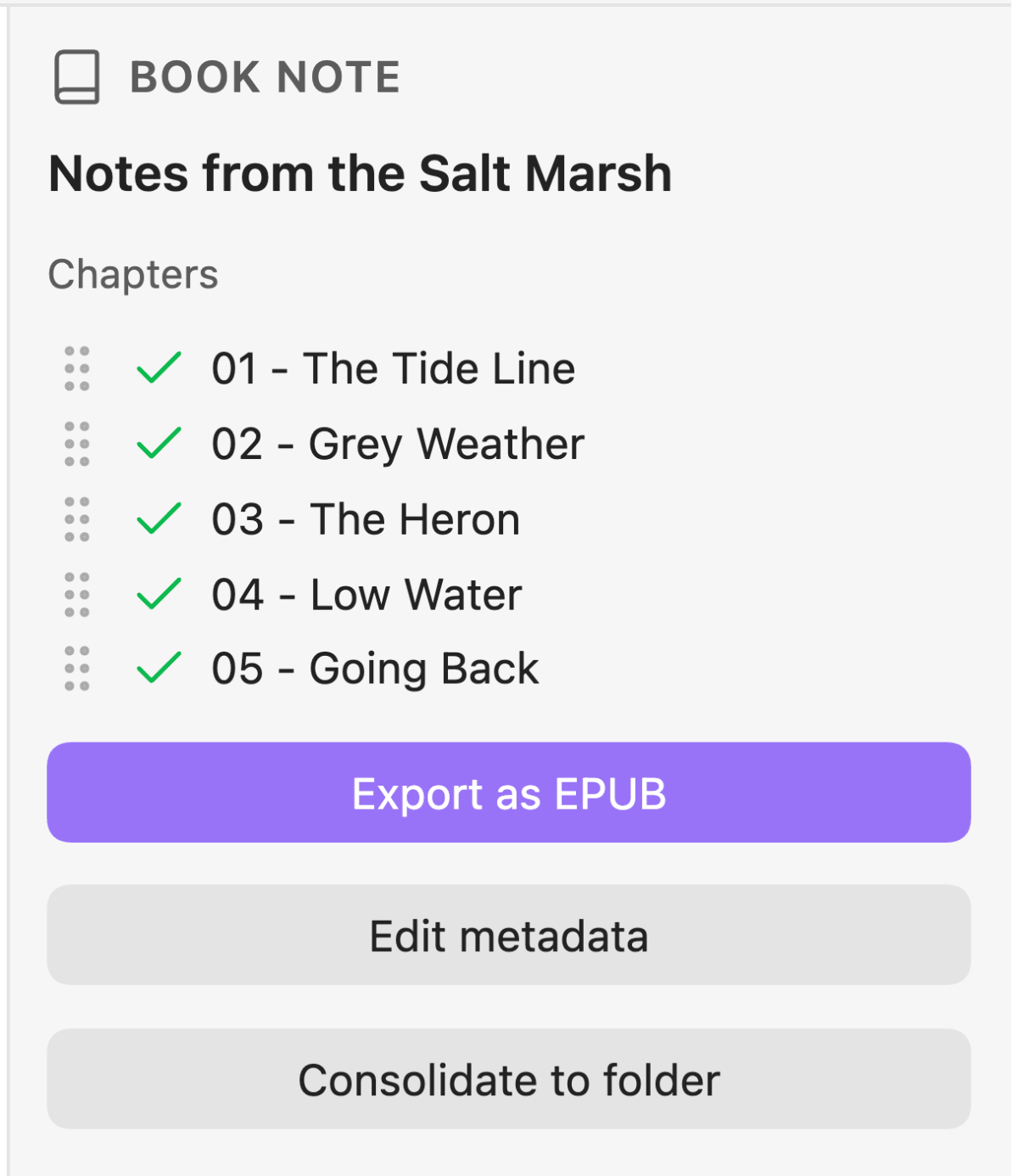
The panel — click the preview for full size
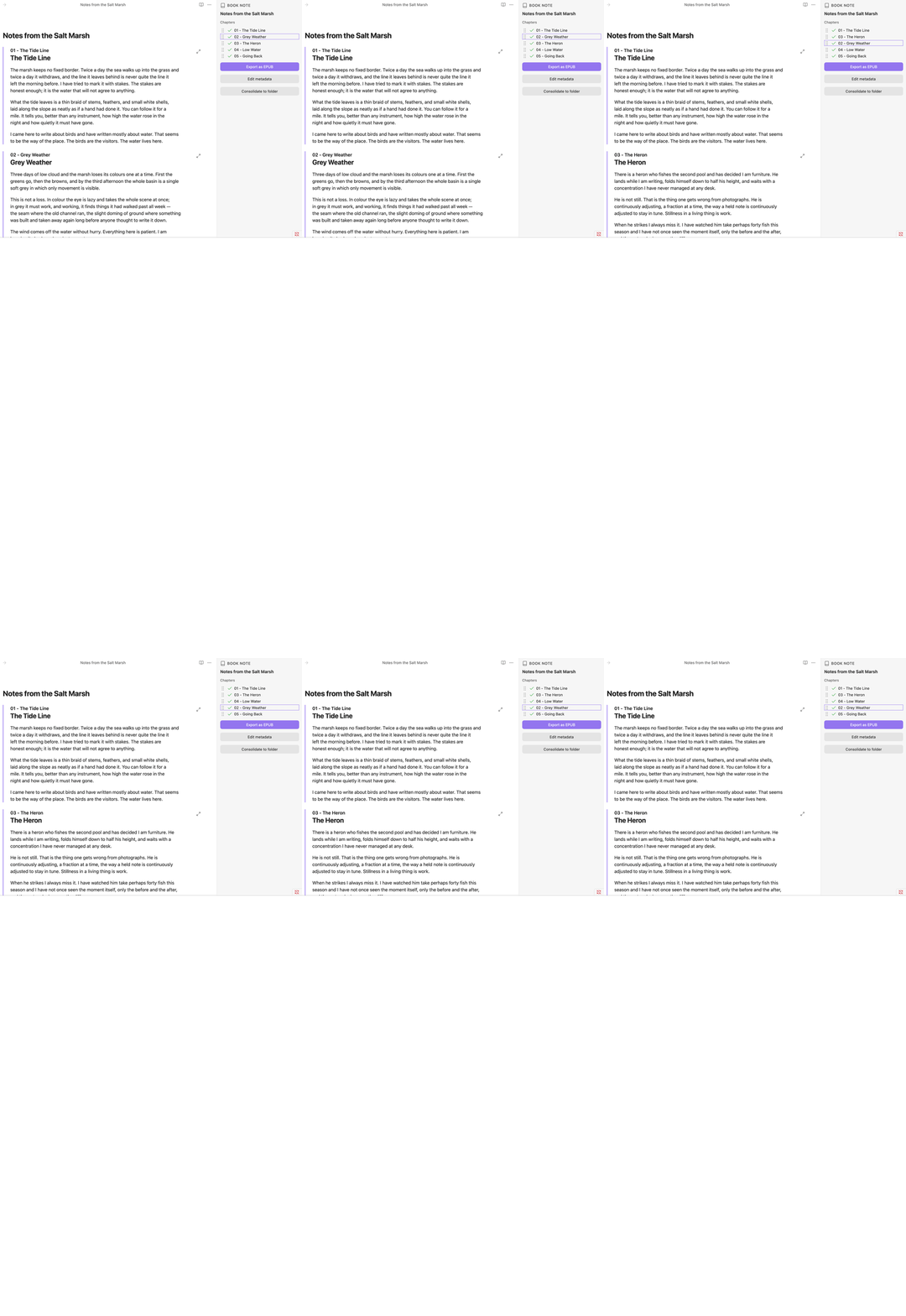 Reordering, by dragging or with
 Alt+↑/↓ — the embed line in the note moves with it.
Per chapter: chapter_title overrides the title in the table of contents,
epub_exclude: true leaves a chapter out.
Configuration
Settings → Community plugins → EPUB Exporter:
| Setting | Default | Meaning |
|---|---|---|
| Output destination | Beside the note | Or: attachment folder, custom folder, or "Share / open in another app" (mobile) |
| Custom folder | (empty) | Only used when the output destination is "Custom folder" |
| Default book language | en |
Used when a book note has no language field |
| Open sidebar on startup | off | Reveals the EPUB Exporter panel when Obsidian starts |
| Consolidate: chapter files | Copy | Copy (keep originals) or move |
| Consolidate: images | Full | Cover + all chapter images, cover only, or none |
The two consolidate settings are only the default in the dialog — it lets you deviate per run.
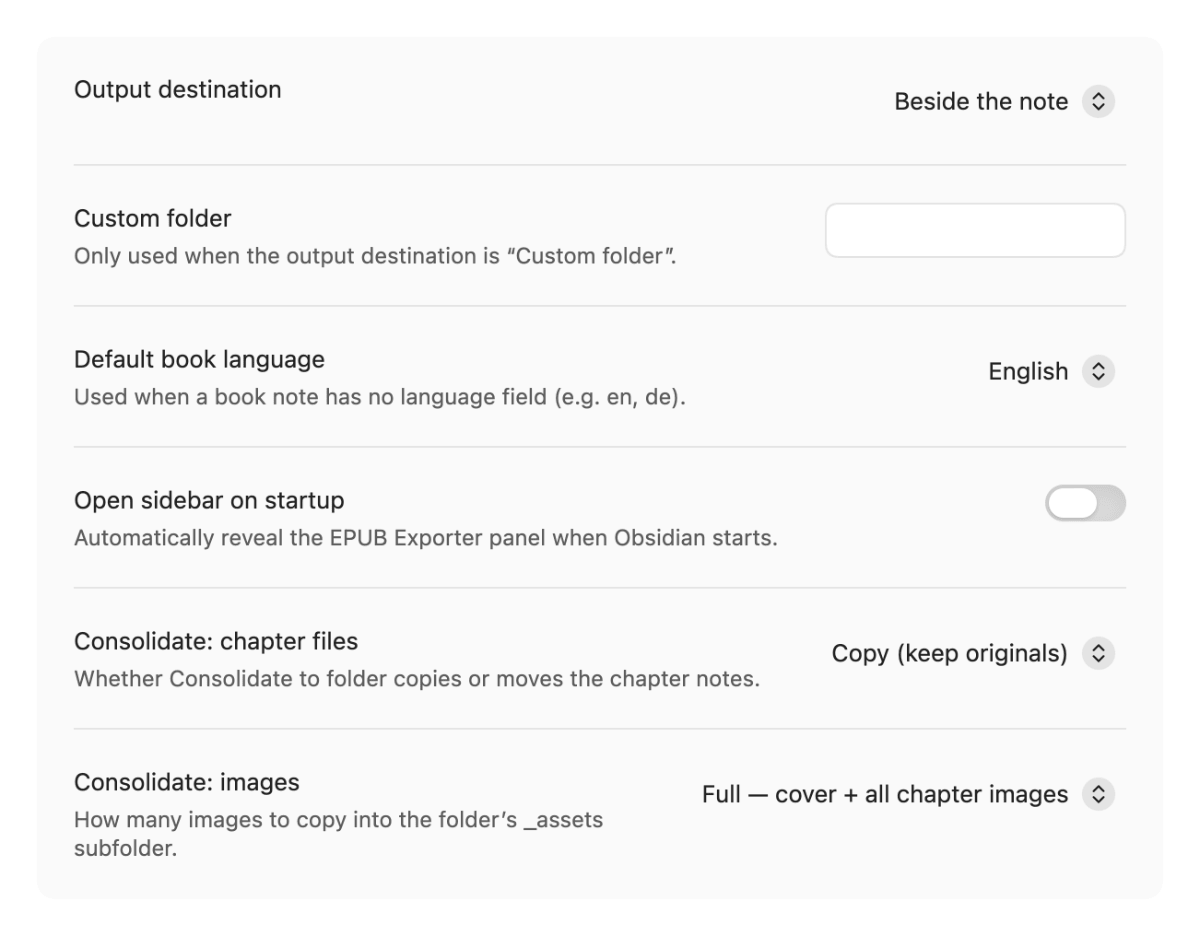
Click the preview for the full-size settings tab
How it works
The EPUB is built entirely inside the plugin, without an EPUB or ZIP library: a minimal,
uncompressed ZIP writer puts mimetype first (as the specification demands), followed by
the container, the OPF package and the navigation document. That is why the export also
works on mobile and needs no network connection.
Each chapter is rendered by Obsidian and then translated from the DOM into XHTML. Whatever EPUB does not know is degraded to the closest element rather than dropped — a notice reports how many elements that affected. Code blocks are swapped for placeholders before rendering and put back unchanged afterwards, so no syntax highlighting ends up in the book. Images are collected by a registry and stored once with the right media type (PNG, JPEG, GIF, SVG, WebP); links to notes within the same book become internal jump targets, links pointing outside become plain text.
Documentation
- Documentation index
- Getting started — from the install to your first EPUB
- Troubleshooting — the messages you may see, what they mean and what to do
License
AGPL-3.0-or-later — see LICENSE. The documentation is licensed CC BY-SA 4.0, see LICENSE-DOCS.