Search...Search plugins and themes...
⌘K
Sign in
  • Get started
  • Download
  • Pricing
  • Enterprise
  • Account
  • Obsidian
  • Overview
  • Sync
  • Publish
  • Canvas
  • Mobile
  • Web Clipper
  • CLI
  • Learn
  • Help
  • Developers
  • Changelog
  • About
  • Roadmap
  • Blog
  • Resources
  • System status
  • License overview
  • Terms of service
  • Privacy policy
  • Security
  • Community
  • Plugins
  • Themes
  • Discord
  • Forum / 中文论坛
  • Merch store
  • Brand guidelines
Follow us
DiscordTwitterBlueskyThreadsMastodonYouTubeGitHub
© 2026 Obsidian

Config Sync

xoooooooooxxooooooooox478 downloads

Selective, on-demand distribution of vault configuration (snippets, hotkeys, plugin settings) across devices and vaults.

Add to Obsidian
  • Overview
  • Scorecard
  • Updates93

Config Sync logo

Config Sync

Selective, on-demand sync of Obsidian settings — hotkeys, CSS snippets, themes, plugin configs — across devices and vaults. The data rides your existing note sync (remotely-save, Obsidian Sync, iCloud…) by default, or config-sync's own git / vault remotes. Nothing ever lands on a device without an explicit Apply from the Sync Center.
Breaking upgrade. This version changes both the store format and the settings schema (schemaVersion: 2) — there is no migration from an older install. Upgrade every device to this version together, then revisit Settings → Config Sync on each one and re-tick what you want to sync before capturing or applying again.

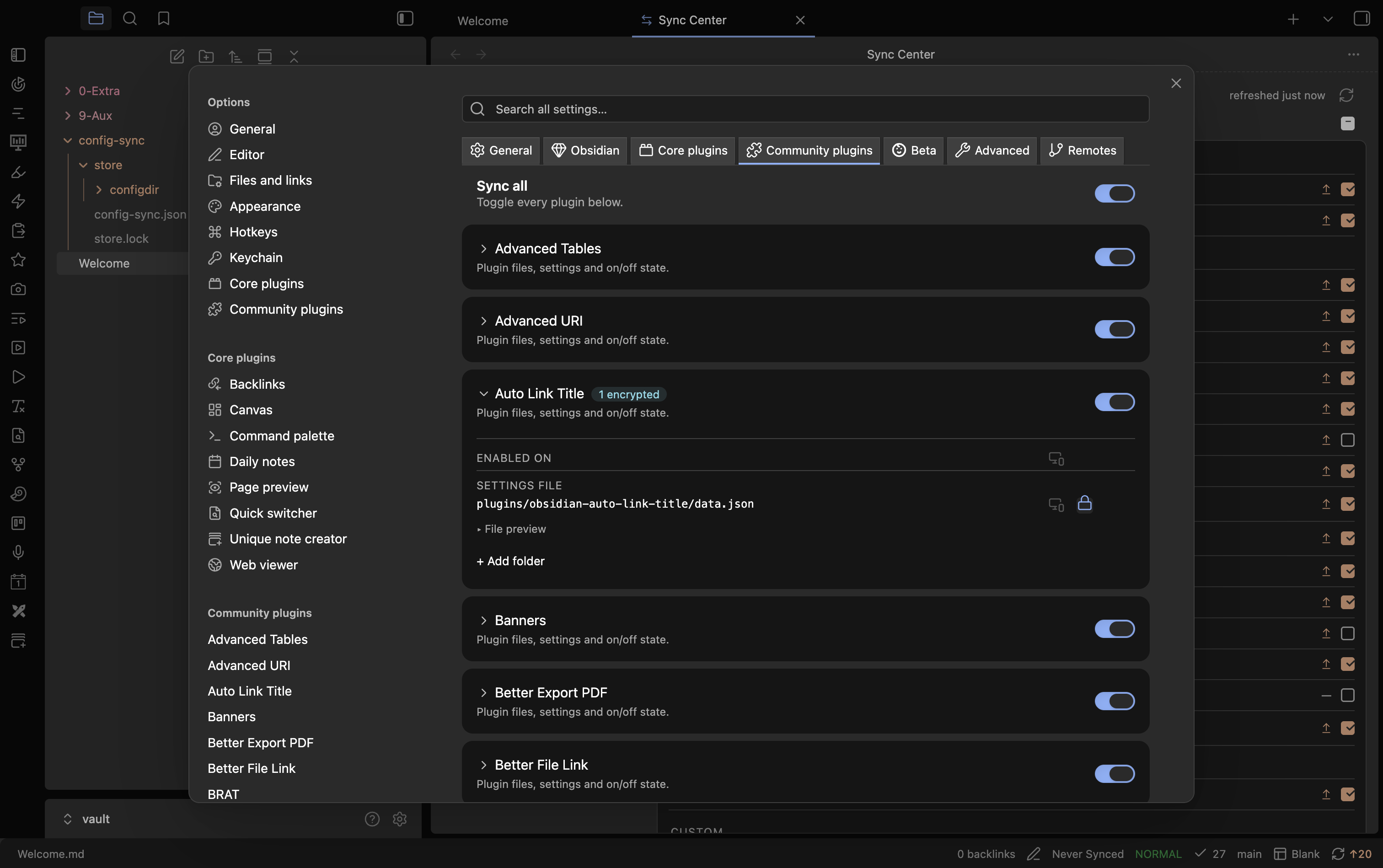
Settings picker

Features

  • One card per item — every synced thing (an Obsidian option group, a core or community plugin, a snippet) is the same row + expandable drawer: name, badges, a sync on/off toggle, and — once opened — up to three zones: Enabled on (which devices turn a plugin on), Settings file (its rules), Companion folders (themes, snippets, or any folder you add). No more separate "Enabled community plugins" / "Enabled core plugins" rows — a plugin's on/off state lives on its own card.
  • Orthogonal rules, per key — every field rule is a {scope, encrypted} pair you can combine freely: All devices, Desktop only, Mobile only or This device, each independently encryptable. A whole file can also be marked encrypted, not just individual fields. String-array keys (a plugin's enabled-elements list, CSS snippets, app.json's userIgnoreFilters…) get a Per-item scopes toggle so every element carries its own scope instead of one rule for the whole key — one mechanism behind per-plugin enablement, per-snippet scope and per-ignore-pattern scope alike.
  • Credential-safe — per-key or whole-file encryption keeps sensitive keys out of the store in plaintext; each device keeps its locally entered This device values across applies.
  • Explicit Apply — pick items, land them directly (no confirmation dialog); every run's changes stay visible in the pinned result strip and History.
  • Removable and tidy — stop syncing an item at any time (optionally deleting its store copy), and store files left behind with no matching item surface as Leftover for one-click cleanup.
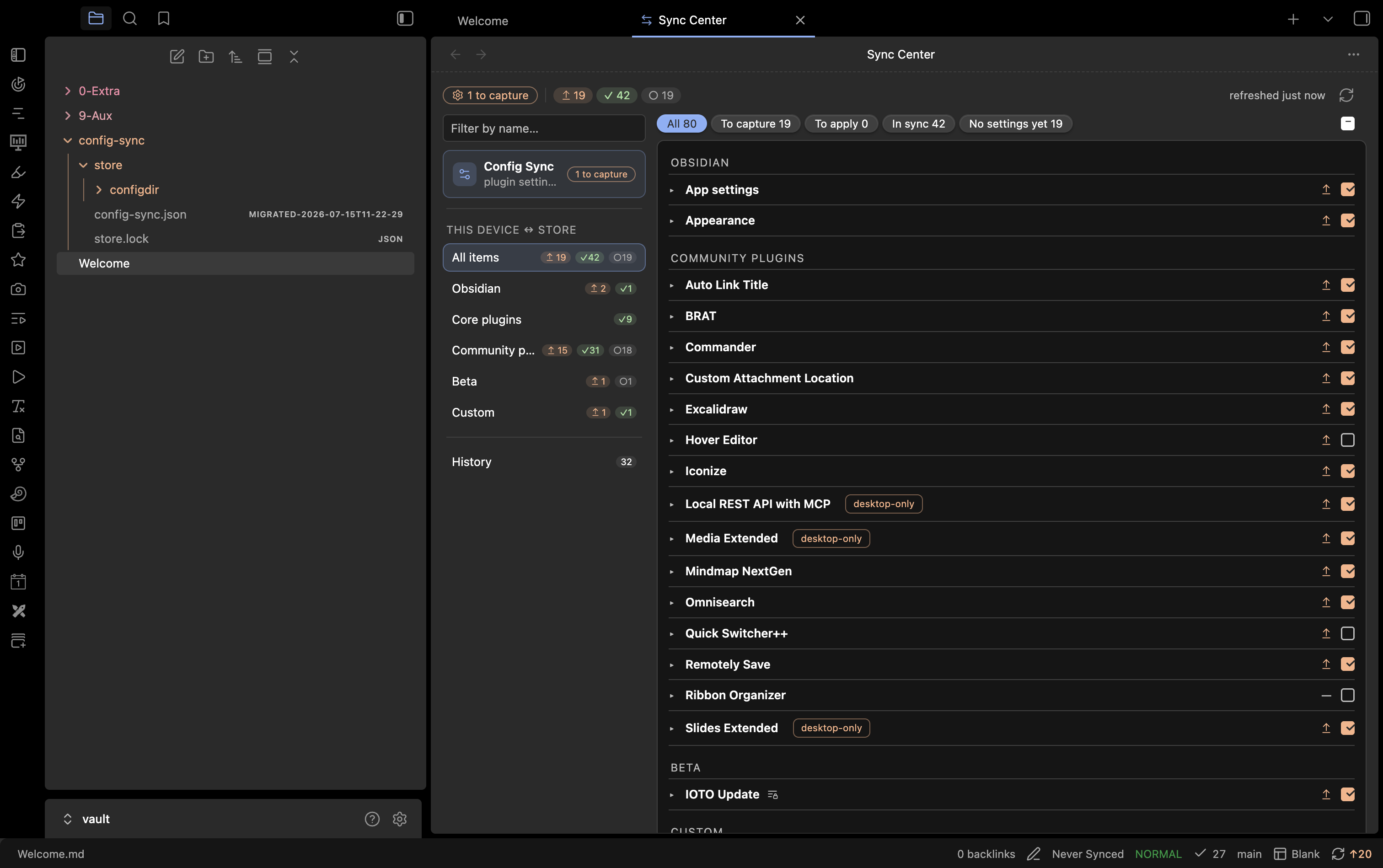
  • Always-visible awareness — open the Sync Center any time for the details; its header is its own status bar: a this device chip (a green check when everything is in sync, otherwise the current state and a shortcut into settings) followed by the totals for every pending action, including per-remote push/pull counts. Every item is badged by state (✓ in sync, changed-on-this-device, store-is-newer, ≠ differs, — not captured yet), each sync action (Capture, Apply, Push, Pull) has its own icon, and remotes are checked automatically.
  • Status bar — sync status at a glance: ↑ to capture, ↓ to apply, plus per-remote ⇡ push / ⇣ pull counts; click opens the Sync Center. All in sync shows just a dimmed icon. The old ribbon-icon dot is now opt-in (off by default), and a mobile-only toggle can force Obsidian's hidden status bar visible on phones.
  • Availability-aware — plugins that are outdated, disabled, or not installed on this device get their own collapsed sections with a plugin-install/update engine, so applying can also update, enable or install a community plugin in the same step. A Beta tab tracks community plugins installed through BRAT, so their configs sync like any other.
  • Remote-aware — the Sync Center's Remotes block auto-checks whether a git or vault remote was captured after your local store; expand a remote for a Pull/Push preview.
  • Fast filtering & search — both search boxes accept key:value qualifiers with autocomplete: in the Sync Center type:/scope:/action:/mode:/device:, in settings scope:/type: — combined freely with plain text.
  • Mobile-friendly — capture, apply and the Sync Center all work on phones; the store is plain vault content, so any note sync carries it.

Install

From Obsidian: Settings → Community plugins → Browse, search Config Sync, install and enable.

Beta builds: via BRAT, add xooooooooox/obsidian-config-sync.

Quick start

  1. Settings → Config Sync — tick what you want to sync (Obsidian / Core plugins / Community plugins tabs).
  2. Open Sync Center from the ribbon menu (or the Sync: open the sync panel command), tick what to capture, and press Capture N items.
  3. On another device, once your note sync has delivered the data folder: open Sync Center, tick what to apply, and press Apply N items.
How it works

Two planes, kept separate.

Local plane — this device's live config ↔ the store:

  • Capture copies every enabled item's settings file and companion folders into <data folder>/store/, applying each field's {scope, encrypted} rule (or the whole-file rule, for items with no per-key rules), skips OS junk files, and records source plugin versions (or the Obsidian app version, for Obsidian/core items) in store.lock.json. Only changed files are rewritten; the Sync Center's Capture button captures just what you've ticked.
  • Apply picks items and lands them into this device's config dir (whatever its name) — there's no confirmation dialog; ticking and pressing Apply executes directly. For a community plugin that's outdated, disabled or not installed on this device, Apply can also update, enable or install it first (see below). This-device-scoped fields and encrypted content resolve per the item's rules; a This device field keeps its local value untouched.
  • The Sync Center compares live config against the store per item, with best-effort direction hints (file times vs the last capture) and automatic remote freshness checks.

Availability sections and the install engine

Beyond the main list, the Sync Center groups community/core plugin items by what's true on this device, in collapsed, opt-in sections that never count into the header pills, sidebar badges, filter pills or footer until you tick something inside them:

  • Outdated on this device — enabled plugins whose installed version is behind what the store was captured on.
  • Disabled on this device — plugins whose config is tracked but the plugin itself is switched off here.
  • Not installed on this device — plugins the store has config for but that aren't installed here at all.

Each row in these sections carries an On apply choice alongside the usual checkbox — the checkbox decides whether the item's config is part of this run, the On apply choice decides what happens to the plugin's state before that config lands:

  • Outdated: ⤓ Update to latest (default) or Keep {version}.
  • Disabled, no version drift: ⏻ Enable (default) or Keep disabled.
  • Disabled and outdated: ⤓ Update & enable (default), ⏻ Enable, or Keep disabled.
  • Not installed: ⤓ Install & enable (default), ⤓ Install, or Stage only.

Installs and updates fetch the plugin from the official community plugin catalog, pinned to the version the store was captured on (recorded in store.lock.json) so every device converges on the same version; when that exact release is missing it falls back to the latest stable with a warning. A plugin that isn't in the catalog is staged (its config is written, ready for whenever you install it manually) with a note to that effect. A failed update leaves the existing config untouched (an old version is assumed unsafe to overwrite blindly); a failed install still stages the config, since an uninstalled plugin can't be harmed by it. A single failure never aborts a bulk install — the offending plugin becomes one error row in the result and the rest of the batch still installs.

A plugin ahead of the store's recorded version shows a quiet metadata line instead of a section (capturing again will refresh the store). Obsidian and core-plugin items are anchored to the Obsidian app version rather than a plugin version — drift there is reminder-only in both directions and never drives an install/update action.

Transport plane — how the store travels:

  • Your note sync (default): the store is plain vault content — remotely-save, Obsidian Sync, iCloud or anything else carries it everywhere, mobile included, zero configuration. On a fresh device, once the store arrives, the Sync Center discovers it on its own and shows an Adopt banner; adopting it runs a one-time guide that walks you through applying the store to set the device up — and warns against capturing over it with the new device's empty defaults.
  • Pull / Push (desktop, optional): config-sync's own transport for a git repo or another vault on this machine, run from the Sync Center's Remotes block. Pull overwrites this vault's store from a remote (repeatable — cold start and ongoing use are the same action); Push sends it out. The git transport clones to a temp dir and never touches your vault's own repo.

Everything hangs off one Config Sync ribbon icon; clicking it opens a menu with Sync Center (badged with the pending capture/apply counts), which opens (or focuses, if already open) the Sync Center, where Capture/Apply/Pull/Push all happen. The status bar is the primary always-visible indicator; the ribbon icon's own status dot is opt-in and off by default (Settings → General → Status bar). An individual ribbon icon for the Sync Center is available under Settings → General, off by default. Quick commands moved to the standalone Ribbon Organizer plugin.

Capture, Apply, Pull and Push each finish by rendering a result strip pinned to the top of the Sync Center — a collapsible summary (changed/unchanged counts, per-item detail on demand) rather than a popup dialog, so it stays visible while you scroll a long list and doesn't interrupt further ticking. Its tone reflects the outcome — green when the run is clean, amber or red when items need attention, with failures expanded by default. Every run is also recorded in a browsable, clearable History: a sidebar entry opens a table of past runs (a card list on narrow/mobile screens, so it reads top-to-bottom with no horizontal scroll), each expandable to its per-item detail.

The Sync Center header is a status bar: a this device chip shows Config Sync's own sync state — a green check when in sync, otherwise its state plus a Settings shortcut — followed by totals for every pending action, including per-remote push/pull counts. The chip opens the this device pane, where Config Sync's own configuration (its item list, field rules and options) is captured and applied like any other item; when that list changes, an expandable view change shows the exact data.json delta and what capturing will publish.

The Filter by name… search box lives in the Sync Center's sidebar and searches globally across every scope at once (Obsidian, Core plugins, Community plugins, snippets, themes, dotfiles). Beyond plain text it accepts key:value qualifiers — type: (file/folder), scope: (obsidian/core/community/beta/custom), action: (capture/apply/ok/none), mode: (plain/fields/encrypted) and device: (all/desktop/mobile) — that narrow together and combine with free text, with an autocomplete dropdown that opens as soon as the box is focused, suggesting keys then values. The sidebar shows a hit count per scope and sections with a match auto-expand to show just the hits.

Sync Center

Settings guide

  • General — PKM mode (auto-detects IOTO vaults), the data folder location, status toggles (sync menu change counts, automatic remote checks, periodic local check), the status bar (item, remote push/pull counts, opt-in ribbon dot, mobile force-show), ribbon icons.
  • Obsidian / Core plugins / Community plugins / Beta — every row is a card: name, badges (a grey desktop-only plugin chip when the plugin can't run on mobile, on: desktop/on: mobile/on: this device when a plugin's enabled state isn't the default, plus counts of device-scoped and encrypted rules), a sync toggle, and a chevron that opens its drawer. The Obsidian tab has three cards: App settings (the whole app.json — editing, new-note and link behavior, and other general options), Appearance (theme, fonts and CSS snippets) and Hotkeys (your custom keyboard shortcuts). Core and Community plugins are listed in full: a core plugin with no settings file yet is a state-only card (just its Enabled on zone) until it writes one. The Search all settings… box spans General, all picker tabs, Advanced and Remotes, and accepts scope: (general/obsidian/core/community/advanced/remotes) and type: (file/folder) qualifiers with autocomplete alongside plain text. The Beta tab tracks community plugins installed through BRAT — same card, same three drawer zones — so their configs sync like any other plugin. Each section lists its cards alphabetically; sensitive-looking keys (tokens, secrets) are highlighted inside a card's File preview so you see them before enabling syncing.
  • A card's drawer has up to three zones, and every scope control in them is the same cycling icon: the glyph shows the current scope (a monitor+phone pair = All devices, a monitor = Desktop only, a phone = Mobile only, an airplay mark = This device), a click advances to the next value, and the default sits dimmed while anything narrower lights up in the accent color. Enabled on (plugin cards only) is one such icon for which devices turn the plugin itself on; it reads and writes the same enabled-plugins list Obsidian maintains. Settings file starts as one path row — the file's path, a scope icon (no This device here) and a lock toggle that encrypts the whole file; the path text itself is the edit entry point — click it to edit in place (Enter commits, Esc cancels, and while editing a committed custom path a quiet Reset to default action restores the built-in default). Below it, a collapsed File preview (▸ File preview) expands into a read-only view of the file, keys colored by their rule, with a color-dot legend underneath (blue = desktop only, amber = mobile only, red = this device, a lock mark = encrypted); click a key to add a rule for it directly. The moment a card has any per-key rule, it switches to per-key mode: the path row's own scope/lock dim (each ruled key now governs itself), and a row appears per configured key with its own scope icon, a lock toggle (greyed out at This device) and a ✕ to remove the rule; a string-array key's rule adds a Per-item scopes toggle so each element gets its own scope icon instead of one rule for the whole key. Removing the last rule reverts the card to whole-file mode. Companion folders lists any vault-relative folder that travels with the item — Appearance ships themes/ and snippets/ as presets, and every card's drawer ends with a quiet + Add folder row to add any other path (duplicates and paths already claimed by another item are rejected); each folder row has a scope icon and a sync toggle (plus a ✕ on any folder you added yourself), and clicking the folder's name opens its path for editing. A folder's member list is collapsed behind a · N files/· N themes count — click to expand it. Opening snippets/ lists each file as its own row with a scope icon: the file itself always syncs, and the icon only decides which devices turn it on. Any other companion folder syncs as a whole, so its members list for information only, without a per-file scope.
  • Advanced — Custom rules (fully yours: vault-root files, extra folders, sync modes) and Discovered files (config files we couldn't classify; toggle to sync — name and path are fixed by the file), each row using its own field-rule editor (a This device/Encrypted/Desktop only/Mobile only action dropdown, separate from a card's icon-based Settings file zone). When any managed item is customized (path, fields or mode diverge from its default), a summary banner lists them with a ↺ Reset all to defaults button.
  • Remotes (desktop) — add a git repository (URL, branch, optional folder) or another vault: click Browse…, pick the vault folder, and the store inside it is auto-detected.

Store layout

<data folder>/               # default "config-sync", configurable
├── store.lock.json          # capture metadata (machine-written)
└── store/
    ├── configdir/…          # mirror of {configDir}/… (device-independent)
    │   └── *.__scopes__.desktop.json / *.__scopes__.mobile.json   # Desktop-only/Mobile-only field sidecars
    │   # a whole-file-encrypted item sits at its normal path as an encrypted JSON envelope ("csenc": 1)
    └── <dotless files>      # vault-root dotfiles, leading dot stripped

There is no hand-edited rule file anymore — what syncs, and each field's {scope, encrypted} rule, is configured entirely through Settings → Config Sync's cards (stored in the plugin's own settings, schemaVersion: 2) and, for anything a card doesn't cover, the Advanced → Custom rules editor in the same tab. OS junk (.DS_Store, Thumbs.db, desktop.ini) is never captured. See Sensitive settings for per-item rules and passphrase-protected encryption.

Walkthroughs

Sync hotkeys, appearance and CSS snippets everywhere

  1. Settings → Config Sync → under Obsidian, tick Hotkeys and Appearance (its card covers the settings file plus the themes/ and snippets/ companion folders).
  2. Open Sync Center from the ribbon menu and press Capture N items.
  3. On each other device, once your note sync has delivered the data folder: open Sync Center and press Apply N items.
  4. Open the Appearance card's snippets/ companion folder to give any snippet its own scope: All devices (synced everywhere) / Desktop only / Mobile only (shared, travels, and is enforced on the other device class) / This device (keeps its own on/off here, never synced). A plugin's Enabled on zone works the same way for which devices turn it on (a desktop-only plugin's cycle skips the mobile stop).

Sync a plugin's settings but keep credentials out of the store

  1. Under Community plugins, open the plugin's card.
  2. In its File preview, click each credential key to add a rule, set its scope to This device (or turn on its lock if you want it to travel).
  3. Capture. This-device credentials never enter the store; each device keeps its locally entered values across applies.

IOTO vault, from zero

  1. Install the plugin — PKM mode auto-detects IOTO and stores data under 0-Extra/config-sync (from your ioto-settings aux folder).
  2. Tick what you want to sync, Capture from the Sync Center, and let remotely-save carry it; other devices Apply from their own Sync Center.

Seed a second vault from another one, without a shared note sync (desktop)

  1. In the target vault: Settings → Config Sync → Remotes → add a remote of type Another vault, click Browse… and pick the source vault's folder — its store is auto-detected into Store path (or add a git remote: URL + branch, optionally a folder in the repo).
  2. Open Sync Center, expand the remote, and press Pull from <name>; then tick what to apply and press Apply N items.
  3. Later, from the source vault, expand the remote in its own Sync Center and press Push to <name> to publish updates for the other vault to pull.

Security & privacy

Everything the plugin does by default stays inside your vault: Capture/Apply copy files between your config folder and the data folder, and your own note sync moves them between devices. Two optional, desktop-only remote features go further and are disclosed here:

  • Network use (git remotes only). If you add a git remote under Settings → Remotes, Pull/Push run the git binary against the URL you configured — that is the only network access the plugin ever performs. No telemetry, no other endpoints.
  • Files outside the vault (vault remotes and git temp clones). If you add a remote of type "Another vault", Pull/Push read/write the absolute store path you configured (typically another vault's data folder). Git pushes additionally use a temporary clone directory that is removed afterwards.

Both features are disabled until you configure a remote, and never run without an explicit Pull or Push from the Sync Center.

Sensitive settings

Every field or file rule is a {scope, encrypted} pair, set per key (or per file, when the item has no per-key rules) from a card's Settings file zone:

  • Scope — All devices keeps the key shared and identical everywhere; Desktop only/Mobile only keep it shared but let each device class hold its own value, in a __scopes__ sidecar next to the file's store copy (e.g. app.json's userIgnoreFilters, per-device search-ignore patterns, is commonly set Desktop only); This device (per-key rules only, not the whole-file rule) keeps a key out of the store entirely and never leaves this machine — Apply preserves the local value.
  • Encrypt — stores the value (or, for the whole-file rule, the whole file) as an encrypted envelope and decrypts it on Apply, so credentials can travel safely. Greyed out at This device, since a value that never leaves the device has nothing to encrypt for transit.
  • Per-item scopes — a string-array key (a plugin's enabled elements, a CSS-snippets list, userIgnoreFilters…) can turn on per-element scopes instead of one rule for the whole key, so each entry travels or stays local independently.

Encrypt modes need a vault-level Passphrase, set once per device in Settings → General — it's never written to any file and never synced; the same passphrase on each device is all that's needed. On Obsidian 1.12+ it is stored encrypted in the app's keychain (Settings → Keychain); older installs keep it in plain app storage. An item with encrypted content but no passphrase set on the current device shows a locked state (marked with a key icon) and won't capture or apply until the passphrase is set. A wrong passphrase on Apply fails cleanly without writing anything.

Every installed plugin is scanned for sensitive-looking keys (API keys, tokens, secrets, passwords, emails) or an opaque encrypted blob before you ever enable syncing — a ⚠ N keys / ⚠ opaque blob badge appears on the row and sorts it to the top of its section; this only informs, you still choose the rule. A card's Settings file zone includes a read-only preview of the file, collapsed behind a File preview disclosure by default: keys are colored by rule state (teal = encrypted · red = this device · blue = desktop only · amber = mobile only; detected-but-unruled keys are purple, plain keys faint), and clicking a key adds it as a rule directly — the escape hatch for anything the built-in detection misses. Each card is badged with its own summary — N device-scoped and N encrypted counts, plus its Enabled on chip when non-default — and capture reports state exactly what was encrypted or stripped.

There is no hard blacklist anymore — remotely-save, ioto-update, slides-rup and config-sync are now normal items like any other (e.g. remotely-save can be whole-file encrypted; ioto-update works well with per-key rules).

Development

npm install
npm run dev     # watch build
npm test        # vitest
npm run build   # type-check + production bundle

Develop against a dedicated test vault (never a real one).

Releasing

  1. npm version <x.y.z> — bumps manifest.json + versions.json (via version-bump.mjs), commits, and tags.
  2. git push --follow-tags
  3. The "Release Obsidian plugin" workflow builds, attests build provenance, and creates a draft GitHub release with main.js, manifest.json, styles.css.
  4. Publish the draft on GitHub — the directory and BRAT only see published releases.

License

MIT

HealthExcellent
ReviewSatisfactory
About
Distribute vault configuration (CSS, hotkeys, plugin settings) selectively across devices and vaults with an explicit per-device Apply. Capture configs into a versioned store that syncs via your notes or via git/local transport; sanitize credentials and keep a single backup to revert the last apply.
SyncingGitBackup
Details
Current version
2.3.2
Last updated
12 hours ago
Created
3 weeks ago
Updates
93 releases
Downloads
478
Compatible with
Obsidian 1.8.7+
Platforms
Desktop, Mobile
License
MIT
Report bugRequest featureReport plugin
Author
xoooooooooxxoooooooooxxooooooooox
GitHubxooooooooox
  1. Community
  2. Plugins
  3. Syncing
  4. Config Sync

Related plugins

GitHub

GitHub Sync

Sync vault to personal GitHub.

Git

Integrate Git version control with automatic backup and other advanced features.

YAOS

Simple real-time sync powered by your own Cloudflare Worker.

Remotely Save

Sync notes between local and cloud with smart conflict: S3, Dropbox, webdav, OneDrive, Google Drive, Box, pCloud, Yandex Disk, Koofr, Azure Blob Storage.

Differential ZIP Backup

Back our vault up with lesser storage.

GitHub

GitHub Gitless Sync

Sync a GitHub repository with vaults on different platforms without requiring git installation

Settings profiles

Create various global settings profiles, that sync between vaults.

GitHub

Git Sync

Sync your vault across all devices using your own GitHub account. Free forever.

Remotely Sync

Security fixes for the remotely-save unofficial plugin allowing users to synchronize notes between local device and the cloud service. Not backwards compatible.

Time Machine

Browse, compare, and restore previous versions of your notes using built-in file-recovery snapshots.