Cited
 notenerd52 downloads
Ask a research question about your vault and get an answer with grounded, claim-grouped citations -- no external account, uses your local claude CLI.
- Overview
- Scorecard
- Updates7
Ask a question about your vault and get an answer you can actually trust, because you can see exactly where every claim came from. No external account, no vault contents sent to a third-party API — it runs your own claude CLI locally, read-only, against your own vault.
The problem this solves: an LLM answer that just asserts things is a black box. Cited instead derives its citations from Claude's actual tool-call transcript (every Read/Grep it ran and what came back), not from Claude self-reporting its sources in prose — so a hallucinated citation is structurally impossible. If a claim can't be backed by a real tool call, it doesn't get a citation.
This makes Cited a natural fit for researchers and anyone working out of a research vault or research repo — literature notes, interview transcripts, primary sources, lab notebooks — where "where did this claim come from" isn't a nice-to-have, it's the whole point. Folder scoping (below) means a researcher can point a question at just one project's notes instead of an entire vault spanning several, and "Export to note" turns an answer straight into a real, footnoted research note with a sources section, ready to cite from.
Screenshots
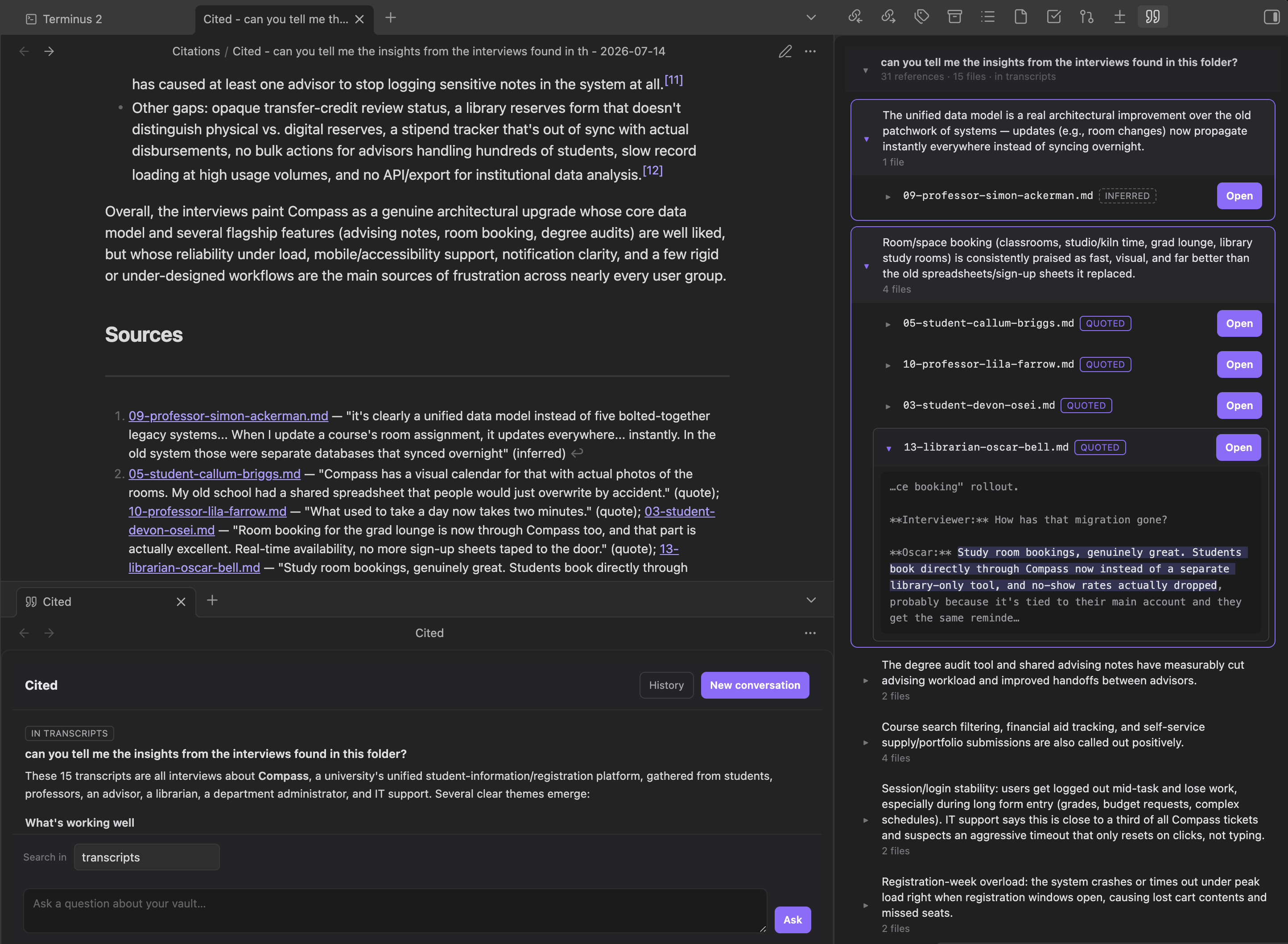
| Exported note (footnoted, with Sources) alongside the claim-grouped citations panel |
|---|
 |
Features
- Two panels, one workflow — a chat panel (ask questions, see answers) and a sources panel (browse citations), stacked together in the right sidebar. Ask a question in one, see it broken down in the other.
- Claim-grouped citations, not a flat file list — the sources panel is organized by claim (a specific assertion in the answer), since one claim can be backed by several files at once; a flat per-file list would hide that. Each claim expands to its contributing files, each file expands to the exact highlighted excerpt.
- Quote vs. inferred, labeled separately — a citation is either an exact substring pulled from the file (
quoted) or a paraphrase Claude is inferring from what it read (inferred); the panel badges each one so you know which kind of trust to place in it. - Per-question folder scoping — a "Search in" field above the chat input (with Obsidian's own folder autocomplete) narrows a single question to one folder and its subfolders instead of the whole vault; leave it blank to search everywhere. This is an execution-level restriction, not just a prompt request:
claudeis spawned with its working directory set to that folder, so Glob/Grep's own default search root is already confined to it — no tokens spent reading files outside scope just to discard their citations afterward. It isn't a hard filesystem sandbox (an explicit absolute path could still escape it), so any citation from outside the folder is also dropped as a backstop, the same way an unverified citation is. Each turn remembers its own scope (shown as a badge in both panels), so you can widen or narrow between questions in the same conversation. - Inline citation markers — click a highlighted claim in the chat answer to jump to and expand the same claim in the sources panel.
- Staleness detection — if you edit a file after Cited cited it, every citation pointing at that file gets flagged
⚠ source changed(no attempt to re-locate the text — just an honest "this may be out of date" flag). - Export to note — turn any answer into a real Obsidian note: the answer body with each claim followed by a proper
[^1]-style footnote and a trailing "Sources" section with[[wikilinks]]to the cited files. - Conversation history — start a new conversation any time; past ones are archived (up to 50, oldest dropped first past that) and reopenable from a history picker, resuming with the same underlying Claude session so follow-ups still have context. Individual conversations can be deleted one at a time from that picker, or all at once from Settings — both require confirmation, since neither has an undo path.
- Configurable search depth — a settings slider bounds how many agentic search/read round trips (
claude's own--max-turns) one question is allowed, trading thoroughness on a large vault against latency/cost. - Live search progress — while a question is running, a progress bar and status line ("Turn 3 of 8 — Reading note.md") update in real time as the
stream-jsontranscript streams in, instead of a static "searching…" message with no sense of how long it'll take or whether it's stuck.
Commands
| Command | Default hotkey |
|---|---|
| Ask about your vault | — |
The ribbon icon ("Open Cited") does the same thing. Both panels can also be configured to auto-open on launch (Settings → Open on launch), independently of each other.
How it works
Asking a question spawns claude -p <question> --allowedTools "Read,Grep,Glob" --disallowedTools "Bash" --output-format stream-json, with its working directory set to the vault root (or the requested scope folder — see "Per-question folder scoping" above). Claude searches the vault itself (agentic, not a fixed retrieval step) and the plugin captures the full stream-json event log, not just the final answer. Each line is also inspected as it streams in (not just once the process exits) to drive the live progress bar — one assistant event per turn, with a short label describing whatever tool call is in it.
That transcript is parsed into a list of exactly which files were opened via Read/Grep and what text came back (src/claude/queryVault.ts). Claude's structured answer (question → claims → per-claim citations) is then cross-validated against that transcript (src/claude/parseAnswer.ts), one citation at a time:
- File never actually opened → the citation is dropped entirely. Claiming a source that was never
ReadorGrep-matched is structurally impossible to get past this check, since the check has nothing to do with what Claude says it looked at. - File was opened, but the claimed excerpt isn't a verbatim substring of what came back → the citation is kept but demoted to
inferredwith no highlight location, rather than shown as a trustworthyquotedmatch.
This guards citations, not the answer's prose as a whole — a sentence with no claim/citation attached at all can still appear in the answer text; it just won't be backed by anything in the sources panel, which is itself the signal that it's ungrounded.
Follow-up questions pass --resume <session_id> (captured from the first turn's system init event) so the conversation carries real context across turns, not just repeated one-shot queries.
Read-only by design: --allowedTools is scoped to Read,Grep,Glob and Bash is explicitly denied on top of that (belt-and-suspenders — an allowlist alone was observed letting a Bash call through in one edge case during manual testing). Cited never writes to your vault except when you explicitly click "Export to note".
Requirements
- Desktop only (needs direct filesystem access via Obsidian's
FileSystemAdapter). - The
claudeCLI installed and logged in. Auto-detected via a login-shellPATHlookup (same approach as Terminus), since Obsidian launched from Finder/Dock often inherits a minimalPATH. - v1 scope is text/markdown files only — no PDFs, images, or canvases.
Development
npm install
npm run dev    # unminified build with inline sourcemaps
npm run build  # typecheck + minified production build
The build bundles src/main.ts into main.js with esbuild; styles.css is a plain hand-written stylesheet (not generated). Copy (or symlink) the plugin folder into <vault>/.obsidian/plugins/cited/ and enable it in Settings → Community plugins.
Layout
| Path | Role |
|---|---|
src/main.ts |
Plugin entry: lifecycle, commands, panel layout, settings persistence |
src/settings.ts |
Settings tab (max search turns, export folder, open-on-launch, clear history) + settings type/defaults |
src/views/ChatView.ts |
Chat panel: ask questions, render answers, inline citation markers |
src/views/CitedView.ts |
Sources panel: claim-grouped, expandable citation list |
src/state/ConversationStore.ts |
Live/archived conversation state, persistence, staleness flagging |
src/claude/claudeBin.ts |
Resolves the claude binary (login-shell PATH lookup + fallbacks) |
src/claude/queryVault.ts |
Spawns claude -p, parses the stream-json tool-call transcript |
src/claude/parseAnswer.ts |
Parses Claude's structured answer, cross-validates citations against the transcript |
src/citations/markers.ts |
Locates claim spans in answer text; builds inline DOM markers and footnoted-markdown export |
src/ui/FolderSuggest.ts |
Folder autocomplete for the chat panel's per-question scope field |
src/export/exportToNote.ts |
Turns one turn into a new note with footnotes + a Sources section |
src/modals/ConversationHistoryModal.ts |
Archived-conversation picker, with per-row delete |
src/modals/ConfirmModal.ts |
Generic yes/no confirmation, used ahead of history deletion |
src/util/stripMarkdown.ts |
Plain-text rendering of claim text in the sources panel |
src/model.ts |
Core types: Citation, Claim, CitedAnswer, Conversation |
License
MIT — see LICENSE.