Blackboard
 James Wolensky2k downloads
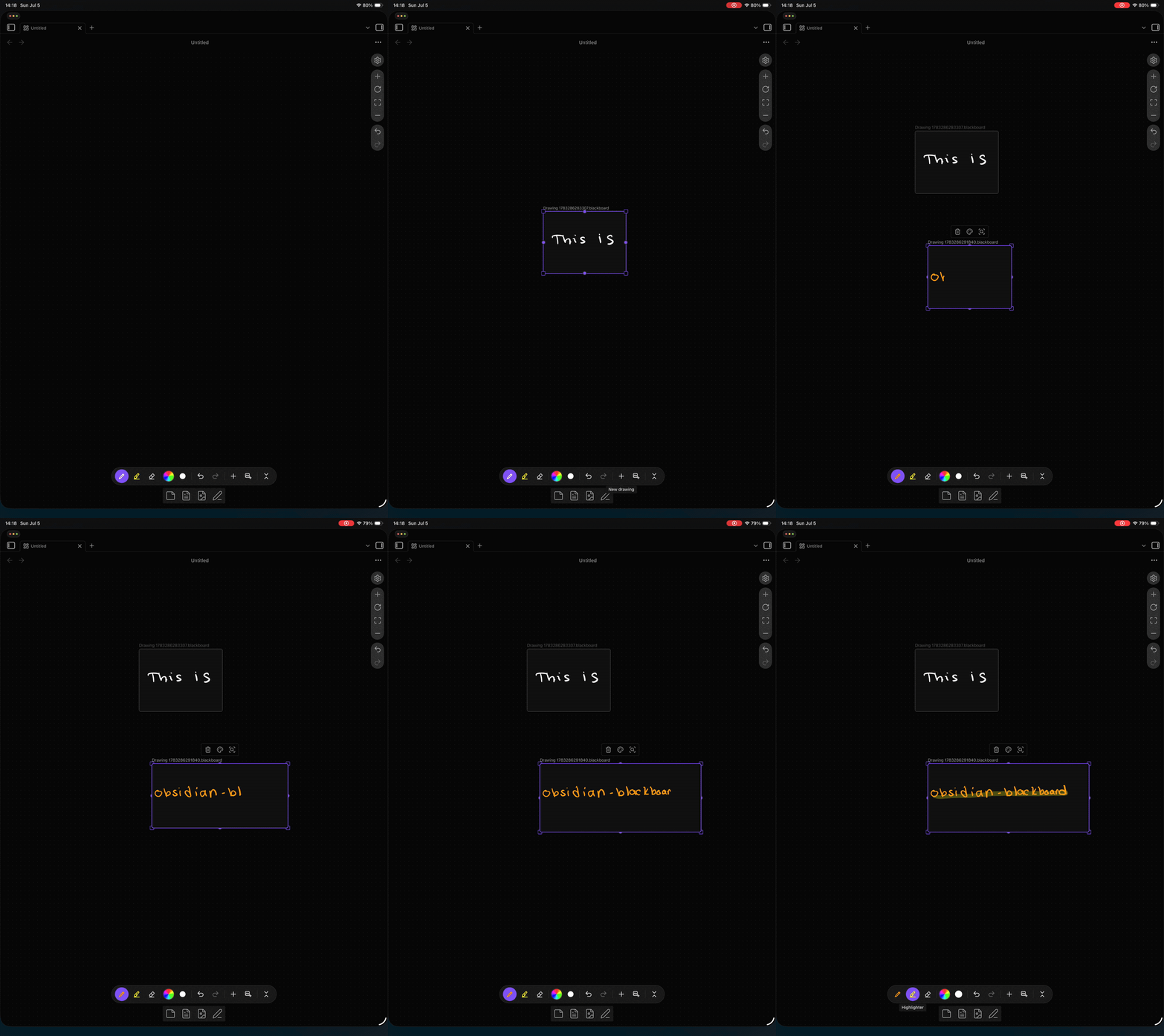
Draw with native stylus and Apple Pencil directly in Canvas nodes and Markdown embeds.
- Overview
- Scorecard
- Updates24
Native stylus and Apple Pencil drawing for Obsidian.
Blackboard adds a .blackboard file type with pressure-sensitive freehand drawing and palm rejection, and lets you draw directly inside Obsidian Canvas nodes and Markdown embeds — no separate editor to open first. It is built for iPad with Apple Pencil, and works on desktop with a mouse.
Features
- Pressure-sensitive drawing — Apple Pencil and stylus support with variable-width strokes via perfect-freehand.
- Draw in place — Pen-down draws immediately on a Canvas node or a Markdown embed; there is no click-to-open step.
- Palm rejection — A stylus always draws; a resting palm or finger never does. Touch is reserved for navigation (see below), so your hand can rest on the screen while you write.
- Touch navigation — In a standalone
.blackboardview, one finger pans and two fingers pinch-zoom the infinite canvas; on desktop, hold Space and drag to pan. The stylus keeps drawing throughout. - Pen, highlighter, eraser — Solid pen strokes, semi-transparent highlighter, and a stroke eraser.
- Blackboard or whiteboard — The board background is a single setting; keep it black or set it white (or any color) for a whiteboard.
- Shared floating toolbar — One toolbar follows the active drawing. Tool, color, and brush size are global across every drawing on the page; it collapses to a corner pill.
- Per-embed sizing — Each embed's display size is controlled by its host (the Canvas node's geometry, or the
|WxHsize on a Markdown embed), never baked into the file. Resizing scales the drawing without distortion; strokes are clipped to the node and never resize it. - Automatic SVG export (optional) — Export a vector
.svgalongside each drawing on save. - Plain-JSON files —
.blackboardfiles are human-readable JSON that diffs cleanly in Git.
How it compares
Blackboard focuses on fast, native pen drawing that lives inside your notes and canvases. Excalidraw is a full diagramming tool; Ink is another handwriting plugin. They're built for different things.
| Blackboard | Excalidraw | Ink | |
|---|---|---|---|
| Draw directly on a Canvas node (no open-to-edit step) | ✓ | ✗ | ✗¹ |
| Live drawing in a Markdown embed | ✓ | ✗ | ✓² |
| Strokes reliably persist on reload | ✓ | ✓ | ⚠️³ |
| Plain-text, git-diffable files | ✓ | ✗⁴ | ✗⁴ |
| Diagramming: shapes, arrows, text | ✗⁵ | ✓ | ✗ |
| Primary focus | pen drawing | diagramming | handwriting |
² Ink renders editable drawings in Markdown embeds today.
³ Ink drawings can disappear on reload — obsidian_ink#125 (open as of 0.3.4).
⁴ Excalidraw stores drawing data compressed by default; Ink stores the tldraw document model; Blackboard files are plain, human-readable JSON.
⁵ Blackboard has no diagramming tools. When a drawing is placed in an Obsidian Canvas, the Canvas itself provides cards, arrows, and text alongside it.
Need rich diagramming? Use Excalidraw — it's excellent at it.
Installation
Manual
- Download
main.js,manifest.json, andstyles.cssfrom the latest release. - Create the folder
<vault>/.obsidian/plugins/blackboard/. - Copy the three files into it.
- Enable Blackboard in Settings → Community plugins.
BRAT
- Install BRAT.
- Add Beta Plugin →
jameswolensky/obsidian-blackboard. - Enable Blackboard in Settings → Community plugins.
Usage
Create a drawing
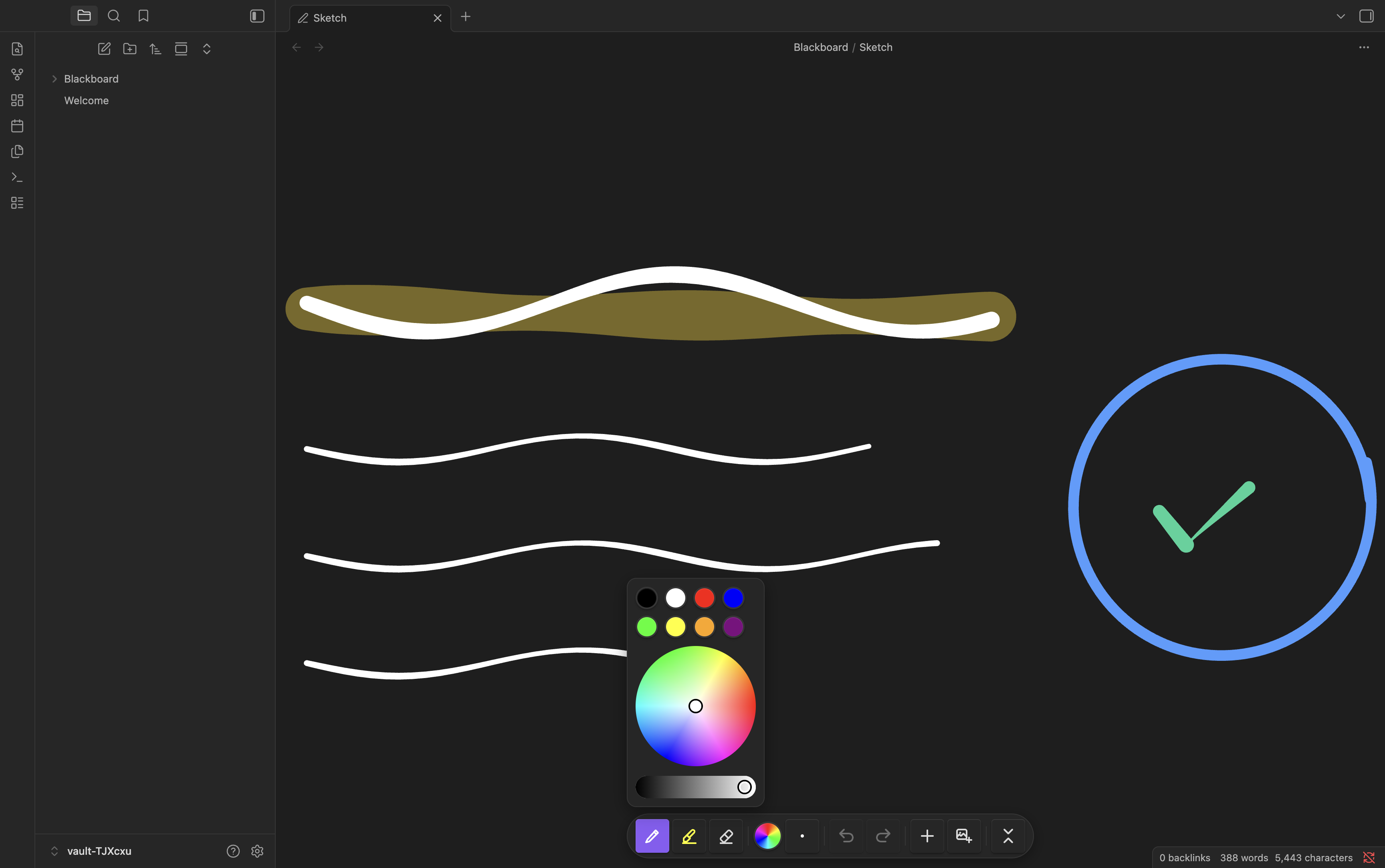
Run Blackboard: New drawing from the command palette. This creates a .blackboard file and opens it.
The toolbar
A single floating toolbar follows whichever drawing is active. It holds the pen, highlighter, and eraser; a color control (preset swatches plus a color wheel); a brush-size control; undo/redo; and a button to collapse it to a small pill. Tool, color, and size apply to every drawing on the page — pick a color once and it stays as you move between drawings and switch tools.
Embed in a Canvas
- Open an Obsidian Canvas.
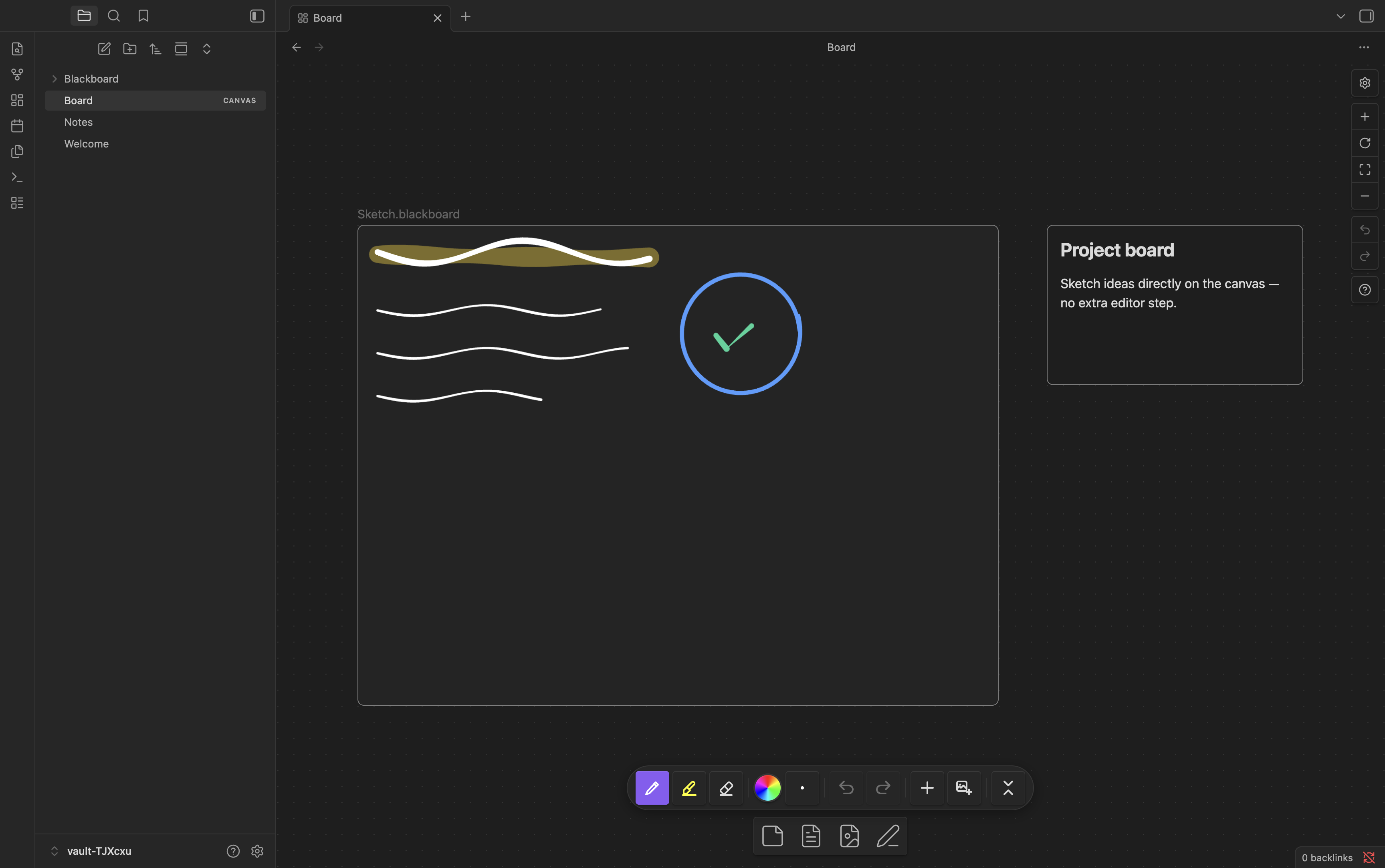
- Use the Canvas card menu's drawing button, or Blackboard: Insert drawing, to add a drawing node.
- Draw on it directly with a stylus. Resize the Canvas node to scale the drawing.
Embed in a Markdown note
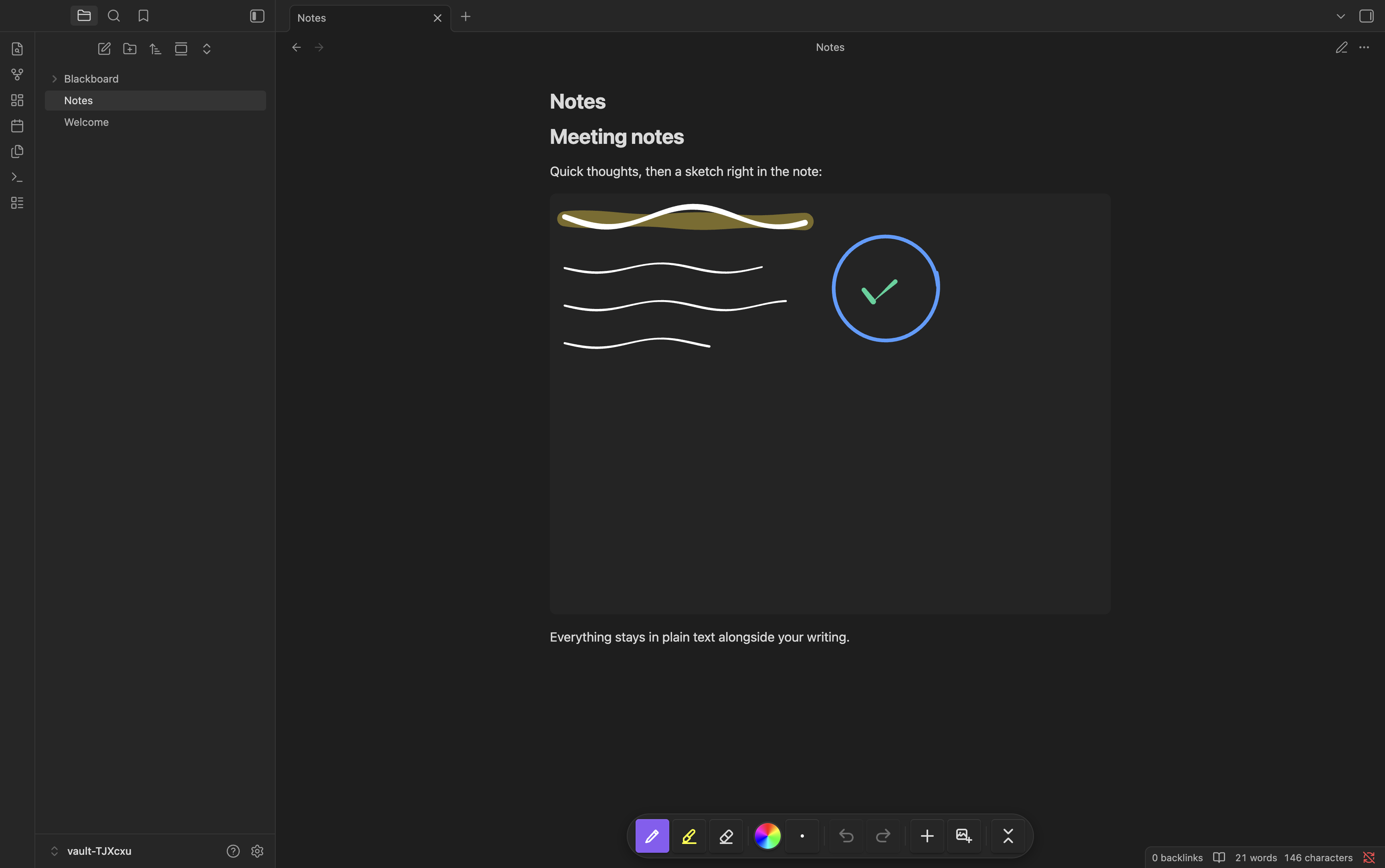
Embed a drawing like any file: ![[My Drawing.blackboard]]. Set a size with the standard Obsidian syntax, e.g. ![[My Drawing.blackboard|640x480]] or ![[My Drawing.blackboard|100%]]. You can draw on the embed directly.
Export
Enable Auto-export SVG in settings to write a .svg next to each drawing whenever it is saved (renames and deletes are kept in sync). Set SVG export path to collect exports in one folder.
Commands
| Command | Description |
|---|---|
| New drawing | Create a new .blackboard file and open it |
| Insert drawing | Create a drawing and embed it at the cursor in a note, or as a node in the active Canvas |
| Insert existing drawing | Pick an existing .blackboard file and embed it at the cursor / in the active Canvas |
Settings
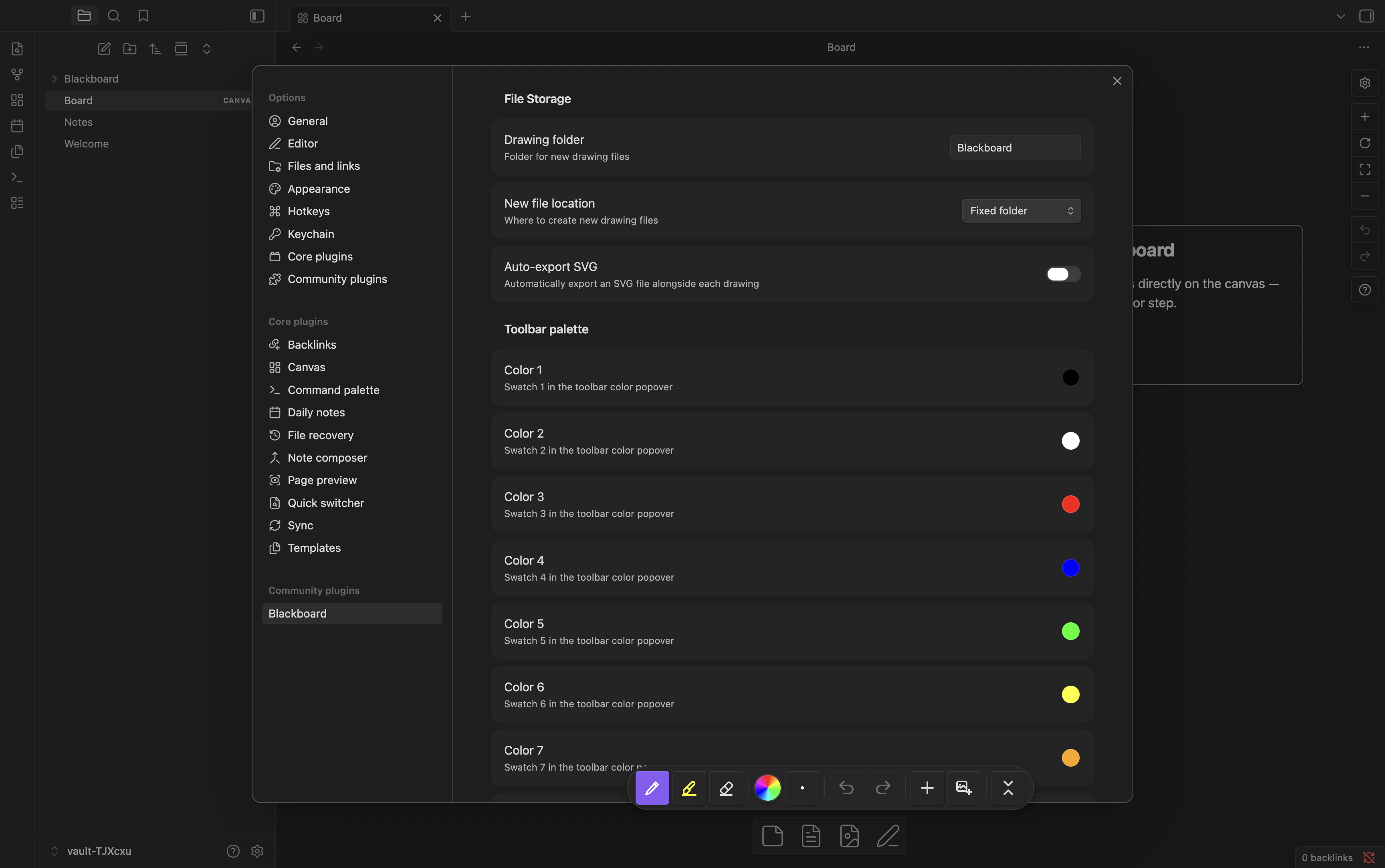
| Setting | Default | Description |
|---|---|---|
| Drawing folder | Blackboard |
Folder for new drawing files |
| New file location | Fixed folder | Create new drawings in the fixed folder, or alongside the active file |
| Auto-export SVG | Off | Write an .svg alongside each drawing on save |
| SVG export path | (same folder) | Folder for exported SVGs (shown when Auto-export SVG is on) |
| Board background | #000000 |
Color painted behind every drawing — set white for a whiteboard |
| Toolbar palette (Color 1–8) | see below | The eight swatches in the toolbar color popover |
| Show toolbar pill | On | Show the collapsed pen-icon pill on Canvas with no active drawing |
The default toolbar palette is #000000, #ffffff, #ff0000, #0000ff, #00ff00, #ffff00, #ffa500, #800080. Pen, highlighter, and eraser sizes and colors are chosen live from the floating toolbar; they are not separate settings.
Compatibility
| Platform | Input | Notes |
|---|---|---|
| iPad + Apple Pencil | Full pressure | Primary target |
| iPad (touch) | Navigation only | One finger pans, two-finger pinch zooms; the stylus draws |
| Android tablet + stylus | Pressure varies by device | Supported |
| Desktop (mouse) | Uniform width (no pressure) | Supported |
File format
.blackboard files are JSON:
{
  "version": 3,
  "width": 320,
  "height": 240,
  "strokes": [
    {
      "id": "abc123",
      "tool": "pen",
      "color": "#ffffff",
      "size": 2,
      "opacity": 1,
      "points": [[100, 200, 0.5], [101, 201, 0.6]],
      "hasPressure": true,
      "timestamp": 1711281600000
    }
  ],
  "background": { "color": "transparent" },
  "contentBounds": { "x": 80, "y": 180, "width": 60, "height": 50 }
}
Each stroke is an array of [x, y, pressure] points in drawing-space. width/height and contentBounds cache the strokes' bounding box for previews and are recomputed from the strokes; display size is decided by each embed, not the file. Files from earlier versions are read without loss.
Development
Requires Node.js 24 and npm.
npm install
npm run dev      # watch build
npm run build    # production build
npm test         # unit tests (Vitest)
npm run check    # typecheck + tests + build
iPad-specific rendering (Apple WebKit) can't be reproduced by the desktop/Electron test runner; verify anything iPad-specific manually in the iOS Simulator (requires Xcode). The static harnesses in test/webkit/ render the toolbar and engine in real WebKit for that.
See CONTRIBUTING.md for the contribution workflow and conventions.
Built with
- perfect-freehand (MIT) — pressure-sensitive stroke geometry
- iro.js (MPL-2.0) — the color wheel
License
MIT © James Wolensky